
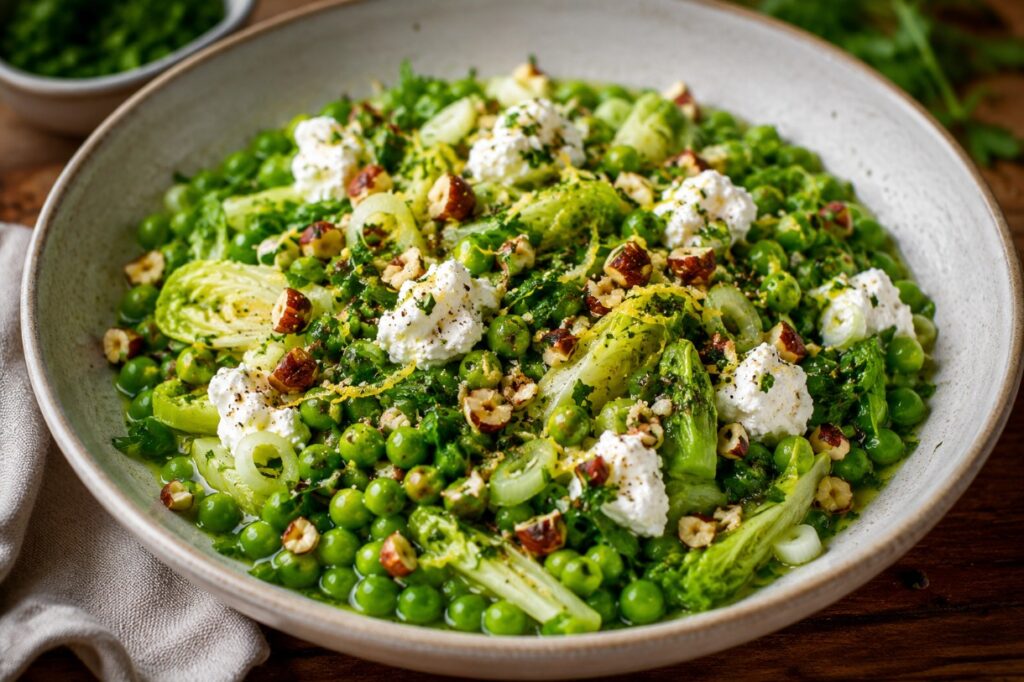
When the first warm days of the year enliven the weekly markets in France, they appear almost at every vegetable stall: fresh and young peas. Few dishes embody the transition from spring to summer in France as well as Petits Pois à la Française. What seems simple at first glance reveals, upon closer examination, the essence of French cuisine: high-quality seasonal ingredients, precise technique, and the ability to create culinary refinement from simplicity.
Traditionally, young peas are gently simmered with hearts of romaine lettuce, spring onions, a bit of bacon, and butter. The result is neither a side dish nor a stew, but a harmonious composition of sweetness, freshness, and savory aromas.
In modern French bistros, this dish is currently experiencing a renaissance. Chefs combine classic techniques with contemporary elements such as herb oil, fermented ingredients, toasted nuts, or fresh goat cheese. The basic idea remains unchanged: the pea is the center of attention.
The story behind the dish
Already in the 17th century, young peas were considered a sought-after delicacy in France. At the court of King Louis XIV, a true passion developed for the first peas of the season. Historical accounts tell of the nobility paying large sums to be able to taste the first harvests.
Over the centuries, the classic Petits Pois à la Française was born. Particularly in the regions around Paris and in the Loire Valley, this dish became a staple of seasonal cuisine. It is still regarded today as a symbol of the beginning of the French summer.
Why the dish is trending again today
Contemporary gastronomy increasingly focuses on vegetables as the stars. Whereas meat used to be often at the center of the plate, now seasonal products and their natural aromas are highlighted.
Petits Pois à la Française perfectly meet these requirements:
- seasonal and local
- light yet flavorful
- adaptable in vegetarian versions
- sustainable
- elegant enough for a menu, yet simple for everyday
The natural sweetness of the peas pairs perfectly with modern ingredients such as lemon zest, fresh mint, or creamy goat cheese.
Modern version with goat cheese, herb oil, and toasted hazelnuts
Ingredients for 4 people
For the peas:
- 600 g of fresh or frozen young peas
- 2 small romaine lettuce hearts
- 3 spring onions
- 30 g of butter
- 100 ml of vegetable broth
- 1 small shallot
- 1 teaspoon of sugar
- salt
- white pepper
For the herb oil:
- 30 g of parsley
- 15 g of mint
- 80 ml of olive oil
- 1 pinch of salt
For the finishing touch:
- 100 g of fresh goat cheese
- 40 g of toasted hazelnuts
- zest of one organic lemon
- some young pea shoots or fresh herbs
Preparation
1. Prepare the herb oil
Briefly blanch the parsley and mint, then immediately plunge them into ice water. Drain thoroughly, then blend finely with the olive oil.
Pass through a fine sieve and keep cool.
This way the oil takes on an intense green color and a fresh flavor.
2. Prepare the vegetables
Thinly slice the shallot.
Cut the spring onions into thin rings.
Cut the romaine lettuce hearts lengthwise into quarters.
Coarsely chop the hazelnuts and toast them in a pan without fat.
3. Simmer the peas
Melt the butter in a large saucepan.
Sauté the shallot and spring onions until they become translucent.
Add the peas and sauté briefly.
Add the sugar and let it caramelize slightly.
Deglaze with the vegetable broth.
Place the lettuce hearts on top.
Let simmer gently over medium heat for about 8 to 10 minutes.
The peas should be tender yet still slightly crunchy.
Season with salt and white pepper.
4. Plating
Distribute the simmered peas on shallow plates.
Place small quenelles of fresh goat cheese on top.
Drizzle with herb oil.
Sprinkle with toasted hazelnuts, lemon zest, and fresh herbs.
Serve immediately.
What makes this recipe special?
The charm lies in the play of different textures and temperatures:
- the warm and soft peas
- the creamy and slightly tangy goat cheese
- the crunchy hazelnuts
- the fresh herb oil
- the tender lettuce hearts
The result is a dish that feels distinctly more modern than the classic version, without losing its character.
Wine Pairings
Peas à la Française pair particularly well with fresh white wines with lively acidity:
- Sauvignon Blanc from the Loire Valley
- Muscadet from the Atlantic coast
- Dry Chenin Blanc
- Young Chardonnay without barrel aging
For a non-alcoholic alternative, it is recommended to serve homemade lemon-mint lemonade or a cold herbal infusion.
Serving Variations
The dish can be developed in various ways:
With Fish
Panfried pike-perch or cod perfectly complement the sweetness of the peas.
With an Egg
A soft-boiled egg turns this dish into a light main course.
Vegan
Replace the butter with a quality olive oil and the goat cheese with a fermented cashew cream.
Fine dining version
Blend a portion of the peas to obtain a velvety cream and incorporate it with the whole peas. This adds additional depth and elegance to the dish.
Conclusion
Les Petits Pois à la Française perfectly illustrate why French cuisine is appreciated worldwide. With just a few ingredients, you get a dish full of finesse, balance, and seasonal freshness. The modern interpretation with herb oil, goat cheese, and hazelnuts adds an extra dimension to the classic and makes it a perfect dish for the first warm weeks of the year. Light enough for a summer evening, elegant enough for entertaining, it is also a beautiful example of how contemporary cuisine can respect its traditional roots without denying creativity.