
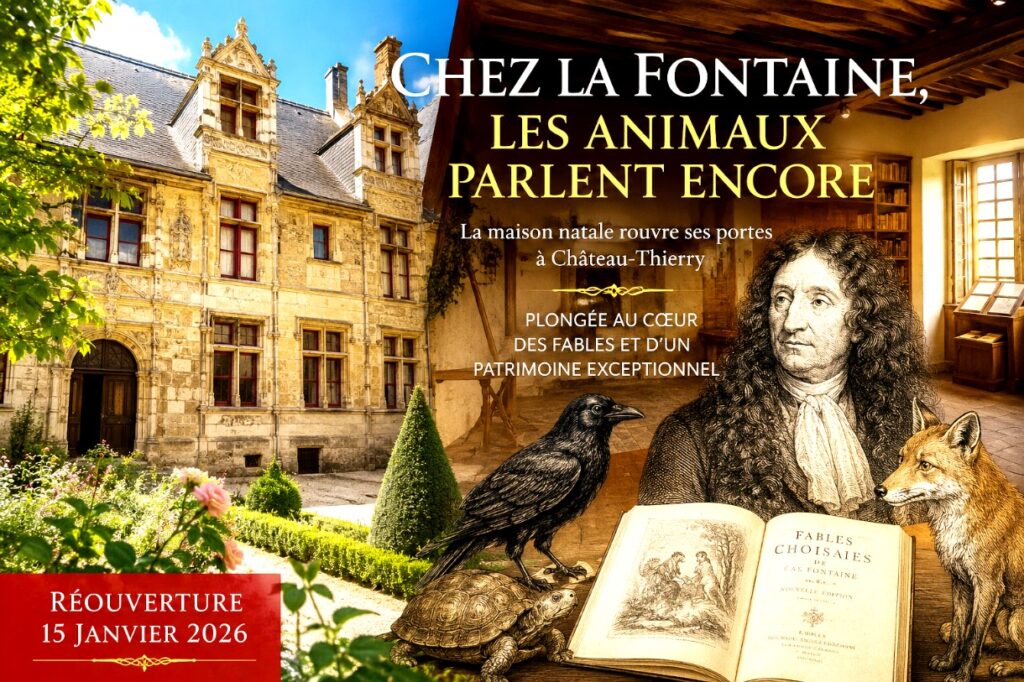
A fox, a raven, a tortoise and, somewhere, presumably a rather self-assured hare: anyone entering the Maison de Jean de La Fontaine in Chateau-Thierry encounters old acquaintances. Since January 15, 2026, the birthplace of the famous French writer of fables has once again been open to visitors after several years of restoration. And a classic literary museum has become a place that tells its story with surprising vitality.
Jean de La Fontaine was born here in 1621. With its richly decorated facade, stone staircase, exposed timber beams and quiet garden, the Renaissance house therefore tells more than just literary history. It also tells the story of a boy from Chateau-Thierry who would later become one of France’s best-known writers.
You notice it as soon as you step inside: no one is expected to move reverently from display case to display case here.
The new exhibition relies on atmosphere, stories and encounters. Animals from the famous Fables accompany visitors through the museum, multimedia elements explain the world of the 17th century, and historical exhibits bring them closer to the man behind the verses. La Fontaine is not presented merely as the author whose fables generations of French schoolchildren learned by heart. Visitors encounter a poet, storyteller, philosopher and remarkably keen observer of his fellow human beings.
And honestly: what could be more interesting to a writer than the small weaknesses of his contemporaries?
That is precisely where the appeal of his stories still lies today.
In his fables, animals quarrel, flatter one another, deceive, rule, lose and triumph. Yet people are hidden behind fur, feathers and paws. Power and vanity, greed and cleverness, injustice and opportunism shape these small literary stage plays. Anyone who has filed them away as harmless animal stories from childhood may encounter more than one surprise during the tour.
The restored Maison de Jean de La Fontaine deliberately places this remarkable relevance at its center. Why do stories from the 17th century sometimes seem as though someone had made a few notes yesterday while looking at our society?
The exhibition does not offer an answer with a wagging finger. It lets La Fontaine speak for himself.
The historical collections are particularly appealing. Old editions of the Fables, handwritten manuscripts, letters and his baptismal record paint a more personal picture of the writer. Documents also recall a less familiar side of his life: for a time, La Fontaine held the office of Maitre des Eaux et Forets and was thus involved in the practical management of forests, waterways and their administration.
Art also occupies considerable space. For centuries, the fables have inspired illustrators and artists. Works and editions show how differently each era has viewed La Fontaine’s animals. The journey extends from Francois Chauveau, who illustrated the poet’s works during his lifetime, to Salvador Dali.
The house itself may remain the most beautiful exhibit of all.
La Fontaine spent his childhood here. The property remained in his family’s possession until 1676, when financial difficulties forced the writer to sell it. Today, the historic rooms create a sense of closeness that no textbook could convey. You are not standing somewhere in front of a biography. You are standing where that biography began.
Following its extensive renovation, the museum is also aimed more strongly at families, the curious and visitors with no prior literary knowledge. Clear interpretation and an accessible tour remove any possible sense of intimidation from French literary history. No one needs to know all the fables beforehand.
That makes the whole experience pleasantly relaxed.
Outside, Chateau-Thierry awaits. The town wears its connection to La Fontaine with visible pride and regards the restored birthplace as an important part of its cultural heritage. From Paris, a visit makes an excellent day trip, offering literature, history and the particular calm that historic houses sometimes radiate.
Perhaps that is the strength of this newly reopened museum. It does not try to make a writer born in 1621 seem artificially modern. Instead, it shows why he has never really grown old.
After all, people change their clothes, their technology and their habits. Their vanities, longings and small tricks, however, apparently have a remarkably long shelf life.
La Fontaine would probably have written a fable about that.
And somewhere in it, an animal would most certainly have had the last word.
M. Legrand