
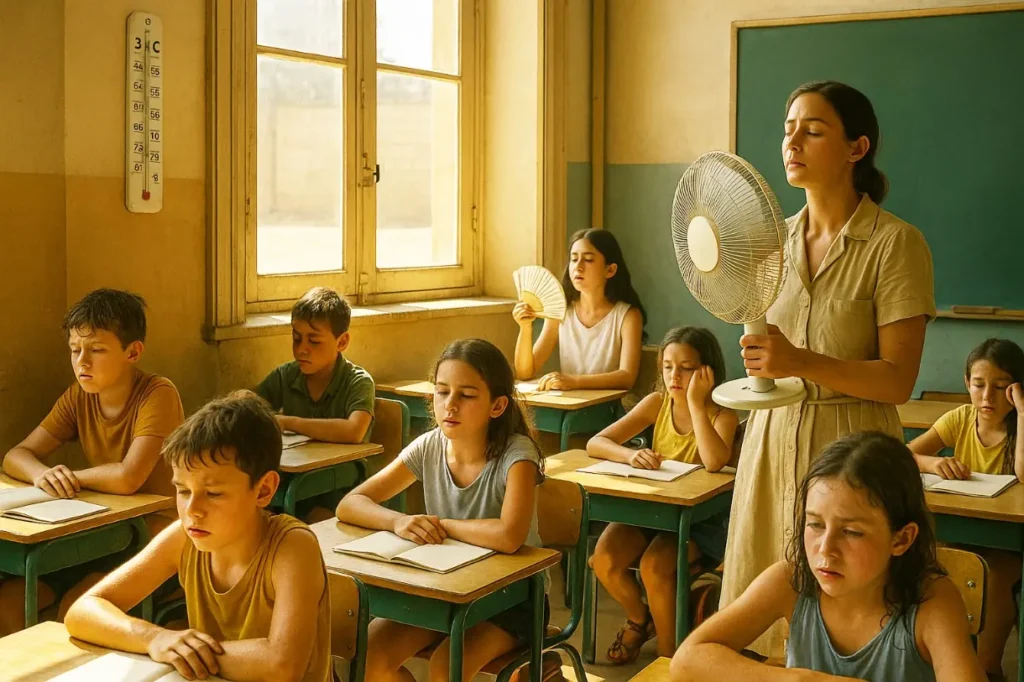
An extremely early heatwave in France is not only creating difficulties in the daily lives of millions of people but is increasingly becoming a political conflict issue. While large areas of the country suffer from temperatures up to 39 degrees Celsius and numerous departments are under strict heat warnings, the government of Prime Minister Sébastien Lecornu is coming under pressure for its crisis management.
The leader of the Greens Les Écologistes, Marine Tondelier, expressed herself particularly categorically. According to her, she was “shocked” by the government’s insufficient level of preparedness for the current weather situation. In her opinion, the state is reacting too late to developments that meteorologists had predicted for several days. The government is now dealing with future heatwaves, while the population is already facing the consequences of the current extreme temperatures.
Dispute over the government’s response time
At the center of the criticism is an interdepartmental crisis meeting, where the government plans to prepare a comprehensive action plan by the end of summer. The plan includes topics such as water supply, healthcare, wildfire prevention, and the resilience of public infrastructure.
However, from the opposition’s point of view, this approach is insufficient. Critics note that although long-term planning is necessary, the emphasis on immediate protective measures remains inadequate. Schools, outdoor workers, the elderly, and people with health problems are already exposed to increased risks.
The political debate illustrates a fundamental tension: while governments need to develop long-term adaptation strategies, citizens in crisis situations expect specific and immediately effective measures.
Demand for introducing “climate holidays”
Marin Tondelié also uses the current heatwave to bring back to the political agenda an idea that has been discussed for a long time. She proposes the introduction of so-called “climate holidays.” Following the example of similar rules in other European countries, workers could receive up to five additional days off per year without financial loss during extreme weather events.
The Greens argue that classic work models are increasingly becoming exhausted as extreme weather situations occur more frequently. The effects of heat have particularly strong impacts on workers in physically demanding jobs or in buildings without proper cooling.
Supporters see this as a necessary step to adapt to the consequences of climate change. Critics, however, warn of additional burdens for businesses and the labor market. Therefore, the discussion will likely extend far beyond the current heat wave.
Growing doubts about climate adaptation
Political accusations are accompanied by a broader discussion about France’s ability to adapt to climate change. Scientists and environmental organizations have been pointing out for years that many public institutions are still insufficiently prepared for extreme temperatures.
Schools are mentioned particularly often, as their buildings often lack sufficient thermal insulation or cooling. Also, numerous apartments in densely built urban areas turn into real heat traps during heat periods. Furthermore, there are deficits in green spaces in cities and a lack of shade in public areas.
Experts emphasize that climate adaptation is no longer only an environmental issue. It increasingly concerns public health, social justice, and the country’s economic capacity. The costs of insufficient preparation in the long term can be significantly higher than investments in preventive measures.
Government refers to existing emergency mechanisms
The government categorically rejects the accusations. Representatives of the Ministry of Health emphasize that France currently has extensive experience in dealing with heat waves. Emergency plans have been activated, hospitals and care facilities are under special supervision, and the population is regularly informed about protective measures.
According to the government, existing structures demonstrate that lessons have been learned from previous crises. However, government representatives also acknowledge that the increasing frequency of extreme weather events presents new challenges.
The current heatwave is considered an additional sign that extremely high temperatures in Europe are becoming increasingly common. This also intensifies political pressure not only to respond to immediate crises but also to continuously adapt cities, infrastructure, and the labor sector to changed climatic conditions.
More than two decades after the devastating heatwave of 2003, which took thousands of lives in France and other European countries, the question of the resilience of state structures arises again. The confrontation between the government and the opposition shows that climate adaptation has long ceased to be just an environmental issue. It is increasingly becoming a central measure of the state’s ability to act and of political trust.
Author: P. Tiko