
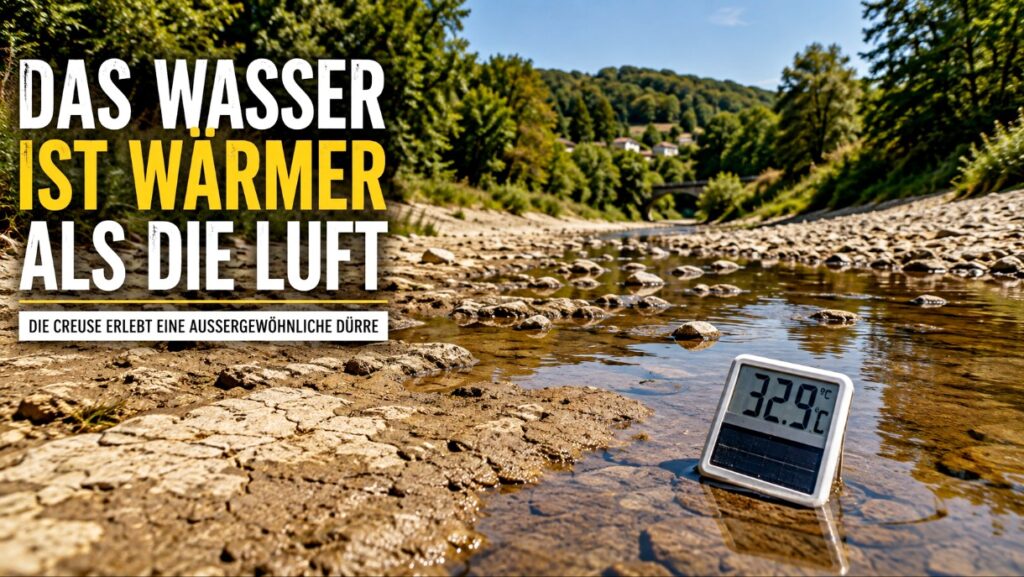
Creuse is one of the greenest and most water-rich departments in central France. This makes what is happening there this summer all the more alarming: water temperatures of up to 32.9 degrees have been recorded in some rivers and streams – values that at times even exceed air temperatures. What initially sounds like an extraordinary weather phenomenon actually illustrates the scale of an ecological crisis.
The urgently needed rain has failed to arrive for months. Numerous smaller waterways are carrying only a fraction of their usual volume of water, and some sections of streams have already dried up completely. Where water barely flows, it warms particularly quickly under intense sunlight. Living rivers are in places turning into little more than narrow trickles or isolated pools of water.
The consequences for nature are severe. Warm water can store significantly less oxygen than cool water. At the same time, high temperatures increase the metabolism of fish and other aquatic organisms, raising their oxygen demand. Low water levels, high temperatures and oxygen shortages reinforce one another – a dangerous combination that pushes sensitive species such as trout to their limits. In isolated pools, many animals ultimately have no way of moving to cooler areas.
In response to these developments, the authorities have acted and temporarily banned freshwater fishing entirely. The ban applies to all fish species and fishing methods. The aim is not merely to protect stocks from further harvesting. Catching and then releasing fish alone causes considerable stress for weakened animals, and under current conditions this often determines life or death. At the same time, those responsible are appealing to the public not to place any additional strain on the remaining water bodies wherever possible.
Creuse thus stands as an example of a development that no longer affects only the dry south of France. Summer 2026 is bringing exceptionally low water levels, parched soils and recurring heatwaves to large parts of the country. Water-use restrictions are in force in numerous departments, while rivers and lakes are reaching unusually high temperatures.
This development appears particularly contradictory in Creuse. The region is known for its forests, pastures and numerous streams, which have shaped agriculture and livestock farming for generations. Water has always been regarded here as a natural part of the landscape. Now it is becoming clear how quickly this image can begin to falter.
The current situation makes clear that drought means far more than the question of whether water still comes out of the tap. Long before drinking water supplies are endangered, sensitive ecosystems come under pressure. Wetlands dry out, habitats become separated from one another, and entire stretches of river lose their ecological function.
France responds to such developments with a graduated drought-management system. Depending on the severity of water scarcity, different measures come into effect – from initial warning stages to far-reaching restrictions on water use. Ensuring drinking water supplies and protecting water bodies are the priorities.
The measurement of 32.9 degrees therefore symbolizes a change that is becoming increasingly apparent. When river water in a department traditionally rich in water is warmer than the surrounding air, the change is no longer visible only in statistics or climate models. It is literally right before our eyes – in the riverbed itself.