
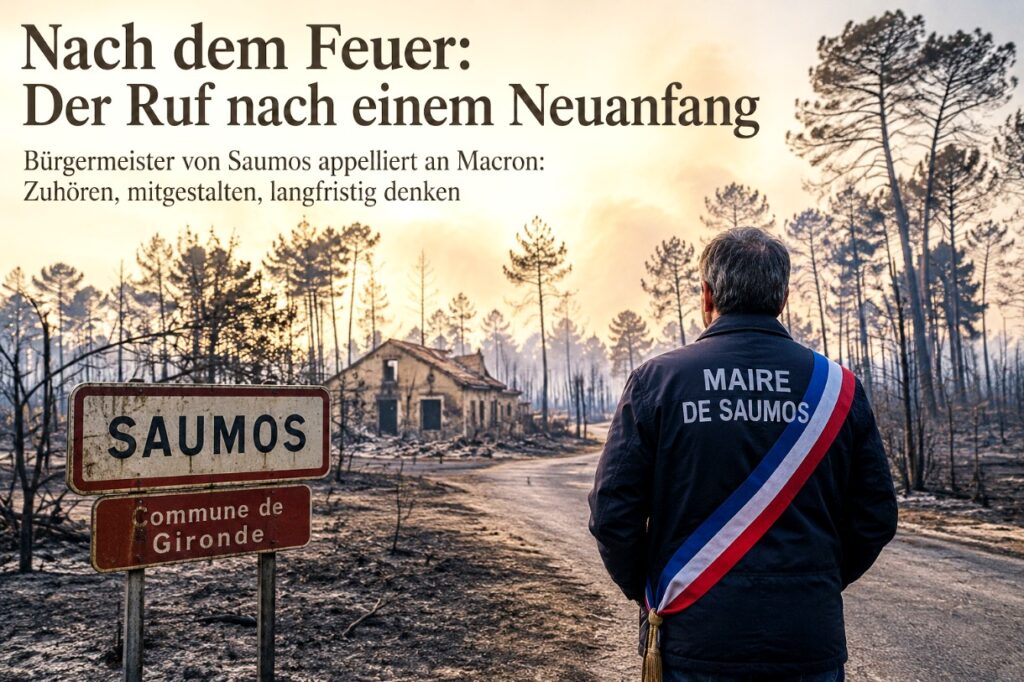
Disasters create political pressure to act. Hardly have the flames been extinguished before debates begin about reconstruction programs, new regulations and state aid. This mechanism is understandable, but it carries the risk that decisions will be made under the immediate impact of the moment. This is precisely what Didier Chautard, mayor of the small municipality of Saumos in the Gironde department, warns against. At the end of July, one of the most devastating forest fires in French history broke out there. In an open letter to President Emmanuel Macron, members of parliament and state representatives, he argues that the disaster should not be understood solely as a crisis to be overcome as quickly as possible, but as a turning point that requires a fundamental reassessment of how landscapes, climate and territorial development are approached.
The mayor’s words are deliberately simple, and it is precisely through this that they have an impact. “Nature is calling us to order,” Chautard writes. The sentence avoids any dramatic exaggeration while nevertheless describing the core of the problem. The forest fires do not appear as an isolated tragedy, but as the expression of a development that has occupied France for years. Longer periods of drought, rising temperatures and increasingly parched vegetation are changing the conditions under which forests, agriculture and rural areas will have to exist in the future.
Criticism of Political Automatism
What is noteworthy is less the reference to climate change than the political conclusion Chautard draws from it. His criticism is not directed against the state, nor against the announced aid programs. Rather, he questions the political automatism with which exceptional events are regularly answered: Paris decides, the regions implement.
This logic may promise efficiency in centrally organized states. However, it reaches its limits where solutions depend on the particularities of a specific area. Forests differ, as do soils, water systems and agricultural structures. What appears sensible for one region may be unsuitable elsewhere.
That is why Chautard formulates a sentence that points far beyond the immediate occasion: “We do not ask you to decide in our place. We ask you to listen to us before you decide.”
It is an appeal against French centralism without explicitly naming it. The demand calls for a different relationship between the state and municipalities – not as competitors, but as partners sharing the work.
Local Knowledge as a Political Prerequisite
France has a long tradition of centralized state planning. It is one of the defining elements of the Fifth Republic and has given the country stability in many areas. At the same time, awareness has been growing for years that complex challenges cannot be solved solely from the ministries of the capital.
Especially after natural disasters, mayors, foresters, farmers and residents often possess the practical knowledge that is difficult to reflect in administrative procedures. They know the waterways, wind conditions, vegetation patterns and the weak points of their landscapes. This knowledge does not replace scientific expertise, but it complements it in a decisive way.
When Chautard rejects additional regulations developed “far from the reality on the ground,” his criticism is therefore directed less against regulation itself than against a policy that neglects local experience in favor of abstract models.
Reconstruction as a Political Turning Point
The real value of the open letter lies in its long-term ambition. Chautard is not merely calling for the reconstruction of destroyed infrastructure or financial support for the affected municipalities. He sees the fires as an opportunity to reflect on the development model of entire regions.
This involves questions that extend far beyond the Gironde. How must forests be managed in the future in order to become more resilient to heat and drought? What role does water management play? How can biodiversity, forestry and agriculture be connected? And what consequences does this have for the spatial planning of a region increasingly affected by climate extremes?
These questions cannot be answered within a few weeks. This is precisely why the mayor warns against turning his municipality into a testing ground for short-term decisions. The temptation is great to present quickly visible political results after a disaster. Sustainable solutions, however, rarely emerge under the pressure of public expectations.
A Debate of National Significance
The timing of the open letter is no coincidence. While the government is preparing reconstruction efforts and ministerial visits to the Gironde have been announced, Chautard is seeking to broaden the political horizon. His intervention is aimed less at individual measures than at the way decisions are made.
This is where the real political significance of his letter lies. It connects the immediate experience of a natural disaster with a fundamental question about how state action is organized. France is representative in this respect of many European countries facing similar challenges amid increasingly frequent extreme weather events: climate adaptation requires national strategies, but their implementation can s쳮d only where regional experience and municipal responsibility are taken seriously.
The fires in Saumos did not merely destroy thousands of hectares of forest. They also made visible the limits of an understanding of politics that seeks to manage crises primarily through administration. The open letter from a mayor may do little to change this on its own. Yet it is a reminder that sustainable politics consists not only in the ability to act quickly, but also in listening to those who must permanently bear the consequences of political decisions.
Andreas M. Brucker