
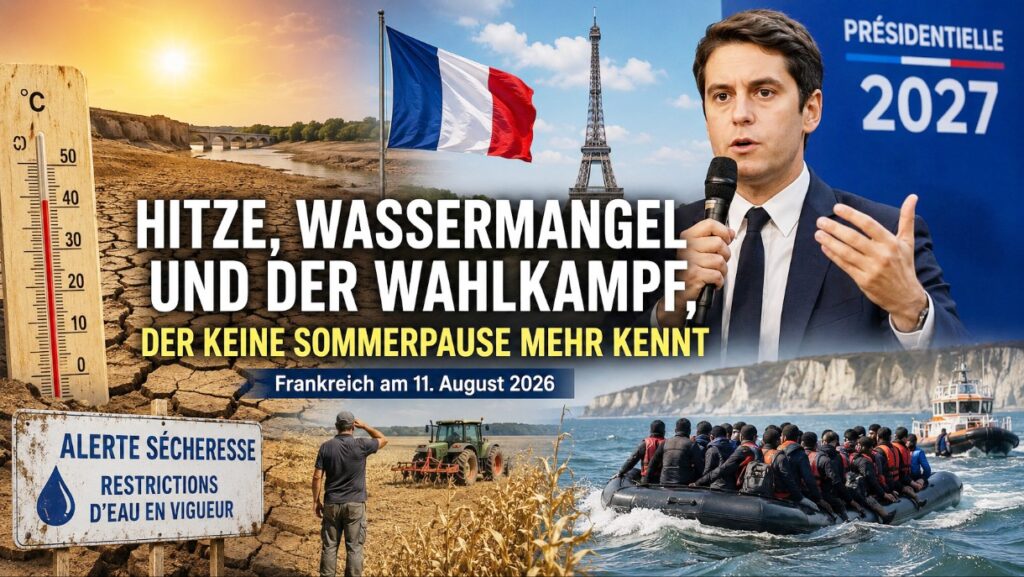
France begins this Tuesday, August 11, 2026, under extraordinary circumstances. While large parts of the country are suffering from a persistent heatwave, the consequences of the drought are worsening by the day. Water shortages, wildfire risk and growing pressures on agriculture are shaping the news agenda. At the same time, the 2027 presidential election is increasingly coming into focus. The political summer break appears to be definitively over – the election campaign is beginning earlier than expected.
A look at the French media reveals five issues that are particularly shaping this Tuesday.
The heatwave is intensifying again
The ongoing Canicule remains the dominant issue of the day. Météo-France has placed 43 departments in western and southeastern France under an orange alert for Tuesday. Meteorologists expect the heatwave to intensify further in the coming days and potentially become one of the longest periods of heat in recent French history.
This is increasingly giving the summer of 2026 a historic character. The focus is not on individual peak temperatures, but on the exceptional duration of the heat. Hot nights prevent adequate cooling, soils continue to dry out and water consumption is steadily rising. At the same time, the risk of wildfires is increasing significantly in numerous regions.
In French reporting, heat, drought and wildfires are now hardly viewed separately. They are increasingly seen as different facets of the same climate crisis.
Nearly 70 percent of France under water restrictions
The water supply situation is particularly tense. Around 70 percent of French territory is now affected by restrictions on water use. All 99 departments of mainland France are at least at the “Vigilance” alert level, while the highest “Crise” alert level is already in force in numerous regions. There, water is generally reserved for essential needs such as drinking-water supply, healthcare and public safety.
The government has announced a crisis meeting for Wednesday to reassess the situation and discuss possible further measures.
The exceptional dryness of the summer is causing additional concern. July 2026 is considered the driest July on record in both France and Switzerland. At the same time, large parts of Europe are now showing clear signs of drought.
This is also changing the political dimension of the issue. Water scarcity is no longer merely a regional challenge, but is increasingly developing into a national question of infrastructure, agricultural and climate policy.
Agriculture raises the alarm
With every additional week without significant rainfall, pressure on agriculture is growing. The farmers’ association FNSEA now speaks of an unprecedented climate disaster and is calling for extensive government support.
The consequences affect virtually all areas of the agricultural economy. Livestock farmers are struggling with parched pastureland and rising feed costs. Fruit, vegetable and arable farms are suffering under irrigation restrictions, while prospects for upcoming harvests are already declining.
The meteorological crisis is thus increasingly threatening to become an economic burden. Declining yields could affect food prices and the economic stability of numerous farms in the medium term, as their financial reserves have already been severely strained in many places after several difficult years.
2027 presidential election: Summer turns political
While many politicians traditionally use August to take time off, former prime minister and Renaissance leader Gabriel Attal is deliberately taking the opposite approach. With an intensive summer tour of France, he is using the comparatively quiet news cycle to position himself early for the 2027 presidential election.
His appearances focus on issues such as education, purchasing power, wages, migration and artificial intelligence. At the same time, Attal is putting forward specific reform proposals, including a significant reduction in public-sector jobs, immigration quotas and the goal of a balanced state budget over the long term.
Observers see this as a remarkable shift in the political landscape. While Emmanuel Macron s쳮ded in 2017 primarily as a political outsider, ten years later government experience once again appears to be regarded as an important qualification. Alongside Attal, Édouard Philippe, Bernard Cazeneuve and Dominique de Villepin, among others, are positioning themselves as possible candidates. François Hollande is also demonstratively keeping his political future open.
The presidential campaign is therefore beginning unusually early and is already marked by considerable diversity in both candidates and policy platforms.
English Channel: Ever-larger migrant boats
Another issue is of particular concern in northern France and in relations between France and the United Kingdom. It concerns migrant crossings of the English Channel.
Over the weekend, reports say that around 230 people were aboard a single inflatable boat – significantly more than on previous crossings. During the journey, numerous people fell into the water, making extensive rescue operations necessary.
The development suggests that smuggling networks are responding to increased checks by using ever-larger boats and carrying more passengers. This significantly increases the risks for migrants.
For French rescue services along the Pas-de-Calais coast, this development represents a new dimension. Individual rescue missions can turn into large-scale emergencies involving several hundred people in a very short time.
France is experiencing several far-reaching developments at once this summer. The consequences of climate change are no longer evident only in temperature statistics, but very concretely in water shortages, crop failures, wildfire risks and sweeping restrictions on daily life. At the same time, political competition over Emmanuel Macron’s succession is gaining considerable momentum.
What is remarkable is less each individual event than their simultaneity. Climate change, agriculture, migration, public finances and the presidential election are increasingly influencing one another and shaping the country’s political agenda.
The traditional French trou d’été, the journalistic summer lull, has practically ceased to exist this year. Instead, August 2026 is becoming a preview of the political, economic and social challenges that will accompany France until the 2027 presidential election.