
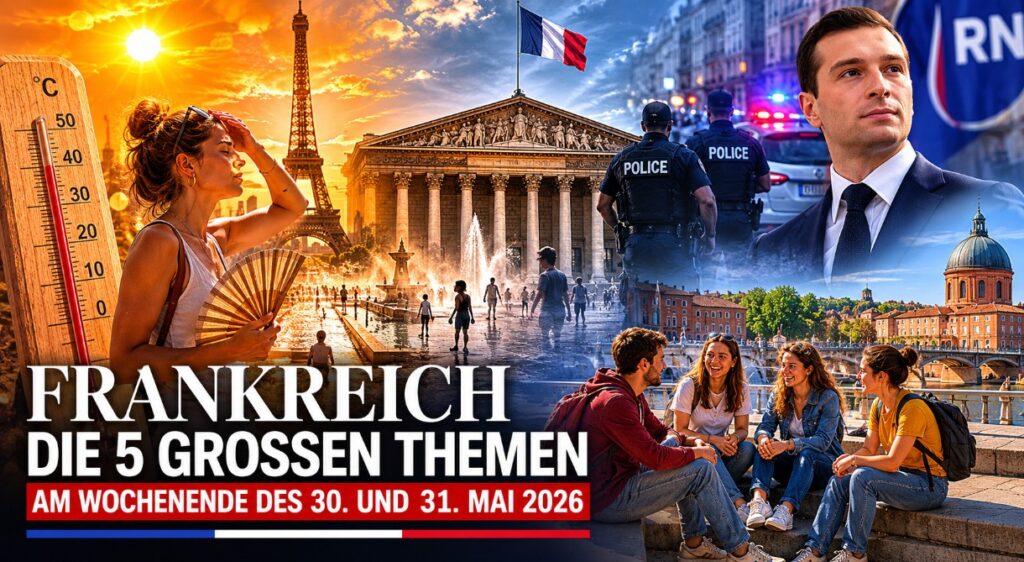
France is approaching a noteworthy weekend towards the end of the month. While an unusually early heatwave is making headlines, domestic security issues, party policy shifts, and social trends are influencing public debate. It is especially clear how closely these themes are intertwined. Discussions about the weather go beyond mere meteorological phenomena to touch on infrastructure, public health, the economy, and the nation’s political responsiveness.
Historic Heatwave at the Center of the News
The theme currently dominating French media is an unusual heatwave covering a wide area of the country. Temperatures recorded at the end of May reached levels typically seen in the summer months of July or August, breaking monthly records in many departments. Particularly, the new nationwide temperature record for May is drawing attention.
The impact is already affecting daily life. Schools are adjusting class hours, municipalities are extending park opening times, and health authorities are warning about heatstroke and the effects of air pollution. Many media outlets perceive this weather situation as a symbol of accelerating climate change, increasingly evident in France.
This discussion is no longer limited to a short-term weather event. Rather, it raises the question of whether France’s cities, public buildings, and transportation infrastructures are adequately prepared for a future in which extreme heatwaves occur more frequently.
Government Faces Pressure over Climate Policy
Political debates are intensifying alongside developments in weather conditions. The opposition accuses the government of underestimating this unprecedented situation and responding too slowly. Representatives of environmental parties in particular strongly criticize the shortcomings in adapting to climate change.
Many commentaries debate whether France has enough climate-resilient schools, hospitals, and public facilities. This heatwave has become a political touchstone for the government.
At the same time, contradictions in basic objectives have come to light. On the one hand, the state must respond promptly to extreme weather conditions, while on the other hand, long-term adaptation requires urban planning, building renovations, and large-scale investments in infrastructure. The current discussions indicate that climate policy is increasingly recognized as a core issue of the state’s capacity for action.
Drug Violence and Safety Issues Draw Attention Again
Separate from weather conditions, domestic security remains one of the dominant themes in French internal affairs. The city of Nantes, in particular, has again become the focus of media coverage. Multiple violent incidents related to drug trafficking have sparked intense debates regarding the effectiveness of previous safety strategies.
The word “Narcotrafic” holds a solid position in political vocabulary. It refers to the organized crime networks that have been strengthening their presence in many large French cities. The government is responding with police reinforcements and additional security measures, but many experts question whether a purely repressive strategy will be sufficient in the long term.
This trend recalls debates that have taken place in the past in Marseille, Lille, and parts of the Paris metropolitan area. Concerns are growing that certain neighborhoods might be permanently under the influence of organized crime, sparking discussions about new approaches in prevention, social policy, and security.
Jordan Bardella works on shaping the profile of the ruling party
At the party level, attention is focused on Jordan Bardella and the strategic development of Rassemblement National. Multiple media outlets are analyzing his efforts to push the party further into a position capable of winning power.
His stance on pension policy, in particular, is being closely observed. Commentators find in Bardella’s recent statements an attempt to adjust economic and social policy positions to meet the expectations of a broader electorate. This strategy is a common pattern among European right-wing parties aiming for power from protest movements.
At the same time, debates surrounding cultural policy are attracting additional attention. The public legal dispute with rapper Soli has reignited discussions about freedom of speech, political provocation, and the limits of public criticism. This debate demonstrates how closely intertwined political and cultural fault lines are in France.
Toulouse Maintains Its Status as France’s Most Attractive Student City
One of the few mostly positive topics this week is that Toulouse has once again been chosen as the best student city in France. The major city in southern France benefits from a combination of high quality of life, economic vitality, and a broad range of educational opportunities.
The significance of this trend goes beyond mere university rankings. Many experts see this as a sign of deep changes within France. While Paris remains the political and economic center, mid-sized cities are becoming increasingly attractive.
The rising housing costs in the capital region, better living environments in the provinces, and ongoing digitalization are changing the residential choices of many young French people. Cities like Toulouse, Rennes, Montpellier, and Nantes benefit from this trend, developing into important hubs for innovation, research, and entrepreneurship.
A Country Between Adaptation and Transformation
This weekend’s coverage in France depicts a country in the midst of change. The heatwave has become a symbol of deeper social transformation. Issues of climate change, public safety, political stability, and regional development are intertwined.
While record temperatures draw short-term attention, the discussions of the past few days indicate that France is increasingly seriously considering how to address long-term and structural challenges. Current events are understood by many observers not as exceptional incidents, but as harbingers of a new reality that will permanently shape politics, economics, and society.