
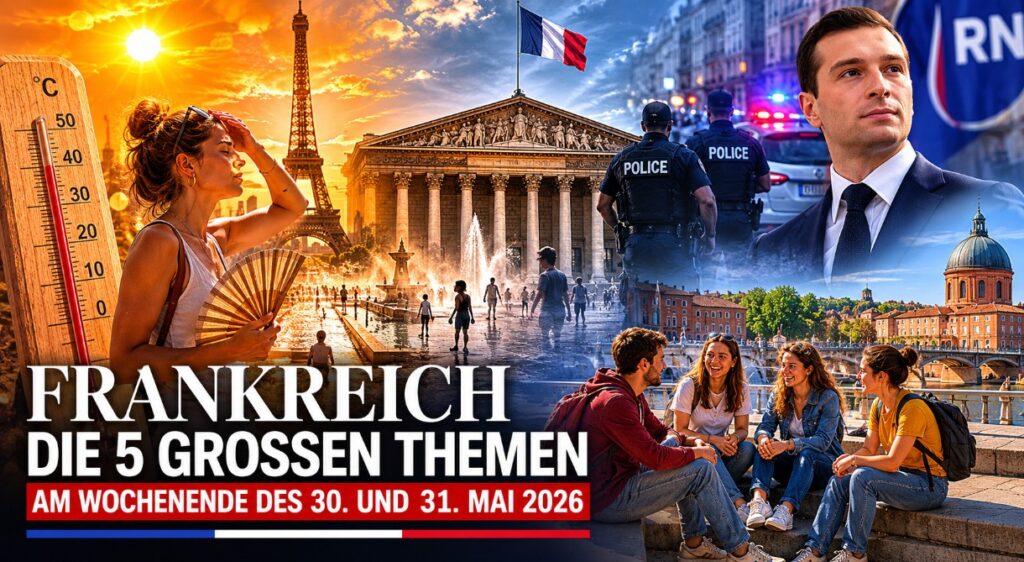
France is experiencing a remarkable weekend at the end of the month. An exceptionally early heat wave dominates the headlines, while at the same time issues of internal security, party reorientations, and social developments shape the public debate. What is striking is, above all, how closely many of these topics are currently linked. The discussion about the climate goes far beyond meteorological aspects and affects issues of infrastructure, public health, the economy, and the political capacity of the state.
The historic heat wave dominates the news agenda
No topic occupies the French media more at the moment than the exceptional heat wave that has affected large parts of the country. At the end of May, temperatures were recorded that are usually only reached in the summer months of July or August. Monthly records were broken in numerous departments. Special attention was given to a new national temperature record for the month of May.
The effects are already being felt in everyday life. Schools are adapting their class schedules, city councils are extending the opening hours of public parks, and health authorities are warning about the effects of heat and air pollution. Many media outlets currently consider the weather situation as a symbol of accelerated climate change, whose effects are increasingly visible in France.
The discussion is no longer limited to short-term weather phenomena. Rather, the question arises as to whether French cities, public buildings, and transport infrastructures are sufficiently prepared for a future in which periods of extreme heat will be more frequent.
The government comes under pressure over its climate policy
Alongside the weather developments, the political debate is intensifying. Opposition parties accuse the government of having underestimated the exceptional situation and of reacting late. In particular, representatives of green parties criticize the shortcomings in adapting to climate change.
In numerous comments, it is discussed whether France has schools, hospitals, and public institutions that are sufficiently climate-resilient. Thus, the heatwave becomes a political test for the government.
At the same time, a fundamental conflict of objectives is revealed: on the one hand, the state must respond in the short term to extreme weather events; on the other, long-term adaptation requires significant investments in urban planning, building renovation, and infrastructure. The current debate shows that climate policy is increasingly perceived as a central issue of state capacity.
Drug-related violence and security problems return to the forefront
In addition to the weather situation, internal security remains one of the dominant topics in French domestic politics. In particular, the city of Nantes is once again at the center of media coverage. Several violent incidents related to drug trafficking have sparked an intense debate about the effectiveness of the security strategy applied so far.
The term “Narcotrafficking” has firmly established itself in the political vocabulary. These are organized criminal networks that are gaining increasing influence in numerous major French cities. The government is responding with reinforced police operations and additional security measures, although many observers doubt that a purely repressive strategy will be sufficient in the long term.
The development is reminiscent of debates that France has already experienced in previous years in Marseille, Lille, or parts of the metropolitan area of Paris. Concern is growing that certain neighborhoods could permanently fall under the influence of organized crime. Therefore, there is intense discussion about new approaches in prevention, social policy, and security policy.
Jordan Bardella is working on the profile of a possible governing party
At the party level, attention is focused on Jordan Bardella and the strategic development of the Rassemblement National. Several media outlets are analyzing his efforts to further position the party towards governing capability.
Special attention is given to his stance on pension policy. Observers see in Bardella’s latest statements an attempt to adapt economic and social positions to the expectations of a broader electorate. The strategy follows a well-known pattern of European right-wing parties seeking to transition from a protest movement to a party with governing possibilities.
At the same time, controversies over cultural policy generate additional attention. The announced legal confrontation with rapper Soli has once again sparked debates about freedom of expression, political provocation, and the limits of public criticism. These discussions show how political and cultural fault lines are increasingly intertwined in France.
Toulouse Remains France’s Most Attractive University City
Among the few predominantly positive topics of the week is the new designation of Toulouse as the best university city in France. The metropolis in the south of France benefits from a combination of high quality of life, economic dynamism, and a broad educational offering.
The significance of this development goes beyond a university ranking. Many observers see it as an indication of profound changes within France. While Paris remains the country’s political and economic center, mid-sized cities are becoming increasingly attractive.
The increase in housing costs in the capital, better living conditions in the regions, and progressive digitalization are changing the location decisions of many young French people. Cities like Toulouse, Rennes, Montpellier, or Nantes are benefiting from this trend and are becoming important centers for innovation, research, and entrepreneurship.
A country between adaptation and change
The French press landscape this weekend paints the picture of a country in transformation. The heatwave is symbolic of deeper social changes. Issues of climate change, public safety, political stability, and regional development are increasingly interconnected.
While record temperatures attract short-term attention, the debates of recent days show above all one thing: France is increasingly concerned with how to respond to long-term structural challenges. For this reason, many observers understand the current events less as an exception and more as harbingers of a new reality that will likely shape politics, the economy, and society in a lasting way.