
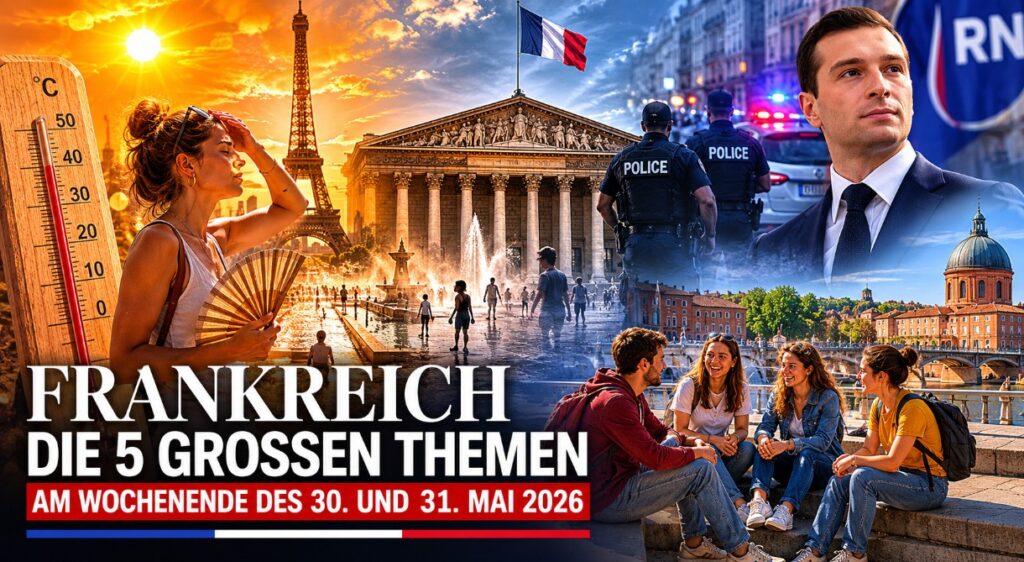
France welcomed an extraordinary weekend at the end of the month. An unusually early heatwave made headlines, while internal security issues, party repositioning, and social developments also dominated public discussion. Especially striking is the close connection between these topics. Discussions about the weather go far beyond meteorology, involving infrastructure, public health, the economy, and national political efficacy.
Historic heatwave dominates news coverage
Currently, the most covered topic in the French media is the widespread abnormal heatwave affecting large parts of the country. Temperatures measured at the end of May usually only occur in the summer months of July or August. Numerous provinces have broken monthly high-temperature records, with the new national temperature record in May being particularly noteworthy.
The impact of the heatwave has become apparent in daily life. Schools have adjusted their class times, local governments extended the opening hours of public parks, and health authorities have issued warnings about the consequences of high temperatures and air pollution. Many media outlets view this weather situation as a symbol of accelerating climate change, whose consequences are increasingly evident in France.
The discussion has long since gone beyond short-term weather events, focusing more on whether France’s cities, public buildings, and transportation infrastructure are sufficient to cope with more frequent extreme heat in the future.
Government under pressure over climate policy
Alongside meteorological developments, the political debate has intensified. Opposition parties accuse the government of underestimating the situation and responding too slowly. Representatives of ecological parties especially criticize the government for shortcomings in climate adaptation.
Numerous commentaries discuss whether France has sufficient climate-adaptive schools, hospitals, and public facilities. The heatwave has become a political test for the government.
At the same time, fundamental goal conflicts are emerging: on the one hand, the state needs to urgently respond to extreme weather, on the other hand, long-term adaptation requires substantial investment in urban planning, building renovation, and infrastructure. The current debate shows that climate policy is being regarded as a core issue of national executive capacity.
Drug Violence and Security Issues Become a Focus Again
Beyond the weather, internal security remains a major topic in France’s domestic affairs. Especially the city of Nantes has once again become a center of reports. Multiple violent incidents related to drug trafficking have sparked intense discussions about the effectiveness of existing security strategies.
The term “Narcotrafic” (drug trafficking) has established itself in political vocabulary, referring to organized crime networks with growing influence in several major French cities. The government has intensified police actions and taken additional security measures, but many observers doubt whether repressive strategies alone can provide a long-term solution.
This development recalls related debates in recent years in Marseille, Lille, and parts of the Paris region. There is growing concern that some urban neighborhoods may be controlled long-term by organized crime, resulting in particularly fierce discussions about new approaches in prevention, social, and security policies.
Jordan Bardella Shapes the Possible Image of a Governing Party
At the party level, the focus is on Jordan Bardella and the National Rally’s strategic development, with multiple media analyses highlighting his efforts to advance the party toward a more capable governing position.
Particularly notable is his stance on pension policy. Observers believe Bardella’s recent statements attempt to align economic and social policy positions more closely with broader voter expectations. This strategy follows the common pattern of European right-wing parties transitioning from protest movements to potential governing parties.
At the same time, cultural policy controversies have also sparked additional attention. The legal battle against rapper Soli has ignited discussions about freedom of speech, political provocation, and the boundaries of public criticism. These debates highlight the increasingly intertwined lines of political and cultural conflict in France.
Toulouse Maintains Status as France’s Most Attractive University City
One of the few positive topics this week is that Toulouse has once again been named the best university city in France. This large southern French city benefits from high quality of life, economic vitality, and abundant educational resources.
This development means much more than just university rankings; many observers see it as reflecting profound changes in France. Although Paris remains the political and economic center, the appeal of medium-sized cities is increasingly growing.
The capital’s ever-rising housing costs, better living conditions in other regions, combined with digitalization, have changed the residential choices of many young French people. Cities such as Toulouse, Rennes, Montpellier, and Nantes have benefited and are developing into important centers for innovation, research, and entrepreneurship.
A Country Between Adaptation and Transformation
This weekend’s French media landscape paints a picture of a country in transition. The heat wave symbolizes deeper social changes. Issues such as climate change, public safety, political stability, and regional development are increasingly intertwined.
Although the record-breaking high temperatures attract short-term attention, the debates over the past few days show that France is thinking more deeply about how to address long-term structural challenges. Many observers regard current events not as isolated incidents but as a prelude to a new reality that will have a lasting impact on politics, economics, and society.