
Today, those who pick up a pen to write have almost become a silent minority. Notes are stored on phones, letters uploaded to the cloud, memories saved on hard drives. Paper is everywhere, yet it has become transparent. It lies beneath printers, hidden in archives and mailing boxes. Almost no one asks anymore where it comes from, how it was born, and who made it.
In an old farmhouse in the heart of Auvergne, a young man is asking himself these questions.
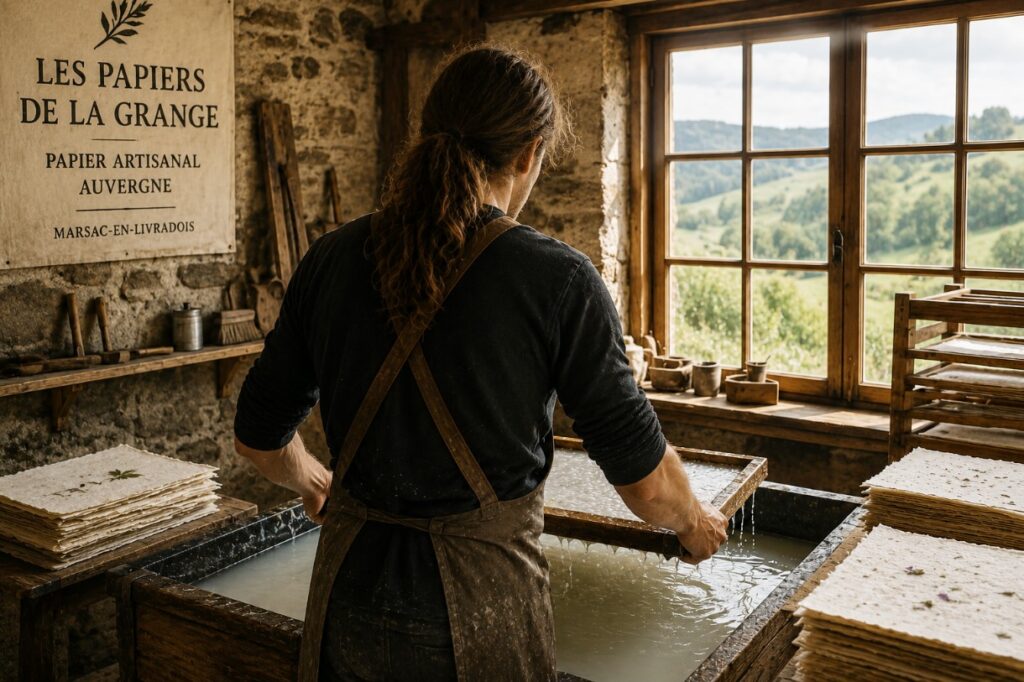
Étienne Gouttefarde, in his early thirties, lives and works in Maslac-en-Livradois, a village located in the Livradois-Forez Regional Nature Park. He makes paper by hand. Slowly, attentively, just as people did centuries ago.
In an era where speed is worshiped as the measure of everything, this has become almost a quiet act of resistance.
Stepping into his workshop, there is no hum of machines, no rhythm of assembly lines. Instead, there is water, wood, fibers, and hands. Many hands.
The paper here is not an industrial product, but something that grows.
His path has not been smooth. For a long time, there were no signs that Étienne Gouttefarde would become a papermaker. His educational background initially focused on other fields. Sports played an important role in his life, as did travel. Getting to know the world, accumulating experience, walking the road — these seemed to be his destiny.
Until 2022.
Important stories in life often begin by chance.
Gouttefarde happened upon one of the last historic papermaking mills in France — Richard de Bas. This mill site is seen not just as a place to exhibit history, but as a space where history lives. For centuries, handcrafted, carefully selected paper was created here, long before the manufacturing revolutions brought by industrial processes.
For this young man from Auvergne, a door to an unknown world was opened.
He suddenly found himself in a craft that requires patience, precision, and attention to details often overlooked by most people.
He learned how to handle fibers. He mastered the papermaking techniques of sheet forming, pressing, and drying.
More importantly, he learned how to wait.
Because good paper cannot be rushed.
At first, this was just professional experience, but it quickly became a passion. He was deeply fascinated by the material work. Every fiber tells its own story. Each paper surface reacts differently to light, humidity, or touch.
It can be said that he fell in love with paper.
Like all passions, eventually being merely a bystander was no longer enough.
He went from employee to creator.
He went from learner to craftsman.
He went from craftsman to entrepreneur.
Étienne Gouttefarde founded his own workshop “Les Papiers de la Grange.” The name is plain and almost rustic. But behind it lies an ambitious project.
He wants to preserve ancient knowledge rather than turn it into a museum piece.
Because he sees the danger many traditional crafts face. They are praised, photographed, and awarded, but they lose their place in living culture and end up as folklore exhibits.
Gouttefarde’s idea is different.
For him, paper not only has a past, but also a future.
Therefore he continuously explores materials. Besides traditional plant fibers, he also uses recycled paper and so-called crepe paper, which is made from old fabrics. Petals are added to the pulp, as well as grass, seeds, and sometimes even small mineral elements from his hometown landscape are used.
As a result, there are papers almost like little landscape paintings.
No two are the same.
When you touch it, you can feel the unevenness, the texture, the scars—
Traces of the manufacturing process.
Industrial products often pursue uniformity, but handmade paper is lively precisely because of these irregularities. It is these little imperfections that make its charm.
It reminds you of the human face.
Perfection is often boring.
But personality is unforgettable.
His clients are no longer just from the local area. Artists order his paper for watercolor painting and printmaking. Bookbinders appreciate its unique fiber quality. Designers look for materials with a story. Brides and grooms want invitations that no one else has.
In a world flooded with standardized products, people long for uniqueness.
Perhaps this explains the success of many young artisan artists.
Today people no longer just buy items.
They buy stories.
And what story is more moving than a sheet of paper made from old fabrics, hometown plants, and craftsmanship?
But having a workshop alone is not enough for Gouttefarde.
He wants to showcase his production process.
Therefore, he often picks up the camera.
With the witty name “Le Dur de la Feuille” he posts videos on social networks, introducing those production steps that today are rarely known outside small circles.
Millions of people use paper every day,
yet few have seen how it is born.
When Gouttefarde dips the paper mould into the water and then slowly lifts it up, the scene is almost meditative. Fibers gather into a thin layer. A sheet of paper is miraculously formed from the cloudy liquid.
Almost like magic.
But it’s real.
His videos touch people’s hearts.
Not because of flashy special effects,
but because of their slow pace.
While many platforms are filled with haste, he shows a process that takes time, movements that require focus, and work steps that cannot be rushed.
It is a rebuttal to endless scrolling.
Perhaps also a response to many people’s fatigue with digital information overload.
After all, who doesn’t like watching something being carefully crafted?
The response has been overwhelming.
An ever-growing community is following his work. Artists, craft enthusiasts, the curious, and collectors follow his projects. Collaborations, exhibitions, and exchanges come one after another.
This niche craft has suddenly become a hot topic.
It is breathtaking.
After all, papermaking was once seen as a nearly extinct profession.
Today, this craft is experiencing a small revival.
Not only in France.
Young people across Europe are rediscovering traditional crafts, seeking work that they can touch and feel, looking for jobs with visible, tangible results.
The digital economy often produces intangible things.
But papermakers create something that rustles at your fingertips.
The difference couldn’t be clearer.
Gouttefarde’s work is continually recognized. In 2025, he received the Handicraft Award from the Auvergne-Rhône-Alpes region. This award not only acknowledged the quality of his products,
but also affirmed an attitude.
Believing that tradition does not have to be an obstacle,
innovation does not always have to come from technology,
and that the future may begin with people rediscovering old paths.
Today, when you enter his workshop, you will not meet a nostalgic person. Gouttefarde does not dream of going back to past centuries,
he uses social media,
collaborates with contemporary artists,
and embraces an entrepreneurial mindset.
But he preserves something that many places have already lost: respect for time.
Every sheet of paper deserves attention,
every fiber has its place,
and every process requires time.
This sounds simple,
but it is not.
Because modern society often views time as a resource to be used as efficiently as possible. In the workshop in Maslacq on the Lot, a different logic applies.
Time is not an obstacle,
time is part of the product.
Perhaps this is the true charm of his work.
A sheet of handmade paper has no dazzling value. It does not glitter, does not send notifications, nor does it update automatically.
But it tells the story of the world where it was born,
about water and plants,
about patience and craft,
and the story of a young craftsman who chooses to refuse letting his material become invisible.
Sometimes, a sheet of paper is enough to remind us that beauty does not come from speed,
but from focus.
Perhaps this is the true message Étienne Gouttefarde wants to convey.
While the world is getting faster, he is sitting by a trough in the Auvergne mountains, copying page after page by hand.
Old-fashioned?
Perhaps.
Trendy?
More fashionable than ever.
Article author: M. Legrand