
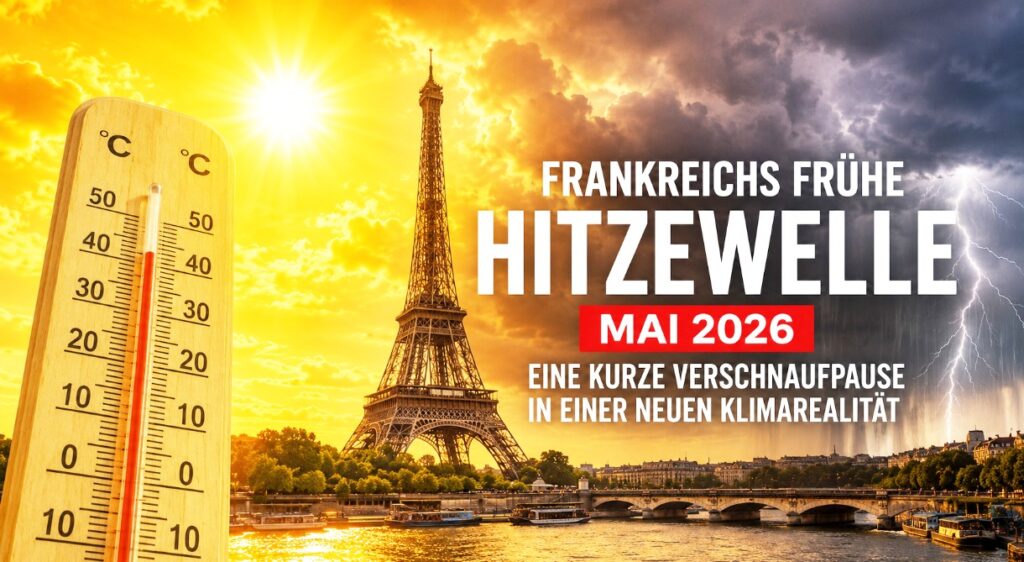
An unusual heatwave that swept across France in recent days is gradually receding. After temperatures more reminiscent of mid-summer than the end of May, the typical Atlantic climate is returning. Thicker clouds, thunderstorms, and significantly cooler air in many places bring relief. However, the temporary cooling does not change the course of events that can hardly be ignored today: France is experiencing the beginning of a new climate reality.
May 2026 has already gone down in history.
Several regions have set new temperature records for this month. In the south of the country, the readings rose to almost 38 degrees, while in Paris, temperatures above 33 degrees were recorded for several days in a row. Particularly notable: May 26 is considered the hottest day of May since the beginning of modern meteorological observations in France.
Many people reacted with surprise. After all, such temperatures are usually associated with the summer months — July or August. But it is precisely this change that worries climatologists. Unusual heat is not considered an exception, but a harbinger of what France will experience more frequently in the coming decades.
In fact, the question is no longer whether further heat waves will come. Rather, the question is how prepared the country is for them.
Since the aftermath of the deadly 2003 heat wave, which took nearly 15,000 lives, France has significantly expanded its alert and protection systems. National heat protection plans, modern weather warnings, and targeted information campaigns have become commonplace. Local authorities keep records of particularly vulnerable individuals, care facilities have emergency protocols, and hospitals prepare in advance for peak workloads.
However, crisis management is no longer sufficient.
The main challenge lies in the long-term adaptation of the country. This is especially noticeable in cities. There, concrete, asphalt, and dense development retain heat like a huge oven. At night, the heat often remains trapped, and the temperature hardly drops. So-called tropical nights, when the thermometer does not fall below 20 degrees, now occur much more frequently.
This is one of the greatest threats to health. After all, the human body needs nighttime cooling to rest. Without it, especially in elderly and weakened individuals, the risk of serious complications increases.
Many cities are already responding. They are planting new trees, creating shade, and some communities are testing light-colored road surfaces that reflect sunlight more strongly. However, redevelopment often happens more slowly than climate change. In addition, there is another problem: millions of homes were originally built to retain heat in winter, and they often do not provide sufficient protection against summer heat.
Technical infrastructure is also under pressure.
The rise in temperatures causes increased electricity consumption due to air conditioners. Railway tracks are sensitive to extreme heat because the rails can deform. Even energy supply faces challenges when rivers and reservoirs used to cool industrial plants reach abnormally high temperatures.
While people are trying to adapt, nature is also paying a high price. Conservation organizations are already noting a significant impact on many bird species. Young chicks suffer from a lack of water or leave nests too early to avoid the heat. At the same time, forests and agricultural lands are under increasing stress. Repeated extreme events leave traces that are often only visible years later.
So far, many regions benefit from sufficient spring rainfall. Soils in many places contain enough moisture, so major damage to plants has so far been limited. However, this advantage can quickly disappear if further hot periods occur.
This is exactly what numerous experts warn against. Early heat waves statistically increase the likelihood of further extremely hot periods during the summer.
France is in a transitional stage. Emergency systems today work significantly better than two decades ago. At the same time, there is a growing impression that the deep adaptation of cities, buildings, and infrastructure is not keeping pace with the rate of climate change.
The return of colder air in recent days looks less like a complete calm. Rather, it resembles a short pause between two phases of development, which is just beginning to gain momentum.
Andreas M. B.