
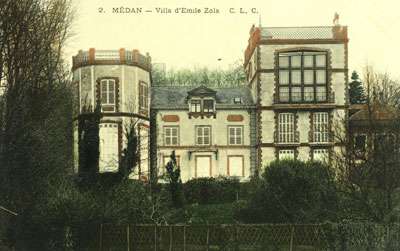
On the banks of the Seine, west of Paris, lies an estate that was not only a home but also a place of creative productivity: the house of Émile Zola in Médan. Here some of his most significant works were created, history was made – and here the famous writer lived his passion for literature, photography, and social commitment.
A Literary Refuge on the Banks of the Seine
When Émile Zola took the money from the success of his novel L’Assommoir in 1878 to buy a house in Médan, he probably had no idea that it would become one of the most important places of his life. The charming country estate overlooking the Seine became much more than just a retreat for him.
He himself affectionately called his property his “cabane à lapin”, his rabbit hut – but in truth it was a steadily growing residence that he gradually expanded. The idyllic surroundings, the calm of nature, and the direct railway connection made Médan the perfect place for a writer who was in the midst of his literary work.
The Towers of Inspiration
Zola’s house in Médan grew with his success. After Nana, he had a first tower built; after Germinal, a second followed. These expansions were not only architectural changes but also symbolized the increasing influence of his work.
Martine Leblond-Zola, his great-grandniece, describes it aptly: “Depending on his literary success, he expanded his house. The rights to Nana financed the construction of one tower, those to Germinal the other.” Thus, the estate became not only a home but a kind of monument to his work.
A Place of Writing and Controversy
In Médan, Zola wrote some of his most famous works. The quiet of the place allowed him to deeply immerse himself in his novels – yet at the same time, his home was also the scene of one of France’s greatest political scandals.
Here he decided to defend Alfred Dreyfus and to publish his famous open letter J’Accuse…! With this article, which appeared on January 13, 1898, in the newspaper L’Aurore, he set a chain of events in motion that ultimately forced him into exile. However, his house in Médan remained – a symbol of his courage and his unwavering belief in justice.
A Writer with an Eye for Details
Zola was not only a gifted author but also a passionate photographer. With his camera, he captured life in Médan: his family, the sun-dappled avenues, the lindens he planted. The surroundings were an inexhaustible source of inspiration for him.
Especially the nearby railway section sparked his imagination. The train that regularly rumbled past his house made its way into his novel La Bête humaine, a dark story of murder and madness on the rails.
Médan Today – A Place of Remembrance
Today, the property is a museum that preserves the spirit of Zola. Visitors can stroll through the rooms, admire his writing study, and gain insight into the life of the great writer. Those who look closely may still discover traces of his creative energy – or sense the breath of history that lingers between the walls of this house.
Is a visit worth it? Absolutely! Because Médan is more than just a writer’s house – it is a window into the soul of a man who changed literature and the world.
A travel report by V.O.Yager