
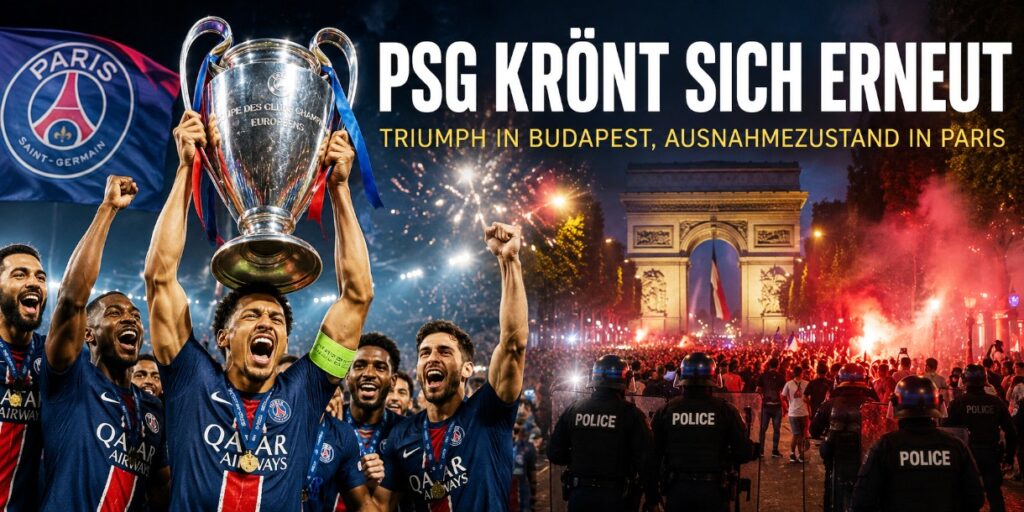
With their second consecutive triumph in the UEFA Champions League, Paris Saint-Germain has firmly secured its place among the clubs that define an era. The final victory against Arsenal FC in Budapest, Hungary, was a sporting feat accompanied by significant societal tensions. While the team celebrated a historic success, the French security authorities faced a test that once again raised questions about the control of major sporting events.
A Final on a Knife’s Edge
Champions League finals live from their drama. The 2026 final was no exception. Arsenal got off to a better start and initially took the lead. The Londoners looked organized and controlled for large parts of the game, while Paris struggled to find its offensive rhythm.
Nonetheless, PSG showed the qualities that have distinguished the club in recent years: patience, individual class, and mental resilience. The equalizer came from a penalty converted by Ousmane Dembélé. After that, an intense match developed where both teams had chances to decide the outcome.
Neither regular time nor extra time produced a winner. Only in the penalty shootout did Paris prevail 4-3. The decisive miss by Gabriel made the French supporters cheer and sealed the repeated title victory.
For Arsenal, the disappointment remains of a final that was played on equal terms for large stretches. For PSG, however, this success means far more than just another trophy.
From a Project to a European Powerhouse
For a long time, Paris Saint-Germain was seen as a symbol of an ambitious but incomplete project. Despite enormous investments and numerous world stars, the club repeatedly failed to meet the highest European demands over the years.
Winning the Champions League already fundamentally changed this narrative. The successful title defense now elevates the club to a new level. In the history of European club football, only a few teams have managed to win the continent’s most prestigious club competition several times in a row.
This also shifts the perception of the club. PSG is no longer primarily defined by transfer fees or ownership structures, but increasingly by sporting continuity. The club has succeeded in shaping a team from a financially strong project that remains competitive at the highest level over the long term.
Especially at a time when the economic disparities between Europe’s top clubs are growing, sustainable sporting success becomes the decisive criterion. Paris has made this step.
Security Forces in a State of Emergency
However, the sporting brilliance was overshadowed by massive security precautions. Days before the final, French authorities had already warned of possible riots.
The mobilization of security forces reached extraordinary dimensions. Tens of thousands of police officers and gendarmes were deployed nationwide. Particularly in Paris, measures focused on the Champs-Élysées, the area around Parc des Princes, and other central fan meeting points.
The authorities’ concerns proved justified. After the final whistle, tens of thousands of supporters flooded the streets of the capital. While the majority of celebrants remained peaceful, clashes with security forces occurred at several locations.
Celebrations and Violence – A Recurring Challenge
The images from the night once again showed the ambivalence of major football successes. On one hand, there was exuberant joy over a historic triumph. On the other hand, numerous acts of vandalism, fires, and violent incidents were recorded.
Security forces arrested hundreds of people. The events recall previous major events in which sporting enthusiasm escalated into violence within certain groups.
For French politics, this is a sensitive issue. Large-scale events are seen as showcases for national organizational capability. Riots therefore always raise questions about prevention, police strategy, and social integration.
At the same time, a structural problem of many European metropolises becomes apparent: the combination of enormous crowds, alcohol consumption, and emotionally charged events significantly increases the risk of escalation. Such developments can hardly be completely prevented so far.
The Political Symbolism of Success
The triumph also has a political dimension. France has presented itself for years as a major sporting nation and host of international major events. The success of the country’s most important football club further strengthens this self-image.
It is therefore no surprise that state institutions actively accompany the title victory. Extensive celebrations in Paris are planned for Sunday. The team is to publicly present the trophy and will then be received by President Emmanuel Macron at the Élysée Palace.
Such gestures follow a long European tradition. Sporting successes are not only viewed as achievements of individual clubs but often interpreted as expressions of national strength, cultural radiance, and social cohesion.
Especially France, which in recent years has been marked by political tensions and social conflicts, likes to use moments of sporting success as signs of collective identification.
With the victory in Budapest, PSG has firmly established itself among Europe’s football elite. The title defense marks a historic milestone for the club and underscores the team’s grown sporting maturity. At the same time, the events in Paris show that great triumphs in modern football are no longer exclusively sporting matters. They touch on issues of public order, political symbolism, and social cohesion. The trophy remains in Paris – and so does the debate about the consequences of such mass events.
Andreas M. Brucker