
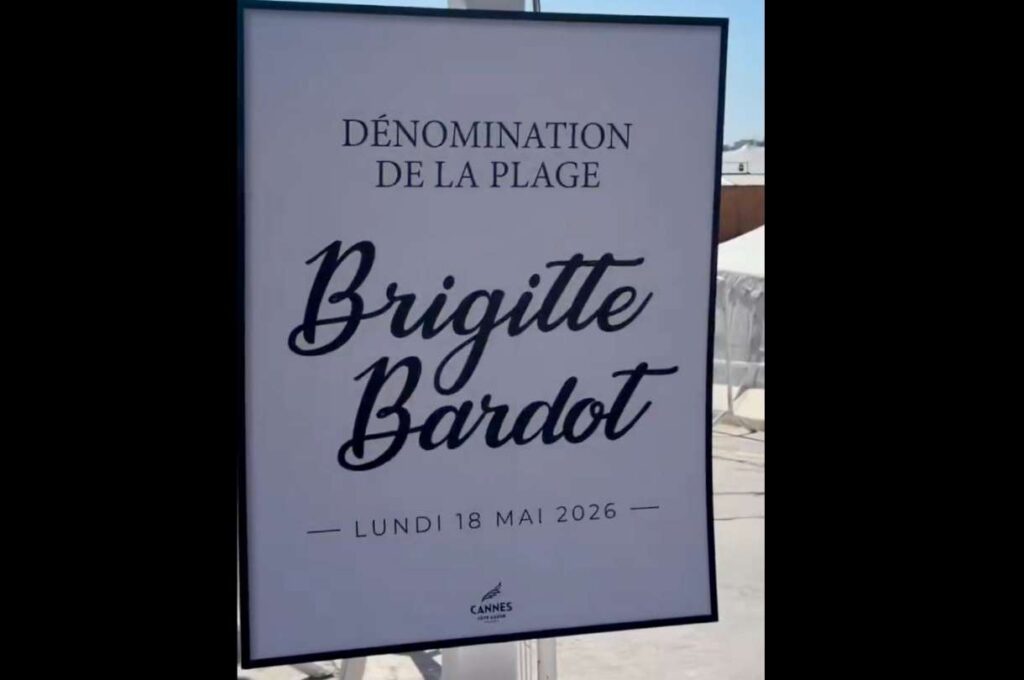
On the Croisette, the Mediterranean sparkles as always. Sunglasses reflect palm trees, photographers wait for the next big appearance, and now one of the city’s best-known beaches bears a name that has been inseparably linked to Cannes for decades: Brigitte Bardot.
The former Macé beach has officially been called “Plage Brigitte Bardot” since Monday. In doing so, Cannes pays tribute to a woman who became a legend here in the mid-1950s. In 1955, during the Film Festival, the young actress appeared on the beach in a floral bikini, danced barefoot in front of photographers and, in the process, changed the image of female freedom in European cinema. From actress to myth. And Cannes? It became the stage for that myth.
The beach is just a few steps from the Palais des Festivals, where the red carpet is rolled out every year and the film world holds its breath for almost two weeks. Right in this place, cinema and memory now merge for good. For the inauguration, the city screened Louis Malle’s film “Viva Maria!” outdoors—free of charge, right by the water’s edge. A rather cinephile way to say goodbye.
Pues Bardot died in December 2025. But her name still echoes across France like a melody from another era. For many, she remains the face of the Nouvelle Vague, although she was never entirely part of that movement. Others remember the woman who left the film industry early to devote herself unreservedly to animal welfare. In France, the initials “BB” are often enough, and everyone knows who is being referred to.
That is why this tribute has a second dimension. Cannes is celebrating not only the actress, but also the activist. Outside the summer season, dogs will be allowed on the beach at certain times. Perhaps a small decision, but one with enormous symbolic value. Bardot fought vehemently for decades against animal cruelty, the fur industry, and factory farming. Her friends called her tenacious. Her detractors, rather difficult. Both were probably true.
Of course, the figure of Brigitte Bardot remains complicated.
Her later political statements repeatedly sparked intense debate. On several occasions, she was taken to court over her controversial remarks. In France, this ambivalence has long been part of the public memory of her. An icon and a controversial figure at the same time: she does not appeal to everyone, especially not in an era when cultural tributes are scrutinized more closely than before.
But Cannes clearly chooses to present itself in favor of the image of the young Bardot. Of that woman who once ran laughing along the Croisette and whose presence shaped the international image of French elegance. Cities like Cannes live from their stories, from photographs, from the great images of cinema. Some of those images fade away. Others remain like salt on the skin.
Brigitte Bardot belongs to this second category.
And now a piece of the Mediterranean bears her name.
By C. Hatty