
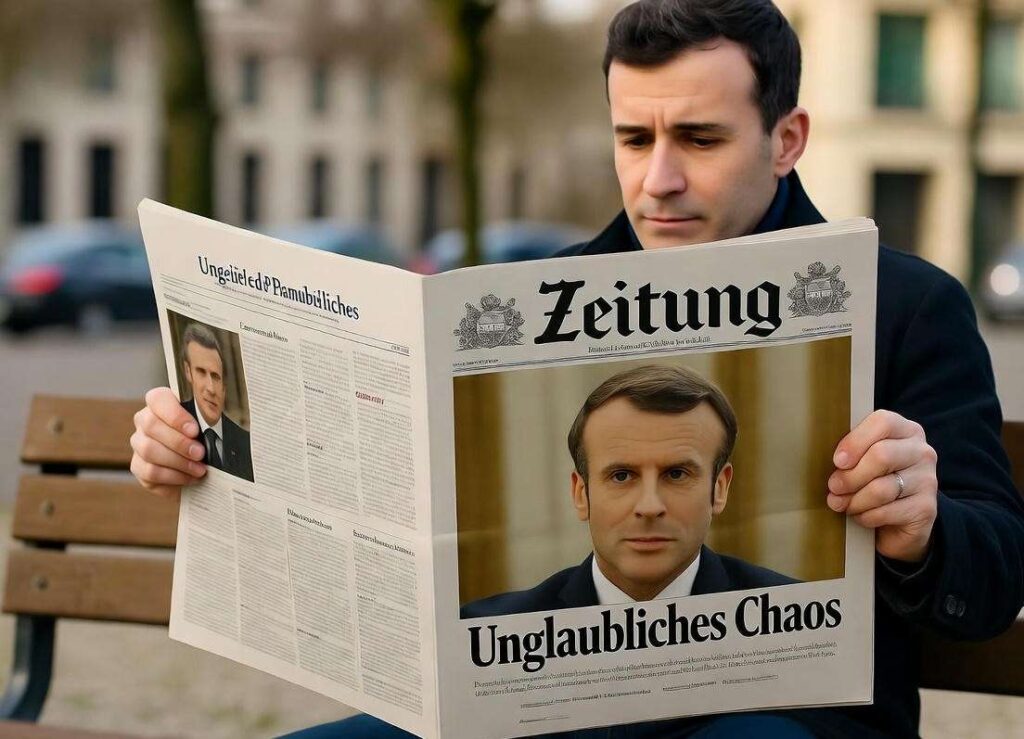
A fake video, in which an alleged coup against Emmanuel Macron is reported, spread rapidly on Facebook in early December 2025. Within a few days, the clip reached more than 13 million views – causing confusion not only in France but also international diplomatic irritation. The French government immediately demanded the removal of the obviously fake content. However, Meta, the parent company of Facebook, refused. An incident that raises questions about the role of platforms, the limits of regulation, and political resilience in the digital age.
A “journalist report” about an invented military coup
The false report begins with a video that appears professionally produced: A woman stands in a neutral studio setting and speaks in a credible tone about alleged unrest in France. President Macron is said to have been overthrown by a coup. A mysterious colonel took power. The depiction is supported by dramatic images – apparently cut together from previous demonstrations – as well as computer-generated speech and a AI-animated presenter.
The video is a prime example of so-called deepfakes, where artificial intelligence is used to create convincingly realistic fictions. Upon closer inspection, it is obvious that it is a forgery – yet the clip quickly gains traction on social media. Especially in Francophone African countries, where French politics are often viewed with skepticism, the video spreads.
The Silence of Meta
Despite multiple interventions by the French authorities, Facebook does not delete the disinformation. Instead, Meta merely attaches a note indicating that the content is “potentially manipulated.” From the company’s perspective, this step is sufficient: the clip does not violate explicit platform guidelines, as it neither incites violence nor fosters hate. The boundary between satire, propaganda, and dangerous disinformation remains deliberately blurred.
The case reveals a fundamental problem: platforms like Facebook moderate content according to their own criteria, which are often economically motivated – and not primarily in the public interest. The responsibility to distinguish between truth and falsehood is shifted onto the users. In an environment where algorithms reward viral spread, this is a dangerous game.
The Reaction from the Élysée
President Emmanuel Macron reacted unusually sharply to the incident. In a public speech in Marseille, he accused Meta of undermining the democratic culture of debate through inaction. He was particularly outraged that an African counterpart personally contacted him to inquire about the situation in Paris – the fake coup report apparently seemed that credible.
Since then, Macron has called for stricter regulation of digital platforms. The goal is to establish clear legal obligations to remove “obviously false and destabilizing content.” He also advocated for a digital identity requirement: users should only be allowed to operate on platforms with verified identities – a proposal that is highly controversial from the perspective of civil rights activists.
Legal Grey Area – Political Vacuum
Meta’s refusal points to a structural gap in international internet regulation. Although laws to combat disinformation now exist in France as well as at the EU level – such as the Digital Services Act – their implementation quickly reaches its limits in the cross-border realm of digital platforms. The distinction between free expression and dangerous deception is legally and technically challenging.
At the same time, it becomes clear: the technical capability for manipulation has reached a new level of maturity. AI-generated content can not only appear deceptively real, but through algorithmically supported distribution can reach millions of people within hours – faster than government authorities can react.
The case of France is therefore exemplary of a development that could lead to political crises even more frequently in the future: the confrontation between national sovereignty and global platform power.
France is not alone with this problem. In other countries – such as the USA, Brazil, or India – deepfakes and manipulated content have already sustainably influenced political elections, social debates, and trust in institutions.
The fact that a democratically elected head of state has to serve as the target of a fictional coup announcement shows how fragile political communication has become – and how urgently legal as well as technical responses to the new challenges of AI disinformation must be found.
Author: Andreas M. Brucker