
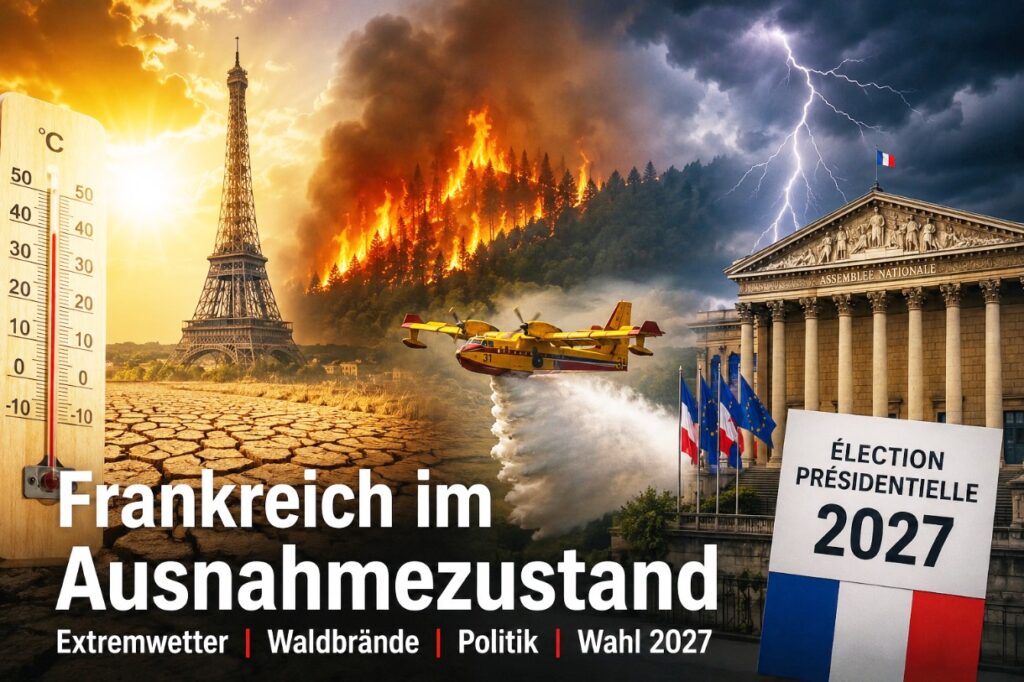
France is experiencing a news day in which natural events and political debates are making headlines in equal measure. The ongoing extreme weather situation, with heat, drought, wildfire risk and severe thunderstorms, is shaping nearly every front page. At the same time, domestic political issues are coming increasingly into focus – from disaster response resources and the implementation of the new assisted dying law to the first strategic positioning for the 2027 presidential election. Several regional events are also developing into issues attracting nationwide attention, underscoring the challenges France currently faces.
Extreme weather keeps France on edge
The dominant issue remains the exceptional weather situation. After the third heatwave of the year, severe thunderstorms with torrential rain and, in some cases, tennis-ball-sized hail are now causing considerable damage. While temperatures well above 35 degrees Celsius continue to be recorded in many parts of the country, numerous departments have had to be placed on alert because of severe weather.
Damaged homes, destroyed vehicles and devastated agricultural land characterize the scene in many places. Fire brigades and emergency services are operating at the limits of their capacity in numerous areas. The rapid succession of extreme weather events is particularly problematic: after weeks of drought, parched soils can barely absorb large volumes of rain, meaning that even brief downpours cause flooding.
Meteorologists see this as another example of the increasing frequency of extreme weather conditions in Western Europe. France is already experiencing a summer that ranks among the most exceptional of recent decades in terms of the duration and intensity of the heat.
Drought and wildfire risk remain a national concern
Alongside the thunderstorms, the prolonged drought remains one of the most pressing issues. Water-use restrictions remain in force in numerous regions. Rivers are carrying exceptionally little water, groundwater levels are falling, and many farmers expect substantial losses in yields.
The situation remains particularly critical in the south and southwest of the country. There, even a small spark can be enough to trigger a major fire within minutes. Fire brigades are therefore keeping their personnel on heightened alert, while additional firefighting aircraft and mobile response units have been deployed to particularly vulnerable regions.
For agriculture, the summer is increasingly becoming an economic burden. In addition to the threat of crop losses, irrigation and feed costs are rising, while numerous municipalities must strictly regulate their water supply.
Political dispute over fire service resources
The severe wildfires of recent weeks have sparked an intense political debate about disaster response. At its center is the modernization of France’s aerial firefighting fleet.
Critics accuse previous governments of postponing necessary investments for years. The aging Canadair fleet in particular has long been considered in need of refurbishment. The government, by contrast, points to modernization programs already underway and stresses that France still has one of Europe’s most capable aerial firefighting capacities.
However, the discussion extends beyond the aircraft fleet. Several associations are calling for additional investment in equipment, personnel and training for fire brigades in order to be better prepared for major emergencies that are likely to occur more frequently in the future.
The new assisted dying law raises practical and ethical questions
The reform of assisted dying legislation also continues to occupy politicians, the judiciary and society. Following the law’s final adoption, attention is now turning to its legal review and practical implementation.
Legal experts are analyzing potential constitutional issues in particular, while hospitals and care facilities are beginning to develop organizational frameworks for applying the new rules. At the same time, medical associations, ethics committees and patient organizations are debating the limits of medical responsibility and the protection of especially vulnerable people.
The reform is among the most significant social policy decisions of recent years and is likely to occupy France for a long time to come.
Investigations following the Fontainebleau fires
Investigations into several wildfires in the historic Fontainebleau forest area south of Paris continue to receive considerable attention.
Particular focus is on a young volunteer firefighter who is said to have confessed to setting a fire himself. At the same time, authorities are investigating another case in which a carelessly discarded cigarette is alleged to have caused a forest fire.
The events have sparked a debate about fire prevention, safety measures in forest areas and the responsible use of natural spaces. Given the extreme drought, even the smallest acts of carelessness can have devastating consequences.
International arms trafficking network dismantled
The dismantling of a cross-border network involved in the illegal trade in military weapons between France and Switzerland is also receiving broad attention.
The investigation centers on a total of nine suspects, including a French police officer. According to investigators, the inquiries highlight the close cooperation of organized criminal networks across national borders.
Many observers view the successful cooperation between French and Swiss security authorities as an example of the growing importance of internationally coordinated law enforcement.
Tourism feels the effects of the heatwave
The exceptional temperatures are now leaving clear marks on the tourism sector. Visitor numbers are falling short of expectations in some cases, especially in inland areas and traditional wine regions.
Places such as Saint-Emilion are recording noticeably fewer day visitors, as many holidaymakers avoid outdoor activities during the hot afternoon hours. Cooler regions along the Atlantic and English Channel coasts are benefiting, where temperatures are considerably more pleasant and many holiday destinations report high occupancy.
Tourism associations are increasingly observing changing travel habits. More and more holidaymakers are making short-notice decisions based on weather forecasts or prefer destinations with a more moderate climate.
The 2027 presidential election is casting its shadow
Although the next presidential election is still several months away, the political debate is already gathering considerable momentum.
Attention is focused on possible successors to Emmanuel Macron and the strategic positioning of the main political camps. In the center-right liberal spectrum, Gabriel Attal and Edouard Philippe are considered promising figures, while Marine Le Pen continues to shape the right-wing camp. At the same time, the left is once again struggling to develop a shared strategy and agree on a competitive candidate.
Political observers expect economic development, migration, security, purchasing power and climate policy to be among the central campaign issues. The coming months are therefore likely to be increasingly shaped by policy debates and internal party power struggles.
France is thus experiencing a summer that extends far beyond exceptional weather phenomena. The consequences of heat, drought and wildfires pose considerable challenges for the state and society, while also intensifying political debates about climate adaptation, disaster response and public investment. At the same time, the political system is beginning to prepare for the period after Emmanuel Macron. On July 16, 2026, the French press paints a picture of a country that must respond to acute crises while setting the long-term course for its political future.