
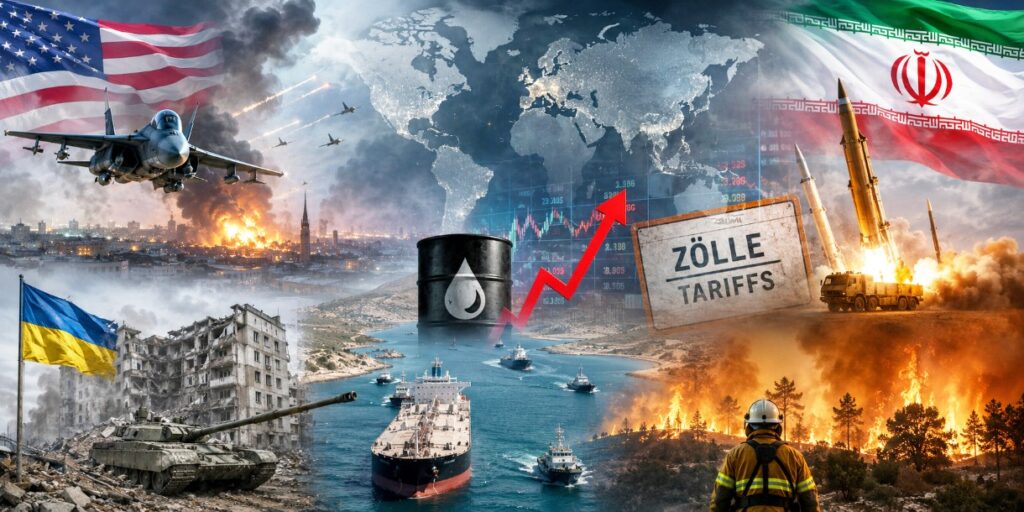
On this Friday, July 24, 2026, the international press is looking at a global situation in which several crises are intensifying simultaneously. At the center is the military escalation between the United States and Iran, which now affects not only the Persian Gulf but also the Red Sea, and thus key arteries of global trade. Added to this are new American tariffs, the ongoing war in Ukraine, severe wildfires in several regions of the world, and the fragile situation in the Gaza Strip.
The war between the United States and Iran is spreading across the region
The main focus of international coverage remains the direct confrontation between Washington and Tehran. According to the U.S. military, it has carried out another series of strikes against Iranian targets. Military infrastructure, drone positions, surveillance installations, and coastal positions were targeted.
Yet the real explosiveness lies not only in the intensity of the attacks, but in the geographical expansion of the conflict. In several Gulf states, fears are growing that they themselves could become theaters of war. Bahrain sounded air-raid alerts overnight, while Kuwait and other states in the region allied with the United States also face an increased threat.
International media are paying particular attention to attacks by the Houthi militia on Saudi oil tankers in the Red Sea. This means that, alongside the Strait of Hormuz, the route through Bab al-Mandab and the Suez Canal is now also affected. This development is of considerable importance for global trade: Asia’s and Europe’s energy supplies depend to a large extent on precisely those sea lanes that are now under military threat.
U.S. President Donald Trump announced a tough military response against Iran and the Houthis. At the same time, reports are mounting that Tehran has supported the Yemeni militia with weapons, advice, and logistical assistance. The United Nations is warning of a regional conflagration. In many editorials, the question is no longer whether the conflict could spread, but how far it has already spread.
Oil prices and supply chains come under pressure
The military escalation is having an immediate impact on the global economy. Oil prices have risen above $100 per barrel. Asian stock markets recorded losses, while shipping companies, insurers, and commodities traders are pricing in higher risks for transport through the Persian Gulf and the Red Sea.
The simultaneous threat to two key sea routes would be particularly problematic for the global economy. The Strait of Hormuz is one of the most important transport corridors for crude oil and liquefied gas. The Red Sea, in turn, connects Asia, Europe, and North Africa through the Suez Canal. If both routes become unsafe, not only energy prices but also freight costs, delivery times, and inflation risks will rise.
In the United States itself, the cost of the war is also increasingly being debated. The military operations are straining the budget, drawing down stocks of advanced precision weapons, and generating growing opposition in Congress. The domestic debate therefore centers not only on the strategic necessity of the strikes, but also on their political and fiscal sustainability.
Washington launches a new round of tariffs
Alongside the war, a new U.S. government trade-policy decision is causing unrest. Washington has imposed new double-digit import tariffs on numerous trading partners. They replace a temporarily applicable flat levy of ten percent, and the government justifies them by citing provisions against goods allegedly produced using forced labor.
This justification is politically sensitive. The fight against forced labor enjoys broad international legitimacy. Critics, however, see the measure primarily as an instrument of trade pressure through which the United States seeks to assert its economic interests. Several trading partners have lodged protests or indicated possible countermeasures.
For export-oriented economies, the decision means additional uncertainty. Companies must reckon with higher costs, disrupted supply chains, and more complex customs procedures. Combined with rising energy prices, this creates a double burden: the global economy is coming under pressure simultaneously from war, transport insecurity, and protectionism.
The war in Ukraine remains a protracted European conflict
The war in Ukraine is currently less dominant in the international press than the escalation in the Middle East, but it remains a central conflict in Europe’s security order. The European Union is working on another package of sanctions against Russia. The focus is on banks, financial platforms, actors in Russia’s oil business, and individuals and companies that support Moscow’s war economy.
At the same time, Ukraine is continuing its strikes deep inside Russian territory. Drone attacks on warehouses and logistics facilities are intended to weaken Russian supply lines. Russia, meanwhile, continues to attack Ukrainian energy and transport infrastructure. For civilians, this means power outages, destroyed transport routes, and growing exhaustion after years of war.
Domestic political pressure is also growing in Kyiv. Personnel decisions within the government and defense establishment are being closely scrutinized. Ukraine’s leadership faces a double challenge: it must remain militarily capable of acting while also safeguarding social cohesion in a war whose end is nowhere in sight.
Wildfires reveal the vulnerability of modern states
Severe forest and vegetation fires in several regions of the world are also shaping international coverage. France, Spain, Scotland, and Canada are reporting extensive fires. Thousands of people had to be evacuated in southwestern France. Large areas burned in Spain’s province of Guadalajara. In Canada, smoke from numerous fires degraded air quality as far as major urban areas.
What is striking is not only the scale of individual fires, but their simultaneity. Many media outlets no longer portray the events as independent natural disasters. Instead, the focus is on a pattern of heat, drought, parched soils, and overstretched emergency services.
Climate change is therefore increasingly being treated as a security issue. Wildfires do not only destroy natural areas; they also strain health systems, transport infrastructure, energy supplies, and public budgets. The decisive question is no longer whether extreme heat and drought increase fire risks. It is whether states are prepared in terms of personnel, technology, and finances when such crises occur at the same time.
Gaza remains part of a wider regional crisis
The Gaza Strip also remains in the international press’s focus. Israel issued new evacuation orders and then bombed targets in the coastal territory. According to Palestinian sources, there were further deaths.
The war in Gaza is currently overshadowed by the U.S.-Iranian confrontation. That does not diminish its significance, however. Rather, the various conflicts in the Middle East are increasingly merging into an overall regional situation: Gaza, Lebanon, Yemen, Iran, the Persian Gulf, and the Red Sea are becoming ever more closely interconnected politically and militarily.
This makes the situation more difficult for diplomats to manage. A local escalation can affect energy prices, shipping, alliance policy, and domestic political debates in Europe and the United States within hours. That is precisely the crisis’s new dimension.
On this Friday, the international press is not describing a single global crisis, but a dangerous concentration of multiple crisis zones. The Iran war threatens key shipping routes and drives up energy prices. The new U.S. tariffs are exacerbating trade tensions. In Ukraine, the war of attrition continues. Wildfires show how quickly the climate crisis can become an immediate danger to security, health, and infrastructure.
What is striking is how closely intertwined these developments are. Military conflicts alter energy prices. Energy prices affect inflation and public budgets. Trade conflicts strain supply chains. Extreme climate events tie up resources that are also needed for defense, disaster relief, and social stability.
The situation on this July 24, 2026, thus shows a world order under growing stress. It is not merely the number of crises that matters, but their simultaneity. The more conflicts escalate in parallel, the narrower the political room for maneuver to contain them becomes.