
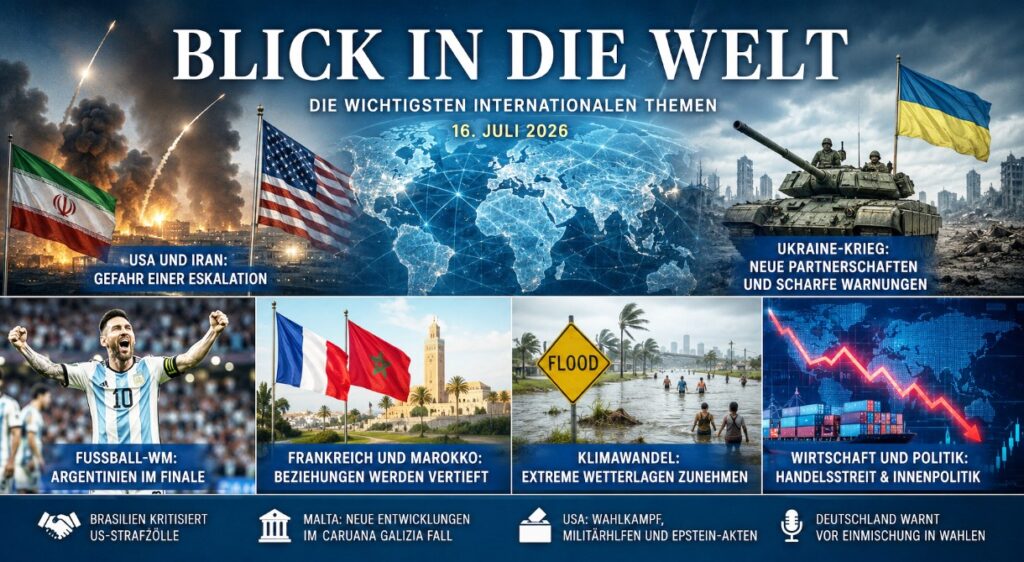
The international news day is dominated by growing geopolitical tensions. Above all, the escalation between the United States and Iran is making headlines and raising fears around the world of further destabilization in the Middle East. At the same time, the war in Ukraine, diplomatic initiatives in North Africa, the effects of climate change, and the FIFA World Cup in the United States remain defining themes of international coverage. The multitude of developments illustrates how closely security, economic, and climate-related challenges have now become interconnected.
Middle East: Escalation between the United States and Iran intensifies
The most dangerous development of the day concerns the conflict between the United States and Iran. Following another wave of US airstrikes on military facilities in southern Iran, Tehran responded with missile and drone attacks on US military bases in Jordan, Bahrain, and Kuwait. Washington announced that it did not rule out further attacks on strategically important infrastructure should Iran fail to change its position and return to the negotiating table.
International observers are increasingly warning of an uncontrollable escalation. Particular attention is focused on the Strait of Hormuz, through which a substantial share of the global oil trade passes. Any disruption to this vital shipping route would have immediate effects on global energy markets and could trigger new economic upheaval. At the same time, there are growing concerns that regional actors could be drawn more deeply into the conflict and that the confrontation could develop into a wider conflagration.
War in Ukraine: Europe deepens military cooperation
Russia’s war of aggression against Ukraine also remains a focus of international coverage. Moscow once again reaffirmed that it considers foreign troops on Ukrainian territory to be legitimate military targets. The statement is seen as a warning to European states that are further expanding their support for Kyiv.
During a visit to the Ukrainian capital, representatives of the European Union and Ukraine signed new agreements on the joint development and production of military drone systems, as well as closer cooperation between their defense industries. The aim is to make the Ukrainian armed forces more independent of external supply chains in the long term while strengthening European defense cooperation.
The agreements underscore the strategic shift in European security policy. Since the beginning of Russia’s war of aggression, cooperation between the EU and Ukraine has steadily deepened. The latest agreements mark another step toward closer security integration.
FIFA World Cup: Argentina reaches the final
Alongside the political crises, the FIFA World Cup in the United States is attracting worldwide attention. Defending champions Argentina secured a place in the final with a 2-1 victory over England.
After falling behind, the team led by Lionel Messi turned the match around in an intense closing phase. Argentina will now face Spain in the final, after Spain prevailed in the second semifinal. England will play France in the third-place match.
The tournament is already among the most watched sporting events of recent years and is also regarded as an important test run for the further international marketing of football on the North American continent.
France and Morocco expand their partnership
The day also saw important diplomatic developments. French Prime Minister Sebastien Lecornu visited Rabat to further deepen relations between France and Morocco. After several years of political tensions, both governments are seeking a lasting normalization of their cooperation.
Talks focused on defense cooperation, migration policy, energy supplies, and major infrastructure projects. In addition, new agreements on the civilian use of nuclear energy and investments in transport and energy projects are intended to strengthen economic ties.
For France, Morocco is of strategic importance as a partner in the western Mediterranean, both in controlling irregular migration and in energy and security policy. The rapprochement is therefore also being closely watched by other European states.
Climate change: Extreme weather conditions are increasing worldwide
Alongside the political crises, the consequences of climate change are once again moving to the center of coverage. Large parts of the United States continue to suffer from an exceptionally intense heat wave, with record temperatures and growing pressure on energy supplies and healthcare systems.
At the same time, heavy rainfall in several West African countries is causing severe flooding. Thousands of people have had to leave their homes, while roads, bridges, and agricultural land have suffered considerable damage.
Climate researchers have pointed out for years that rising global average temperatures increase the likelihood of extreme weather events. While no individual event can be attributed exclusively to climate change, the increasing frequency of such extremes is consistent with the projections of numerous scientific studies.
Other international developments
In addition to the dominant issues, other political and economic developments shaped the international news agenda.
Brazil responded with sharp criticism to newly announced punitive tariffs by the United States and warned of negative consequences for international trade. The tensions highlight the growing trade policy differences between the two largest economies in the Americas.
In the United States itself, domestic political debates over military aid, campaign financing, and the continued examination of the so-called Epstein files set the political agenda. The discussions are gaining additional significance in light of the upcoming elections.
Malta also once again came into the focus of international media. In connection with the murder of investigative journalist Daphne Caruana Galizia, further witness testimony emerged in court, advancing the long-running judicial examination of the case.
Meanwhile, warnings came from Germany to the United States not to interfere in European election campaigns. The remarks reflect the growing sensitivity of European governments to possible external influence on democratic processes.
The international news situation on July 16, 2026, illustrates a world in which geopolitical crises, economic uncertainties, and climate-related challenges are increasingly intertwined. While the escalation between the United States and Iran represents the greatest immediate risk to international security, Europe and Ukraine continue to pursue their strategic cooperation resolutely. At the same time, diplomatic initiatives such as the rapprochement between France and Morocco show that political stabilization remains possible. The FIFA World Cup may provide a rare moment of worldwide attention beyond crises, but overall, the international environment remains characterized by uncertainty, strategic competition, and profound global challenges.