
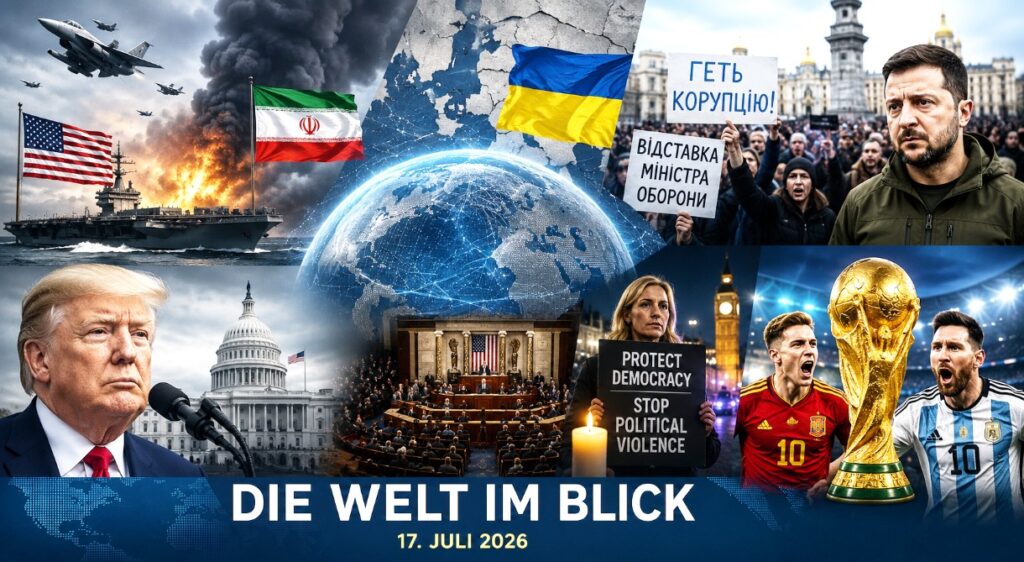
The international news landscape is currently marked by an extraordinary concentration of geopolitical crises and domestic political tensions. At the center is the dangerous escalation of the conflict between the United States and Iran, which could have economic and security consequences far beyond the Middle East. At the same time, political turmoil in Ukraine and the United States is creating uncertainty, while Europe debates the protection of its democratic institutions. Away from the crises, the attention of the global public is turning to the World Cup final, which for a moment brings global attention together.
United States and Iran: The risk of regional escalation is growing
The dominant topic of international coverage remains the military confrontation between the United States and Iran. After several days of mutual attacks, the situation is worsening further. Washington is continuing its airstrikes against Iranian military facilities, while Tehran is threatening retaliatory measures and announcing attacks on American facilities and allied states in the region.
Particular attention is focused on the Strait of Hormuz. A significant share of the world’s traded oil is transported through this waterway. Any restriction on shipping has immediate effects on international energy markets, transport costs and inflation trends in many economies. Governments and financial markets are therefore closely monitoring military developments.
Numerous states are now calling on both sides to avoid further escalation. Diplomatic mediation efforts continue behind the scenes, but so far there are few signs of lasting de-escalation.
Ukraine: Domestic political tensions overshadow the war
Ukraine is also in the focus of the international press. President Volodymyr Zelenskyy is facing unusually sharp criticism following the surprise dismissal of his defense minister. Thousands of people took to the streets in Kyiv, demanding greater transparency in key personnel decisions during the ongoing war against Russia.
At the same time, the domestic political tensions overshadowed the farewell visit of British Prime Minister Keir Starmer. Britain reaffirmed its military and financial support for Ukraine, but the events underscore that even in a country at war, political disputes and questions of trust are gaining importance.
International observers see this as a new phase of the conflict. While Western military support appears fundamentally unwavering, issues of governance, anti-corruption efforts and political stability are increasingly moving to the forefront.
United States: Election campaign and foreign policy intertwine
Meanwhile, domestic political tensions are intensifying in the United States. President Donald Trump is preparing for a landmark televised address, which is expected to address not only the international security situation but also, in particular, issues of election security and the upcoming midterm elections.
At the same time, personnel changes in Congress and increasing polarization between Democrats and Republicans are creating a tense political atmosphere. International commentators point out that foreign policy decisions are increasingly being made with domestic political considerations in mind.
The development illustrates how closely intertwined American domestic and foreign policy have become. Conflicts in the Middle East, the war in Ukraine and strategic competition with China influence domestic political discourse just as much as economic issues or the election campaign.
Europe debates the protection of democratic institutions
In Britain, an intense debate about the safety of politicians is making headlines. Following another fatal attack on a prominent female politician, the increasing coarsening of the political climate is once again being debated.
Experts have warned for years about the growing radicalization of public debate. Hate campaigns on social media, personal intimidation and threats of violence against elected officials have increased significantly in numerous European countries. Women and members of ethnic and religious minorities are particularly affected.
The discussion now extends far beyond Britain. Several European countries are considering stricter security concepts for political events. At the same time, the fundamental question arises of how democratic societies can preserve open political discourse without endangering the safety of their elected representatives.
Football World Cup: The final draws closer
Alongside the political crises, many media outlets are focusing their attention on the Football World Cup in North America. Following the semifinal matches, it is clear that Spain and Argentina will compete for the world title on Sunday. France and England will face each other beforehand in the third-place match.
International sports commentators are primarily analyzing the differing playing philosophies of the two finalists. Spain has impressed throughout the tournament so far with dominant possession and tactical versatility, while Argentina has once again demonstrated its extensive tournament experience and defensive solidity.
The final is already regarded as one of the sporting highlights of the year and is likely to draw hundreds of millions of viewers worldwide to their screens. For a brief time, sport will take center stage in a world otherwise marked by political crises and military conflicts.
July 17, 2026, illustrates how closely geopolitical conflicts, domestic political developments and societal challenges are now interconnected. The escalation between the United States and Iran remains the dominant international issue and carries considerable risks for global security and the world economy. At the same time, developments in Ukraine and the United States show that political stability cannot be taken for granted even within democratic states. The debates about violence against politicians also underscore the growing challenges facing Western democracies. Amid these crises, the Football World Cup serves as a reminder that, despite all tensions, international sporting events can still bring people together across national and political borders.