
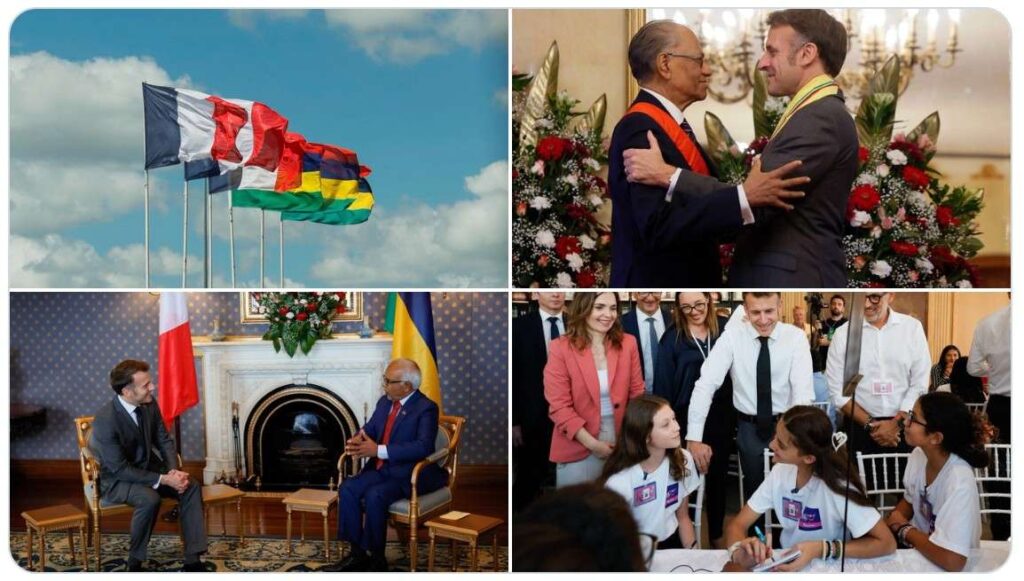
For the first time in over three decades, a French president is visiting the island of Mauritius. It is no coincidence that Emmanuel Macron begins his five-day Africa trip there. The symbolic start marks an attempt to bring France’s Africa policy into a new phase – beyond postcolonial shadows and strategic setbacks, such as those Paris has recently experienced particularly in the Sahel region. The subsequent stops in South Africa, Gabon, and Angola indicate that Macron is aiming for more than bilateral expressions of friendship: It is about global positioning, economic partnerships – and the restoration of lost credibility.
Mauritius: The Indian Ocean as a Geostrategic Window
Mauritius is small, but not insignificant. The Francophone republic is considered a stable, democratic actor in the Indian Ocean – an area that is increasingly coming into geopolitical focus. Not just because of its proximity to global maritime trade routes, but also because of growing Chinese and Indian presence in the region. France, which maintains its own overseas territories in the Indian Ocean with La Réunion and Mayotte, sees Mauritius as a natural partner on issues of maritime security, ecological resilience, and technological development.
Macron spoke in Port Louis with Prime Minister Pravind Jugnauth about food security, artificial intelligence, and energy cooperation. The latter are of particular interest in the context of French ambitions in green hydrogen production and the expansion of sustainable energy partnerships. For Macron, Mauritius also offers a narrative window: The visit signals openness to partnerships beyond the former French colonial axis – a new geography of cooperation that focuses on balance and innovation.
South Africa and the G20 Summit: Stage for French World Politics
A few days after Mauritius, Johannesburg is in the spotlight. There, the G20 summit is taking place on African soil for the first time – a diplomatic milestone for the continent and a deliberate venue for Macron’s African strategy. France wants to position itself here as a bridge builder: between industrialized countries and the Global South, between traditional development aid and modern technology diplomacy.
The meeting with South Africa’s President Cyril Ramaphosa is not merely ceremonial. France has been striving for years to deepen relations with Pretoria – a country that, through its membership in BRICS and its ambivalent foreign policy, plays an important role in the global order structure. Already beforehand, the Élysée emphasized that South Africa is seen as a “strategic partner for multilateral challenges” – from health policy to energy markets and international tax coordination.
At the same time, the South African environment is not free of tensions: economic uncertainty, high unemployment, social protests, and a geopolitical profile that does not always align with Western positions make diplomatic missions demanding. Macron will have to act particularly carefully here in order to present French engagement not as interference, but as an offer on equal footing.
A new Africa strategy? Between demarcation and realignment
The trip fits into Macron’s long-proclaimed intention to definitively close the chapter of “Françafrique” – the often criticized post-colonial entanglement of France with many of its former colonies. Already in speeches in Ouagadougou (2017) or Algiers (2022), Macron emphasized a new partnership logic: no paternalistic narratives, but cooperation based on mutual interests.
But the reality has so far been contradictory. France’s withdrawal from Mali, Burkina Faso, and Niger due to increasing anti-French protests and geopolitical upheavals – not least due to Russia’s influence – has revealed the limits of this strategy. The current tour is now intended to send a counter-signal: France is still a reliable, innovation-oriented partner on the African continent – but no longer in the mode of a dominant protective power, rather as part of an equal network.
The selection of countries – Mauritius, South Africa, Gabon, Angola – underscores this ambition. These are mostly states that are not at the center of France’s colonial past and that have regional significance. Especially Angola and Gabon also offer economic potential, for example in the raw materials sector or in the expansion of renewable energies. Here, Macron’s intention becomes clear to conduct an economic and climate-focused diplomacy that goes beyond security policy interests.
International Dimension: France’s Role in the G20 and EU Context
Participation in the G20 summit is not only an opportunity for bilateral networking – it is also a moment of multilateral positioning. France has been striving for years to promote an African-European partnership in the context of the EU that is not solely based on development aid, but on fair trade relations, technological cooperation, and strategic resilience. Topics such as global minimum taxation, reform of multilateral development banks, or dealing with the consequences of climate change in vulnerable regions are particularly on Macron’s agenda.
In the background, European interests also play a role: the EU is increasingly seeking stable partners in Africa, not least in the context of migration policy and economic diversification. France’s Africa policy is therefore also interpreted as a proxy for European interests – which increases the responsibility for achieving results.
If Macron succeeds in not only presenting new rhetoric on this tour but also initiating concrete projects – for example in the areas of AI, green energy, or education – this could lead to a sustainable long-term course. However, if only symbolic gestures and declarations of intent remain, there is a risk of the impression of routine image maintenance without strategic depth.
In the end, the success of this journey will be measured by whether tangible formats emerge from the announced partnerships – for example through joint economic initiatives, technology transfer programs, or multilateral environmental cooperation. Africa’s young generation – increasingly educated, digitally connected, and economically ambitious – expects more than diplomatic platitudes. Macron faces the task of meeting these expectations without falling back into old patterns.