
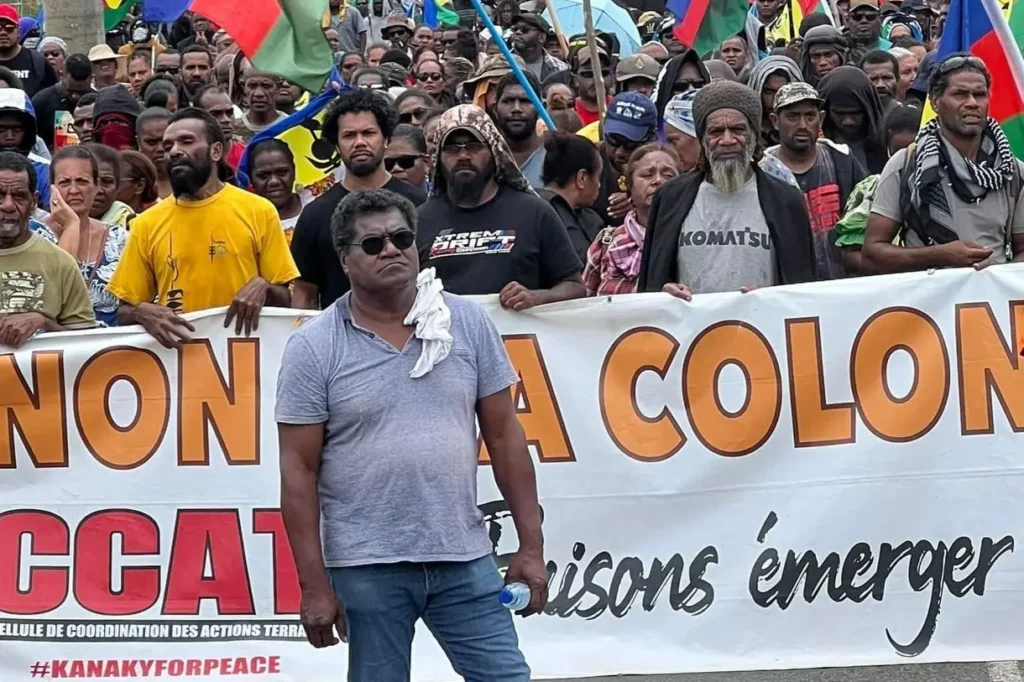
Two years after serious disturbances in New Caledonia, the French judiciary made a decision that goes far beyond an individual legal case. Investigating judges in Paris closed a major proceeding against fourteen Kanak activists, including Christian Tain, one of the most well-known figures of the independence movement. This decision marks a turning point in the legal investigation of the violence of 2024 — and at the same time raises new questions about the relationship between the French state and its Pacific overseas province.
Impressive turn in the case
The investigation against members of the “Cellule de coordination des actions de terrain” (CCAT) was one of the most politically sensitive proceedings in recent years in France. After the violent riots in May 2024, leading representatives of the organization were accused of organizing or at least supporting a coordinated insurgent movement.
The toll of the unrest at that time was terrible. Fourteen people died, numerous government and private buildings were destroyed, and economic damage reached billions. The capital Noumea and its suburbs were particularly affected, where for weeks streets were blocked, there were arson attacks and clashes with law enforcement, paralyzing public life.
That is why the investigative authorities acted very harshly. The charges included organizing a criminal group and aiding and abetting serious violent crimes. For the French government, the stability of this strategically important territorial entity in the Pacific was key.
But now the investigating judges have come to a different conclusion. In their opinion, the evidence provided is insufficient to bring the accused before a criminal or jury court. The judges do not see sufficient grounds to believe that the accused planned or led an armed uprising.
Political Nature of the Movement
The legal reasoning of the decision is especially important. The judges clearly distinguish between a political movement for independence and an attempt to violently overthrow the state order.
Thus, they touch on the central controversial issue of the proceedings. The prosecution claimed that CCAT not only accompanied the riots but actively organized them. The defense, however, has emphasized from the beginning that the movement pursues political goals within the framework of a longstanding struggle for the self-determination of New Caledonia.
The judges seem to have at least partially agreed with this argument. In their view, the case is not about preparing a violent coup d’état, but about the political mobilization of the independence movement. This does not mean that the violence of 2024 is recognized or minimized. Rather, the judges do not see sufficient evidence that the leaders of CCAT consciously directed or ordered the riots.
This is an important legal distinction. Political demands for independence in a democratic society are generally legitimate. Criminal responsibility arises only when there is concrete evidence of planning or organizing serious crimes.
Christian Tein in the spotlight
Particular attention is focused on Christian Tain. The activist became a symbol of the Kanak movement during the crisis. His arrest and subsequent transfer to France caused significant political tensions not only in New Caledonia but also beyond.
For many Kanaks, Tain became an image that, in their opinion, reflects the excessive response of the French state. Opponents of the independence movement viewed him as a key figure responsible for the events of 2024.
Already in 2025, investigating judges expressed doubts about the initial version of the charges. At that time, they decided to release Tain and other activists. In their assessment, there was not enough evidence of organizing or supporting armed gatherings. Public appeals to calm the situation, supposedly coming from Tain, were also taken into account.
So, the current closure of the proceedings is not completely unexpected. It is rather the result of a gradual reassessment of the large volume of case materials.
Justice remains divided
However, it is impossible to speak of a final conclusion. The Paris prosecutor’s office has already appealed this decision, and the respective appellate chamber will review the case again.
The prosecution argues that further investigations are necessary and the case materials have not yet been sufficiently assessed. Considering the scale of the proceedings, this is not an unusual step. The investigation involves thousands of documents, testimonies, and analyses of digital communications.
The appeal proceedings may last for months. Only then will it become clear whether the decision to close the case will remain in effect or whether some charges need to be re-examined.
This legal uncertainty simultaneously reflects the political complexity of the conflict. The events of 2024 were not only a matter of individual responsibility but also an expression of deep social tensions.
New Caledonia between France and Independence
The dispute around CCAT cannot be understood without historical context. New Caledonia has belonged to France since the 19th century and currently has a special status of autonomy. However, the indigenous Kanak population has been fighting for greater autonomy or full independence for decades.
Between 2018 and 2021, several referendums were held regarding the future of the territory. In all votes, the majority voted to remain part of France. However, many independence supporters especially did not recognize the results of the last referendum because it took place during the Covid pandemic and was partially boycotted by the Kanak community.
The 2024 unrest erupted due to a planned reform of the electoral law. Critics believed that it weakens the political influence of the indigenous population. Within a few days, this escalated into the most serious crisis in decades.
Against this background, the judges’ decision carries significant symbolic meaning. For the independence movement, it confirms the longstanding criticism of state accusations. For opponents of the movement, the question remains open as to who bears political responsibility for the violence.
The legal decision, therefore, does not resolve the fundamental conflicts that have characterized New Caledonia for years. It demonstrates how difficult it is to draw the line between political protest, social mobilization, and criminal responsibility in highly polarized conflicts. While the courts determine individual guilt or innocence, the political future of the archipelago remains uncertain. The case of Christian Taine shows that the real challenge for France lies not only in the legal assessment of the events but in finding a sustainable political system for the territory, whose identity remains unresolved.