
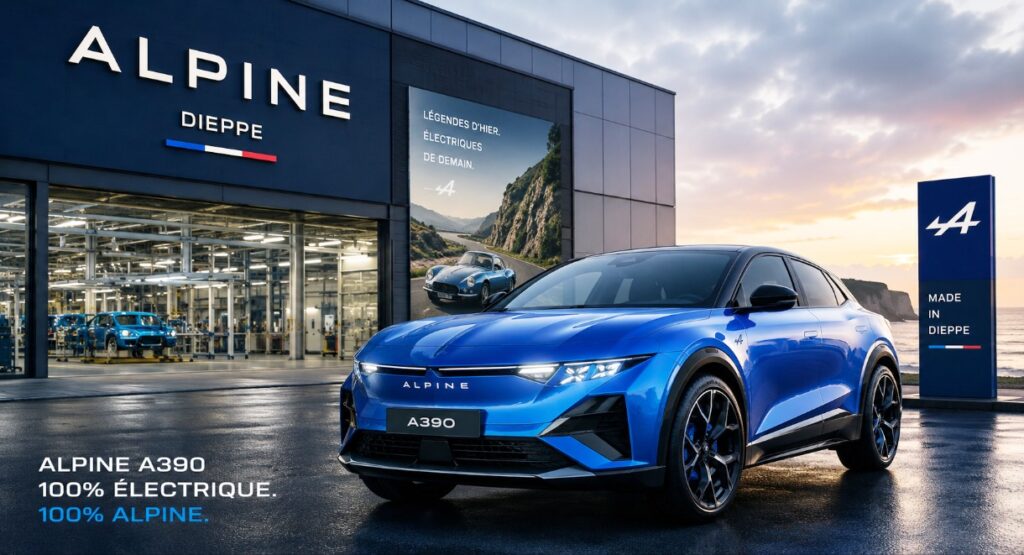
A new era has begun at the historic Alpine factory in Dieppe, Normandy. The deep rumble of combustion engines is a thing of the past. Instead, electric motors, high-voltage batteries and modern testing technology now shape everyday work. For Alpine, this transformation means far more than an ordinary model change. The French sports car brand is opening a new chapter and taking the step into an electric future.
For decades, Alpine stood for lightweight, agile sports cars that impressed not only with engine power. The recipe for success was low weight, precise handling and plenty of driving fun. The legendary A110 in particular made motorsport history and became an icon through its rally successes in the 1970s. The generation relaunched in 2017 also remained true to this concept and thrilled enthusiasts around the world.
However, the end of production of the second A110 generation in June 2026 marked the end of an era. Since its return, 28,701 vehicles had rolled off the line in Dieppe. For many fans, it was an emotional farewell, as the A110 was, for the time being, the last classic sports car with a combustion engine to disappear from the Alpine range.
The future is now called the A390. The all-electric five-door sports fastback targets a significantly broader customer base than the compact A110. Despite its more family-friendly concept, its sporting credentials remain intact. Depending on the version, the new model delivers up to 470 hp and accelerates to 100 km/h in under four seconds. Its range of more than 500 kilometres also makes the vehicle suitable for everyday use.
The most powerful version is driven by three electric motors. One is mounted on the front axle, while two are on the rear axle. By controlling the rear wheels separately, the system distributes power specifically to each wheel. This so-called torque vectoring is intended to ensure that the large fastback moves through corners with surprising agility.
This is precisely where the greatest challenge lies. At more than two tonnes, the A390 weighs almost twice as much as a classic A110. Alpine must now prove that the brand’s famous spirit is not defined solely by lightweight construction. Performance alone hardly impresses anyone today – there are now plenty of fast electric cars. What remains crucial is the driving experience. And that is exactly how the success of the new model will be judged.
The factory in Dieppe also had to undergo fundamental changes. Extensive conversions took place over two years. Production lines were adapted, safety areas for high-voltage technology were established, and employees received intensive training. More than 10,000 hours of training went into preparing for electric mobility.
Nevertheless, Alpine remains true to its distinctive manufacturing philosophy. Vehicles will continue to be produced in comparatively small volumes. Many steps are carried out by small teams, keeping production and quality control closely interconnected. This combination of modern industry and craftsmanship has defined the site for decades.
However, the restart has not been entirely without difficulties. Delays in battery supplies slowed the production ramp-up of the more powerful A390 version. For a manufacturer committed to predominantly French and European value creation, this also highlights the dependence on a still-young battery industry.
Nevertheless, Dieppe remains the heart of the brand. It was here that Jean Rédélé founded Alpine in 1955, laying the foundations for one of France’s best-known sports car brands. The next generation of the A110 is also set to be built at this historic site – all-electric, on a new aluminium platform and with modern 800-volt technology.
Alpine is therefore embarking on an exciting balancing act. The brand wants to win new customers, grow economically and at the same time preserve its sporting identity. The motors may be quieter today, but the passion that has distinguished Alpine for decades need not fall silent.
Author: Andreas M. Brucker