
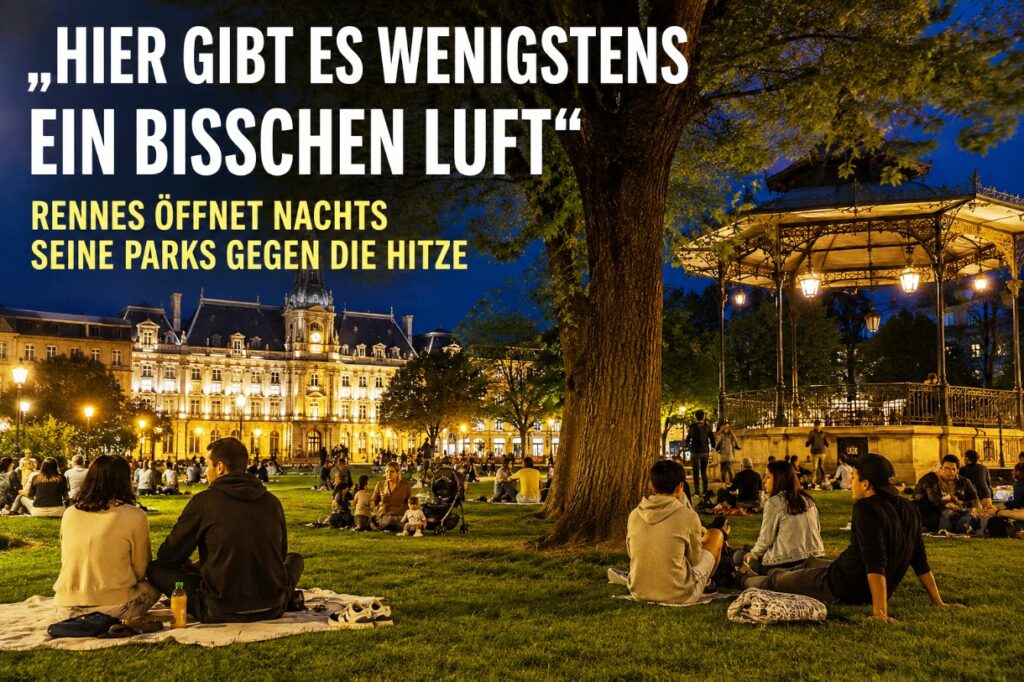
When the sun sets, a second city life begins in present-day Rennes.
During the day the heat makes the streets shimmer, and the facades of the Brittany capital’s buildings warm up almost like a countertop, but at night hundreds of people gather in the parks. Families spread blankets on the grass, young people sit laughing beneath old plane trees, and elderly people enjoy the cool breeze. Some stay past midnight—not because it is romantic, but because being inside their homes is almost unbearable.
Rennes has recorded high temperatures much earlier in the year than usual. Daytime highs reaching 36 degrees, which would normally be expected in midsummer, and tropical nights that hardly cool down cause anxiety for many French people. Especially in Brittany, intense sweating had previously been seen as a problem associated with holidays in the south.
So the city has taken a measure that sounds simple but tells of this new reality: opening parks and public gardens at night.
Tabor Park, which is usually closed at night, is particularly popular. Now people sit on benches and directly on the grass until late at night. “It’s like royalty,” visitors say of the opened green space. Another person calmly described it as, “There’s just a little bit of air here.”
And that is precisely what matters.
Modern cities store heat like a sponge. Asphalt, concrete and dense buildings release heat hours later. People living on upper floors or in attics know the feeling. At night the home becomes as hot as an oven with the door left slightly ajar. You can’t sleep.
Especially the elderly, children, pregnant people and those living alone are prone to ill health in such temperatures. For that reason authorities treat opening parks at night not merely as a nice summer idea but as part of protecting public health.
This is not a Rennes-only issue. In many French cities climate change is affecting daily life. Public water stations, extended hours for swimming pools, misting systems on squares and new shade installations have become standard equipment in heatwave responses across the country. It sounds technical, but it directly affects people’s everyday lives.
And suddenly parks no longer feel like pleasant green spaces between neighborhoods but like life-saving refuges.
That is why the city is expanding a network of places called “fresh islands” — areas with trees, water and plants that effectively lower surrounding temperatures. Walk through Rennes on a hot evening and you can feel the difference after just a few metres. In the valleys of the heated streets, a shaded park feels like a different climate zone.
A few years ago, no one would have believed that at the end of May people in Brittany would be sheltering overnight from the heat in parks. Now this scene has suddenly become part of everyday life.
And honestly, for many French people it is more frightening than any weather app.
Author: C. Hatty