
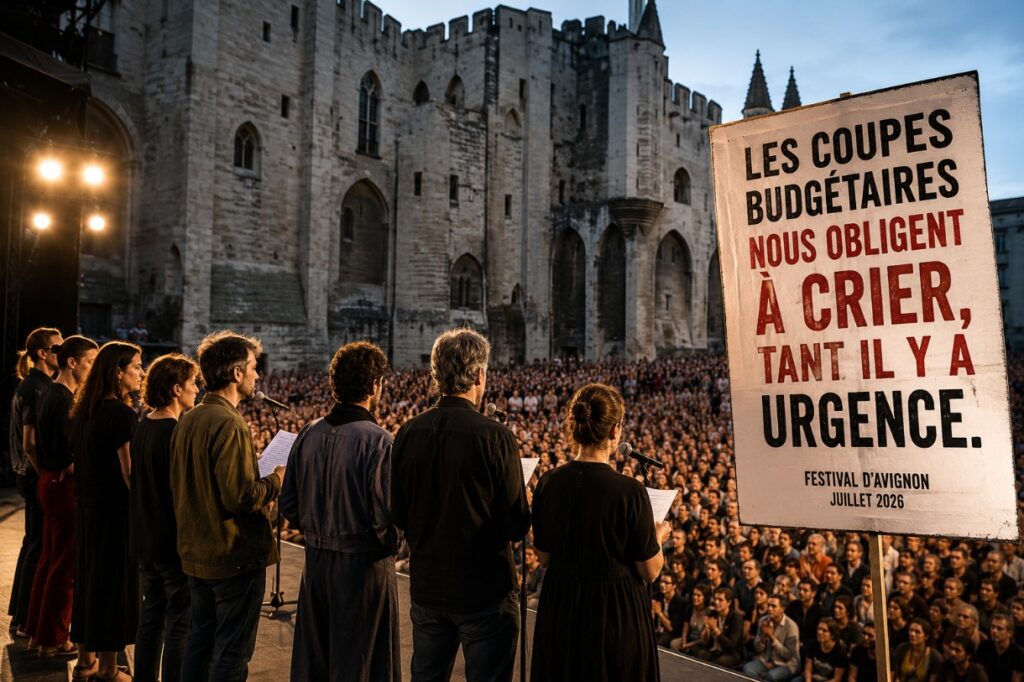
In an urgent appeal, cultural workers at the Festival d’Avignon protested against the French government’s austerity policies. After the final performance of Maldoror in the Cour d’Honneur of the Palais des Papes, nine artists, together with around forty other cultural workers, addressed a public statement directly to President Emmanuel Macron. The action marks a new peak in resistance to cuts in the cultural budget and underscores growing concern about the future of France’s publicly funded cultural sector.
A Symbolic Protest at the Heart of French Theatre
For decades, the Festival d’Avignon has been regarded as the foremost stage for French theatre and a barometer of cultural-policy debates. Accordingly, the protest action, which took place in the presence of festival director Tiago Rodrigues, carried considerable symbolic weight.
The signatories to the statement include directors Julien Gosselin, Rébecca Chaillon, Julie Deliquet and Baptiste Amann, as well as several choreographers and representatives of the performing arts. They accuse the government of placing the cultural sector in existential jeopardy through repeated cuts.
In their statement, they say that the continued cutbacks are forcing the cultural sector to raise its voice because the situation has now become dramatic.
Visible Consequences of Austerity Policies
According to the initiators, the effects of the savings measures are already being felt at numerous institutions. Productions are being cancelled at short notice, seasons shortened and theatres forced to significantly scale back their programmes. At the same time, artistic, technical and administrative teams are coming under increasing financial pressure.
Many venues must reduce their cultural activities or abandon projects altogether. The signatories warn that this will harm not only individual institutions but the entire system of publicly supported cultural funding.
Addressing Emmanuel Macron, they appeal to his historical responsibility. They formulate the final sentence of their open letter particularly forcefully:
“Mr President, the time has come to decide which side of history you want to stand on. Do not be the one who destroys everything.”
Cultural Sector Under Considerable Financial Pressure
The protest comes at a time of growing uncertainty for France’s cultural landscape. After the state initially froze budget funds and subsequently announced further cuts, numerous regions, departments and municipalities also reduced their cultural funding. Since many theatres depend simultaneously on state and municipal subsidies, the cutbacks compound one another.
Industry representatives are now warning of a domino effect. If funding is not secured swiftly, closures of venues, the cancellation of already planned productions and short-time work for numerous employees could follow.
The Ministry of Culture recently indicated that part of the frozen funds might be released again. However, a final decision depends on the ongoing budget negotiations with the Ministry of Finance.
Debate Over Further Forms of Protest
Within the cultural sector, an expansion of the protests is now being openly discussed. Several festival participants said that a nationwide protest, or even a strike by the cultural sector, is increasingly being considered as a possible option.
The CGT-Spectacle union supports such considerations. At the same time, various theatre leaders advocate embedding potential protest actions in a broader campaign for public services in order to win wider public support.
This would make the debate over cultural funding part of the wider confrontation over state austerity policies, which currently affect numerous public sectors in France.
The approximately 2,000 spectators in the Cour d’Honneur of the Palais des Papes listened to the statement being read in complete silence. Only after the final sentence did applause break out, lasting several minutes. The scene made clear that the conflict over cultural funding has long extended beyond individual budget figures. For many artists, the question is what role the state intends to assume in the future for theatre, dance, music and other publicly funded art forms. The Avignon protest could thus become the starting point for a broader cultural-policy confrontation extending far beyond the historic festival.
C. Hatty