
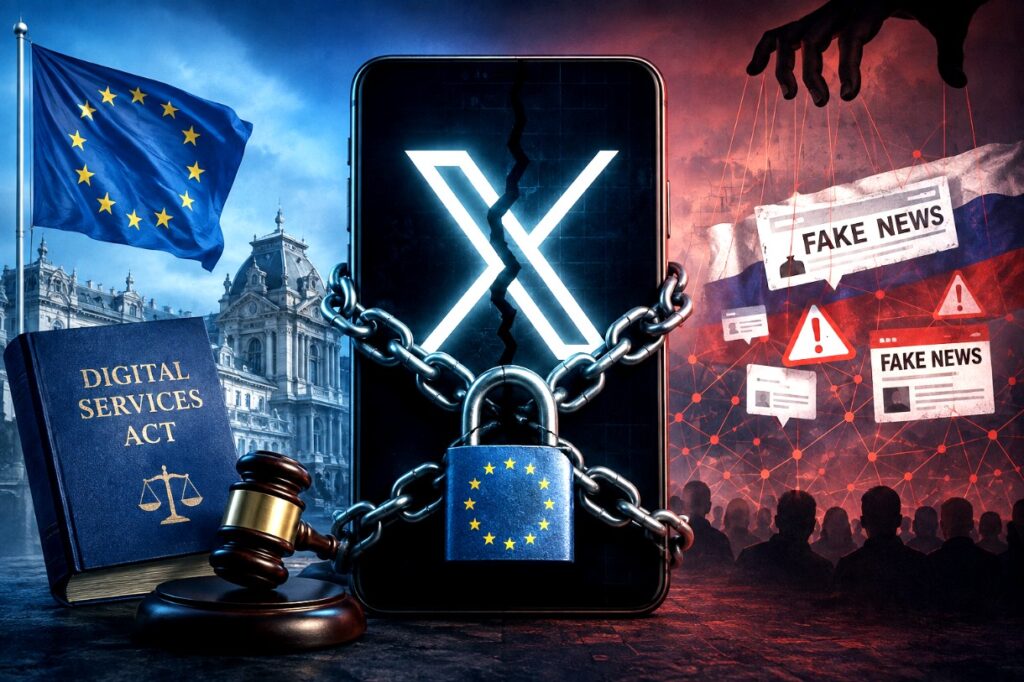
The demand was long considered a fringe position. It has now become part of the political debate. In light of growing evidence of foreign influence operations, coordinated disinformation campaigns, and Elon Musk’s increasingly political role, the question is being asked with increasing frequency whether the platform X should be banned in France – or even in the European Union. What would have been considered excessive only a few years ago now appears to some as a resolute response to a new form of hybrid threat.
Yet precisely in times of increasing geopolitical tensions, liberal democracies must carefully distinguish between necessary resilience and the self-restraint required by the rule of law. For the crucial question is not whether X is a problem. Rather, it is whether a ban would actually be the appropriate response.
A Platform Becomes a Geopolitical Actor
Since its takeover by Elon Musk, X has changed profoundly. The drastic reduction in content moderation, the reinstatement of previously suspended user accounts, changes to recommendation algorithms, and the owner’s repeated political statements have taken the platform far beyond its original function as a social network.
At the same time, European authorities are increasingly examining whether X is complying with the obligations of the Digital Services Act (DSA). The focus is on allegations of insufficient transparency, inadequate risk assessment, and possible algorithmic mechanisms that could encourage the spread of manipulative content.
This debate has long ceased to be limited to France. For years, the European Parliament has warned of systematic influence operations by authoritarian states that use social networks to promote political polarization, influence elections, or undermine trust in democratic institutions. Digital platforms have thus become part of a security infrastructure whose stability now appears just as relevant as the protection of critical networks or financial systems.
The Logic of the Supporters
The arguments of those calling for a ban on X appear compelling at first glance.
If a company persistently disregards European rules, evades regulatory requirements, or becomes an instrument of foreign influence, why should it continue to be granted unrestricted access to the European single market? After all, the European Union does not accept the permanent disregard of its legal order in other areas either.
Supporters also point out that democratic states have, in exceptional cases, already temporarily blocked platforms when court decisions were systematically ignored. From this perspective, a ban would not suppress particular opinions, but ensure the enforcement of rule-of-law standards against a private actor.
This position carries particular weight against the backdrop of hybrid conflicts. Information spaces have long become part of geopolitical confrontations. Those who leave them entirely to the market or to the decisions of individual platform operators risk gradually surrendering state sovereignty.
The Limits of a Ban
However understandable these considerations may seem, significant objections remain.
The first concerns the core of liberal democracies: freedom of expression. A complete ban on a communications platform constitutes a profound intervention in public discourse. European legal systems have traditionally taken a different approach. The focus of state action is not the medium itself, but specific legal violations. Transparency obligations, removal orders, fines, and court-imposed requirements are regarded as more proportionate instruments than the blanket shutdown of a digital forum.
There is also a practical problem. Disinformation does not disappear when a single platform is shut down. Users move to alternative networks – whether Telegram, TikTok, Reddit, Discord, or future services with the same structural weaknesses. The real problem does not lie with one platform, but in a digital ecosystem whose dynamics can escape state control only to a limited extent.
Finally, a ban would create a precedent whose long-term consequences must be carefully considered. Who will decide in the future when a platform is deemed sufficiently dangerous? What criteria will apply? And what safeguards will prevent political abuse? Democracies differ from authoritarian systems precisely in that state interventions remain clearly limited and subject to judicial review.
Europe’s Response: Regulation Instead of a Culture of Bans
With the Digital Services Act, the European Union has deliberately chosen a different path. Rather than hastily excluding platforms, it requires particularly large providers to ensure extensive transparency, conduct independent risk analyses, and cooperate closely with supervisory authorities.
The possible sanctions are substantial. Repeated violations can result in significant fines. In particularly serious cases, the European legal framework even provides for the possibility of a temporary suspension of a service. What matters, however, is the difference from the political demand for a blanket ban: a suspension takes place only through due legal process, under judicial oversight, and as a measure of last resort.
This distinction is of fundamental importance. The rule of law has forceful instruments – but uses them only under clearly defined conditions. It does not replace political outrage with blanket bans, but with procedures that can be reviewed.
The Real Challenge Runs Deeper
The debate over X sometimes obscures the real problem. It is not Elon Musk alone who presents Europe’s democracies with new challenges, but the fundamental transformation of the digital information order.
Foreign influence campaigns today operate with automated bot networks, professionally organized disinformation structures, paid influencers, and increasingly with generative artificial intelligence. Texts, images, and videos can be produced and distributed at speeds and levels of quality previously unknown. The costs of targeted manipulation are falling, while its reach continues to grow.
This is changing the understanding of state security. Where borders, energy supplies, or financial systems once had to be protected, the public information space is now increasingly moving to the forefront. Defending democratic societies has long involved more than military capabilities or economic resilience. It also requires robust institutions, transparent digital infrastructures, and a high degree of media literacy.
A ban on individual platforms would do little to change this structural development. At most, it could address symptoms, but not their causes.
Europe’s real test, therefore, is not to ban a platform, but to enforce its own rules consistently – regardless of how powerful or influential a company may be. The rule of law demonstrates its strength not through spectacular symbolic politics, but through the reliable application of existing law. This is precisely where its greatest resilience against authoritarian attempts at influence lies.
Andreas M. Brucker