
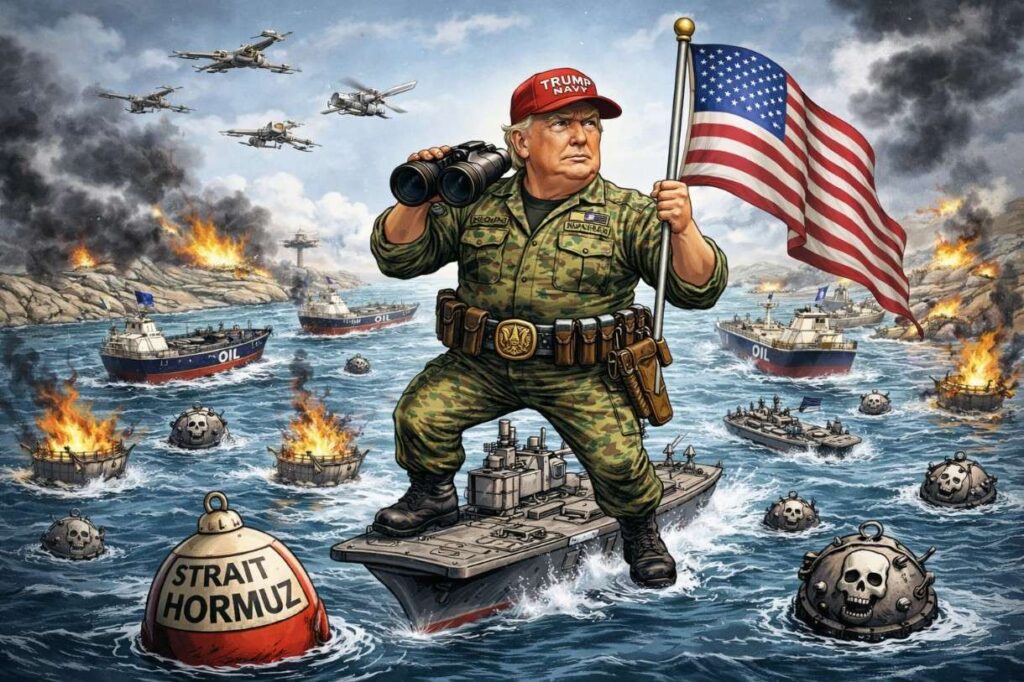
After months of military tensions, the United States and Iran have apparently taken an important diplomatic step. Both sides confirmed the signing of a Memorandum of Understanding (MOU) that aims to end immediate hostilities and pave the way for further negotiations on the Iranian nuclear program. Nevertheless, caution is advised: the document does not constitute a final treaty but a political framework whose concrete implementation still needs to be negotiated.
What Is Considered Certain
End of Hostilities and Reopening of the Strait of Hormuz
A central part of the memorandum is the gradual reopening of the Strait of Hormuz to international shipping. The strait is one of the world’s most strategically important trade routes as a significant portion of global oil exports passes through it. Normalizing the situation could therefore have immediate effects on energy markets and the global economy.
Iran’s Commitment to Renounce Nuclear Weapons
Within the framework of the agreement, Tehran once again affirms its refusal to develop or acquire nuclear weapons. The Islamic Republic has officially held this position for decades. However, the new aspect is the attempt to embed this commitment within a verifiable diplomatic framework designed to meet Washington’s demands for transparency.
Temporary Halt to Nuclear Activities
Several consistent reports indicate that Iran will not carry out additional uranium enrichment or expand its nuclear capacities during the negotiation phase. This is intended to prevent new facts on the ground that could complicate the negotiations.
Negotiation Window of 60 Days
The memorandum itself does not resolve the open disputes. Rather, it opens approximately a two-month period during which both sides will negotiate a more comprehensive agreement. Central to this are future enrichment limits, the handling of existing uranium stocks, international controls, and the future of economic sanctions.
The Key Disputes Remain Unresolved
The Stockpile of Highly Enriched Uranium
One of the most sensitive issues remains the question of existing material. Estimates suggest that Iran possesses significant quantities of uranium enriched up to 60 percent. Technically, this level is significantly above concentrations typically used for civilian purposes and relatively close to weapons-grade material.
Several options are being discussed: diluting the material, transferring it abroad, or storing it under international supervision. The chosen solution will likely be crucial to the success of the talks.
Scope and Depth of International Controls
The question of inspections is similarly contentious. The United States is pressing for extensive control rights by the International Atomic Energy Agency (IAEA). For Tehran, this raises issues of national sovereignty and security. The exact design of future monitoring mechanisms will likely be among the most difficult points in the negotiations.
The Future of Sanctions
There is also no final agreement on sanctions so far. Reports from Iranian government circles mention time-limited exceptions for oil exports and the release of frozen assets as topics under discussion. A broad lifting of US sanctions would probably only be considered after a definitive agreement is reached.
Topics Temporarily Excluded
Notably, two of the most contentious issues in the Middle East apparently do not belong to the immediate negotiation agenda: Iran’s missile program and support for regional militias and partner organizations.
These issues were major contributors to the failure of previous rapprochement attempts in recent years. Critics in the US, Israel, and several European countries argue that an agreement excluding these topics leaves important security questions unanswered.
Reminders of the 2015 Nuclear Agreement
The current memorandum shows structural parallels to the path that once led to the Joint Comprehensive Plan of Action (JCPOA) in 2015. Back then, confidence-building measures were initially agreed upon before detailed regulations were developed.
However, the starting situation today is fundamentally different. The Iranian nuclear program is much more advanced than it was ten years ago. Meanwhile, regional conflicts, geopolitical rivalries, and deeper mutual mistrust have significantly complicated the negotiation landscape.
Nevertheless, the agreement shows that both sides currently share an interest in avoiding further military escalation. Whether this actually leads to a lasting agreement depends on the coming weeks. The crucial questions — handling highly enriched uranium, monitoring mechanisms, and the gradual lifting of sanctions — remain unresolved. Thus, the memorandum marks less an end to the conflict and more the beginning of a new diplomatic phase.
Author: P. Tiko