
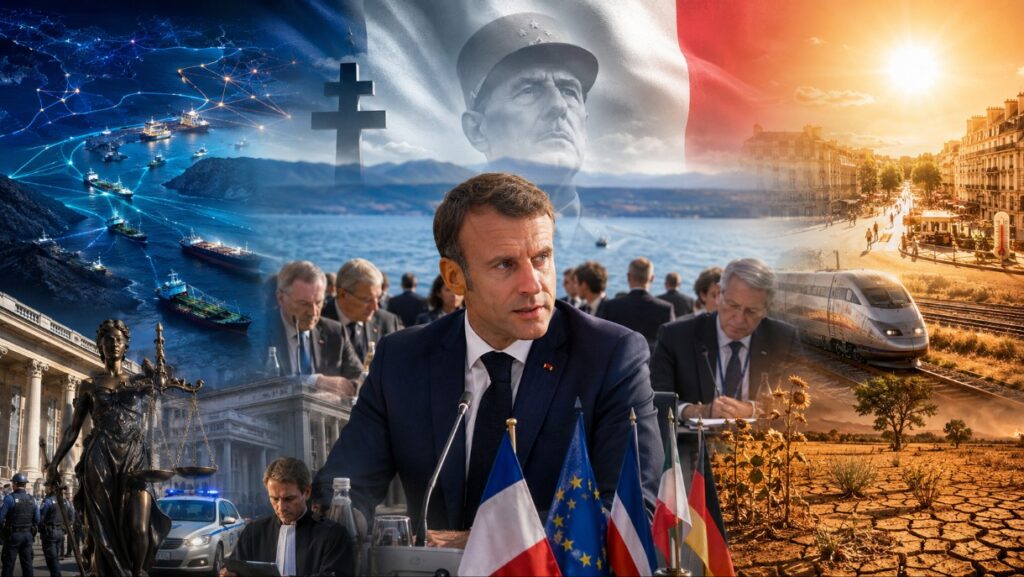
France is experiencing a news day this Friday that highlights the range of political and social challenges. While President Emmanuel Macron records a diplomatic success on the international stage, the population is simultaneously concerned with the consequences of an exceptional heatwave, a shocking criminal case in the south of the country, and questions of national memory culture. The topics dominating French media today reflect a country grappling with global power shifts as well as very concrete domestic political problems.
Macron Benefits from the G7 Summit in Évian
The G7 summit in Évian, which ended the previous day, remains at the center of political reporting. President Emmanuel Macron is seen by many observers as one of the political winners of the meeting.
Particularly noteworthy is the rapprochement between the United States and European partners on several key foreign policy issues. Washington’s willingness to continue support for Ukraine is being closely observed in France. Equally, the diplomatic initiative towards Iran is sparking intense discussions.
For Macron, this development comes at a favorable time. Since the start of his second term, he has been trying to position France as an independent European leadership power. The diplomatic efforts of recent years—from mediation attempts in the Ukraine war to debates about European strategic autonomy—receive renewed attention through the latest developments.
Commentators, however, point out that diplomatic successes are often fragile. Whether the understandings reached during the summit will lead to long-term political outcomes remains to be seen in the coming months. Nevertheless, the summit is already considered an important signal of France’s international influence.
The Iran Agreement and Hopes for Stability
Hardly any foreign policy topic is currently debated more intensely than the new framework agreement between the USA and Iran. Many French media interpret the agreement as a possible turning point for stability in the Middle East.
The Strait of Hormuz is particularly in focus. This narrow sea passage between Iran and Oman is one of the world’s most important energy and trade routes. A significant portion of global crude oil and natural gas exports passes through this strategic corridor. Any easing of tensions there directly affects international energy markets.
French economic experts see the potential restoration of more stable trade conditions as an opportunity for lower energy prices and reduced geopolitical risks. After several years of global crises—from the pandemic to the Ukraine war to conflicts in the Middle East—there is growing hope for a phase of greater economic predictability.
At the same time, skepticism remains warranted. Many details of the agreement are not yet publicly known. Critics warn against considering the agreement as a definitive breakthrough. The history of relations between Washington and Tehran shows how quickly diplomatic advances can stall again.
France Under the Strain of Extreme Heat
While international politics dominates the headlines, many French people are experiencing the immediate effects of a new heatwave. In numerous regions, temperatures well above 35 degrees Celsius are expected.
Schools, hospitals, and transport companies are particularly affected. The state railway company SNCF has already preemptively canceled numerous Intercités connections to avoid technical failures. High temperatures place a considerable strain on air conditioning systems, power supply, and rail infrastructure.
Agriculture is also watching the weather developments with concern. After several years of recurring heat periods, uncertainty about the long-term effects on crop yields and water reserves is growing. Regions in the south of the country have already been under considerable pressure from drought for years.
The debate now goes beyond short-term weather phenomena. Increasingly, questions are being raised about whether France needs to fundamentally adapt its infrastructure to a changed climate. Discussions include altered school calendars, more heat-resistant public buildings, new standards in the transport sector, and investments in water management and urban planning.
The current heatwave thus intensifies a political discussion that is likely to gain further importance in the coming years.
A Crime Shakes the Nation
Besides the major political and economic issues, a criminal case deeply concerns the French public. The murder of an 86-year-old woman near Le Grau-du-Roi has sparked nationwide shock.
Many observers find the suspect’s age particularly shocking. According to initial investigations, a 15-year-old minor has confessed to the act. The brutality of the crime and the early details that have emerged have triggered an intense social debate.
Many commentaries focus on issues of youth violence, mental health, and social prevention. Experts caution against hasty conclusions. Individual violent acts are rarely attributable to simple causes.
Nevertheless, the case touches a sensitive nerve in French society. Concerns about increasing youth propensity for violence have been regularly discussed domestic political topics for years. The Le Grau-du-Roi crime lends new urgency to this debate.
At the same time, the public reaction shows how strongly acts against elderly and especially vulnerable people shape social perception. The case is likely to remain the subject of political and media discussions for some time.
The Remembrance of June 18, 1940
One day after the official commemorative events, the historical memory remains present. The June 18, 1940 Appeal, in which General Charles de Gaulle called from London exile for resistance against the German occupation, is one of the founding myths of the modern French Republic.
Many media use the anniversary for historical retrospectives and political contextualization. This is not only about the past but also about the question of the significance today of concepts such as resistance, responsibility, and civic courage.
In a time of geopolitical tensions, growing social polarization, and increasing uncertainty, historical remembrance gains new relevance. De Gaulle is seen less as a historical figure and more as a symbol of political steadfastness and national independence.
The debate shows that history continues to play an important role in France’s political self-understanding. Memory culture is not limited to commemorative ceremonies but is part of current societal debates.
France is thus experiencing a day where global developments and national challenges overlap in a remarkable way. The diplomatic successes of the G7 summit and hopes for easing tensions in the Middle East point to the country’s role in a changing world order. At the same time, the heatwave and the murder case of Le Grau-du-Roi show how strongly domestic political and social issues shape everyday life.
The topics of the day illustrate a dual reality: France looks outward to major geopolitical conflicts and inward to the challenges of a society in transition. This very connection of international responsibility and national self-questioning shapes the country’s political debate in the summer of 2026.