
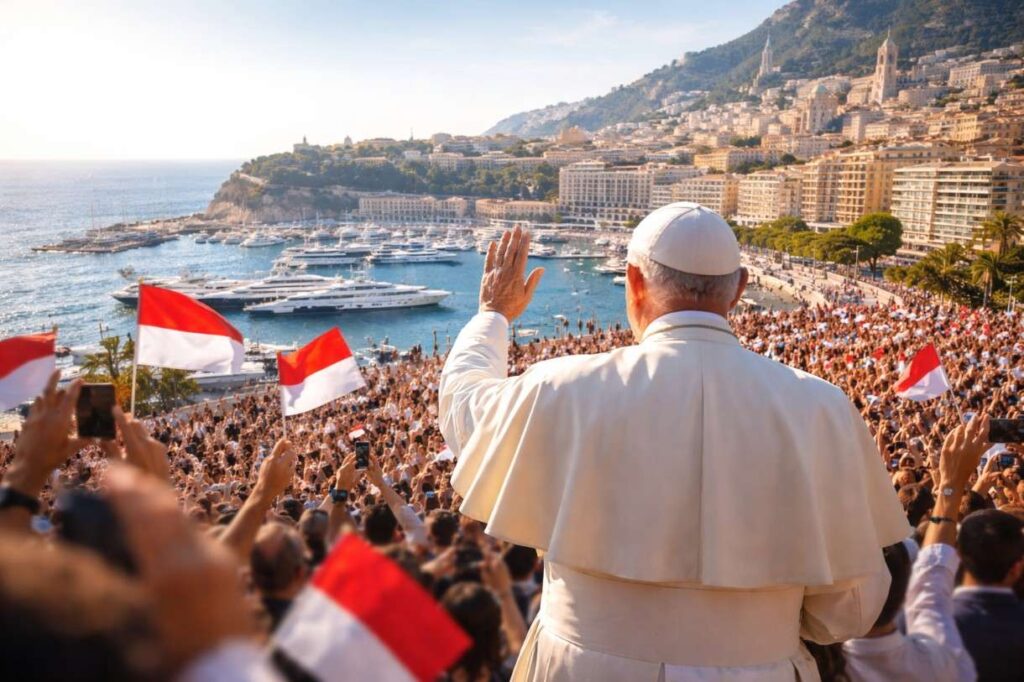
The news hit like a small lightning bolt in the clear Mediterranean sky.
A pope, newly in office, chooses Monaco as an early travel destination. Not for a crisis region, not for a forgotten area, but for a place that smells of champagne, fast cars, and discreet management of millions. Sounds strange at first, doesn’t it?
And yet.
The longer you think about it, the more this puzzle starts to form a pretty clear picture.
Monaco is more than what postcards show.
Of course, there are the yachts, polished to the max. There is the famous casino, glowing at night like a promise. And of course, the Grand Prix, where engines scream as if there were no tomorrow.
But beneath this shiny surface, something else pulses.
Something quieter. Deeper.
Almost underestimated.
The Catholic tradition in Monaco is firmly rooted – like an old olive tree whose roots are not easily uprooted. The cathedral, the Grimaldi family, religious festivals that are not merely folklore but remain part of the identity.
It doesn’t make noise.
More like a quiet background noise.
But precisely this noise carries weight.
And then suddenly there stands this pope.
Right in the middle.
Between tailored suit and mass vestment.
An image that lingers.
So why Monaco?
Why not where poverty is visible on the streets?
Why not where help seems more urgent?
Is this a break with the line of his predecessors – or just another way of telling the same story?
Maybe it’s not about either-or at all.
Maybe it’s about both-and.
Because those who only speak at the margins don’t automatically reach the center.
And those who avoid the center leave it to others.
That sounds almost trivial – but it is not.
Monaco stands like a symbol for a world where money is not only present but concentrated. Here, people meet who make decisions. Investors, entrepreneurs, power brokers behind the scenes.
In short: people who have influence.
And influence is its own currency.
When a pope goes exactly there, it’s no coincidence.
That is a statement.
Without many words.
Simply through presence.
You could say: He doesn’t knock on the door of the poor – he already knows them well. This time he rings at those who rarely receive visitors.
And asks questions that could seem uncomfortable.
Not loudly.
But noticeably.
How much responsibility does wealth carry?
Not phrased as a moral finger-wagging, but rather like a mirror.
What happens when someone suddenly looks into that mirror?
Maybe nothing at all.
Maybe everything.
Catholic social teaching has existed for a long time. It talks about justice, solidarity, responsibility towards the community.
At first, it sounds like a chapter from an old book.
But suddenly this book stands right in the middle of Monaco.
Among luxury cars.
Between glass facades.
And it no longer seems so abstract.
This is the moment when theory meets reality.
And that seems to be intentional.
Of course, diplomacy also plays a role.
The relationship between Monaco and the Vatican goes back a long way. Microstate meets world church – and both understand each other better than you might think at first glance.
There is protocol, tradition, mutual recognition.
All neatly packaged.
But this visit feels different.
Less like routine.
More like a deliberately set accent.
Somewhat like someone suddenly introducing a new topic into a familiar conversation.
Not disruptive.
But surprising.
And surprise creates attention.
Anyone who wants to reach the public nowadays knows that.
Monaco is a perfect resonance chamber.
What happens there rarely stays there.
Cameras are never far away.
Comments follow quickly.
And suddenly the world is discussing a trip that at first glance might seem quite unspectacular.
Smart, isn’t it?
A pope between luxury and morality – that is a contrast that almost automatically makes headlines.
And precisely this contrast carries the message further.
All without a marketing department.
But of course criticism also lurks.
It comes faster than you can say “aperitif.”
“Why is he going to the rich?”
“Why not to the needy?”
“Is the church losing its focus?”
Questions that seem justified.
And that cannot simply be brushed aside.
But maybe that is precisely where the real tension lies.
Because the church has always stood between two poles.
On one side, the poor.
On the other side, the powerful.
And somewhere in between, it tries to keep its voice.
Not an easy task.
More like a balancing act on a thin rope.
Without a safety net.
This visit shows exactly this balancing act.
Not as theory.
But in real time.
Monaco thereby becomes a kind of stage.
Not for a spectacle, but for a quiet confrontation.
Between conscience and comfort.
Between responsibility and convenience.
And perhaps also between self-image and reality.
One must not forget: wealth does not exclude questions.
On the contrary.
It creates new ones.
What does it mean to own a lot?
What does it mean to be able to decide a lot?
And what happens if both are ignored?
The pope does not bring these questions as an accusation.
More like an invitation to conversation.
And that is where a certain subtlety lies.
Because whoever feels attacked shuts down.
Whoever feels addressed might listen.
Small difference.
Big impact.
It’s a bit like a good conversation among friends.
You don’t lecture each other.
You nudge each other.
“Hey, have you ever thought about that?”
Something like that.
And suddenly space arises.
For doubt.
For reflection.
Perhaps even for change.
Does it work?
Well.
That is the big question.
Does a visit change the world?
Hardly.
But it can provide food for thought.
And sometimes that’s exactly enough to get something rolling.
Like a small stone that starts to wobble at the top of a hill.
At first, nothing happens.
Then a little.
And eventually more moves than one would have expected.
Maybe Monaco is exactly such a hill.
A place where many things appear stable.
But are not immobile.
The Pope does not use this place to shine.
But to make contrasts visible.
And contrasts have an effect.
Always.
Because they force you to look.
A Pope in the slum?
Expected.
A Pope in Monaco?
Debatable.
And that’s exactly what makes the difference.
Sometimes it takes a change of perspective to break through entrenched thought patterns.
And honestly:
When was the last time a papal visit provided so much material for discussion?
Exactly.
The Church faces challenges.
That is no secret.
Questions of trust, loss of significance, social change.
All topics that weigh heavily.
It is no longer enough to follow only familiar paths.
You have to enter new paths.
Even if they seem unusual.
Perhaps especially then.
Monaco is such a path.
Not obviously sensible.
But on closer inspection, quite thoughtful.
It’s not about forgetting the poor.
It’s about not shutting out the rich.
Because both belong to the same world.
Whether you want to or not.
And perhaps that is exactly the real message of this journey.
That responsibility is not a question of balance sheet.
But a question of attitude.
Sounds simple.
But it is not.
Because attitude is not shown in words.
But in actions.
And that is exactly what this visit aims at.
Not for applause.
Not for quick results.
But for a process.
Slow.
Quiet.
But with potential.
You could say: an experiment.
An attempt to open new spaces.
Will it succeed?
That remains open.
But one thing is certain:
This approach is not boring.
And maybe exactly that is needed.
A little courage.
A little irritation.
And the willingness to also go where you are not immediately understood.
Because change rarely begins where everything is comfortable.
But exactly where it starts to grind.
And Monaco?
Suddenly no longer seems so far-fetched.
But quite logical.
If you look closely.
An article by M. Legrand