
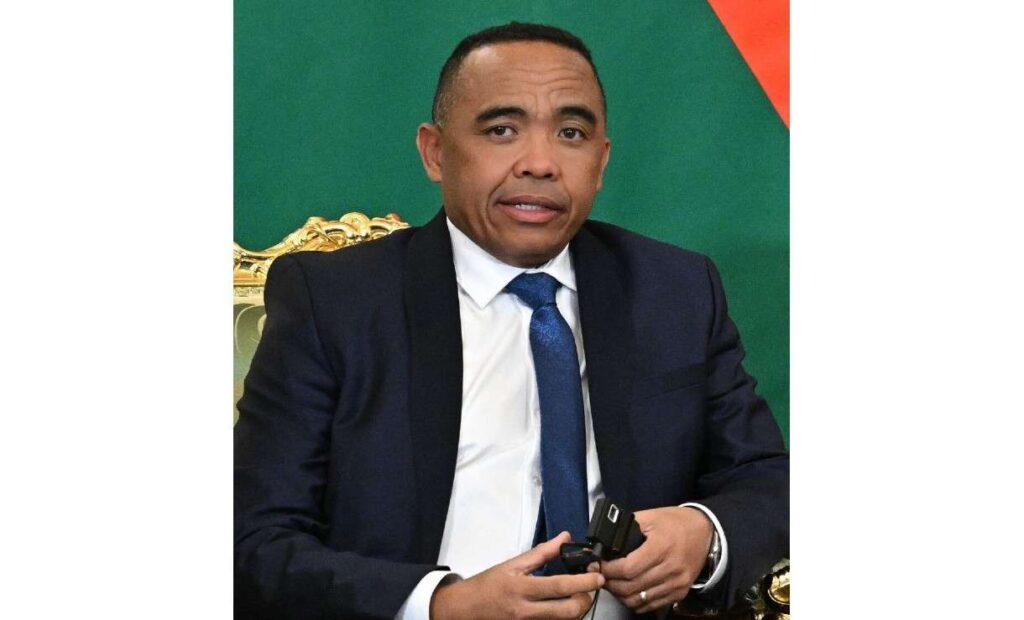
When French President Emmanuel Macron welcomes the new strongman from Antananarivo to the Élysée Palace on 24 February, it is about far more than a diplomatic working lunch. Colonel Michaël Randrianirina’s visit marks a sensitive phase in relations between France and Madagascar — politically, historically and geopolitically.
The meeting is Randrianirina’s first official visit to Paris since he seized power in October 2025. It comes after an abrupt political upheaval that shook the fragile order of the island state and was closely watched in France. For Macron the appointment is a diplomatic tightrope: he must uphold democratic principles without losing sight of strategic interests.
A change of power under pressure from the streets
Randrianirina’s rise to the head of state is inseparable from the massive protests of young Malagasy in the autumn of 2025. Weeks of demonstrations against corruption, economic hopelessness and political stagnation culminated in a military-backed change of power. The then president Andry Rajoelina left the country under dramatic circumstances.
Randrianirina, formerly a colonel in the armed forces, was subsequently confirmed as transitional president by constitutional institutions. He proclaimed a “Refondation de la République” — a political reorganization that foresees reforms, institutional consolidation, and, in the medium term, new elections. A concrete timetable has not yet been established. This is precisely the crux: the international community is demanding reliable assurances for a return to a transparent, democratic process.
Madagascar is not an unknown quantity when it comes to political instability. Since independence from France in 1960, the country has repeatedly experienced changes of power involving the military. Political cycles of reform promises and disillusionment have shaped recent decades. For the young population — around two thirds of Malagasy are under 25 years old — social issues are paramount: jobs, education, prospects.
France’s delicate role
For Paris, resuming a visible political dialogue with the new leadership in Antananarivo is a balancing act. France maintains close historical, cultural, and economic ties to Madagascar. French is an official language, thousands of Malagasy study or work in France, and French companies are present in key sectors such as energy, telecommunications, and infrastructure.
At the same time, the colonial legacy is not forgotten. From 1896 to 1960 Madagascar was a French colony. Even today unresolved questions – for example about the Îles Éparses in the Indian Ocean – regularly cause diplomatic tensions. Every political move between Paris and Antananarivo is therefore also interpreted in light of historical sensitivities.
Macron is also influenced by a changed African reality. In several West and Central African states French influence has been massively pushed back in recent years. Military cooperations were ended, French troops withdrawn, and anti-French sentiments gained momentum. Against this background, Madagascar is for Paris not only a bilateral partner but part of a larger strategic equation.
Geopolitical competition in the Indian Ocean
The geopolitical dimension of the meeting is amplified by the growing competition from external actors. The Indian Ocean is seen as a strategic hub of global trade routes. In addition to traditional actors such as India or China, Russia is also increasingly seeking influence in the region.
Randrianirina had visited Moscow shortly before his trip to Paris. Such signals are closely noted in European capitals. France has direct territorial presence in the Indian Ocean through its overseas territories – for example La Réunion and Mayotte. Stability in Madagascar is therefore not only a matter of development-policy responsibility, but also of security-policy calculation.
In Paris it is therefore likely to be about showing the new leadership alternatives to exclusive partnerships with competing powers. Cooperation in infrastructure, energy supply or disaster control can offer concrete incentives. At the same time, France wants to avoid being perceived as a supporter of a potentially permanently militarized regime.
Economic and social challenges
Despite considerable mineral resources – including nickel, cobalt and graphite – Madagascar is among the poorest countries in the world. A significant portion of the population lives below the international poverty line. In addition, there are structural deficits in administration, justice and public infrastructure.
Natural disasters regularly worsen the situation. Cyclones and floods have devastated wide areas in recent years, destroyed harvests and brought hundreds of thousands of people into need. Climate change further increases the intensity of such extreme events.
Against this backdrop, the working lunch at the Élysée is likely to cover several concrete topics: support for reconstruction after natural disasters, investments in sustainable energy, training programs for young people, and institutional advice in the context of the political transition. France could act here as a bridge to European and multilateral financing instruments.
Democratic principles versus realpolitik
For Macron the meeting is not only relevant in terms of foreign policy but also domestically. France traditionally sees itself as a defender of democratic values. A too-rapid normalization with a leadership that emerged from a military-shaped change of power carries reputational risks.
At the same time, the practice of international politics shows that isolation rarely contributes to stabilization. A controlled dialogue, coupled with clear expectations regarding reforms and election preparations, can secure influence without granting formal recognition uncritically. Crucial will be whether Randrianirina sends credible signals for an inclusive political opening— for example by involving civil society or through transparent timelines for elections.
Macron has emphasized in the past that France does not want to patronize Africa but to act in partnership. Whether this guiding principle applies in the case of Madagascar depends largely on how clearly Paris demands democratic minimum standards—and how seriously Antananarivo takes these expectations.
The meeting at the Élysée Palace is therefore more than a protocol appointment. It exemplifies the readjustment of French Africa policy in an environment of growing geopolitical competition and increasing skepticism toward former colonial powers. For Madagascar it offers the chance to mobilize international support for an economically and politically fragile transitional period. For France it is a test of whether normative claims and strategic interests can be reconciled — in a world where influence is no longer a given but must be renegotiated again and again.