
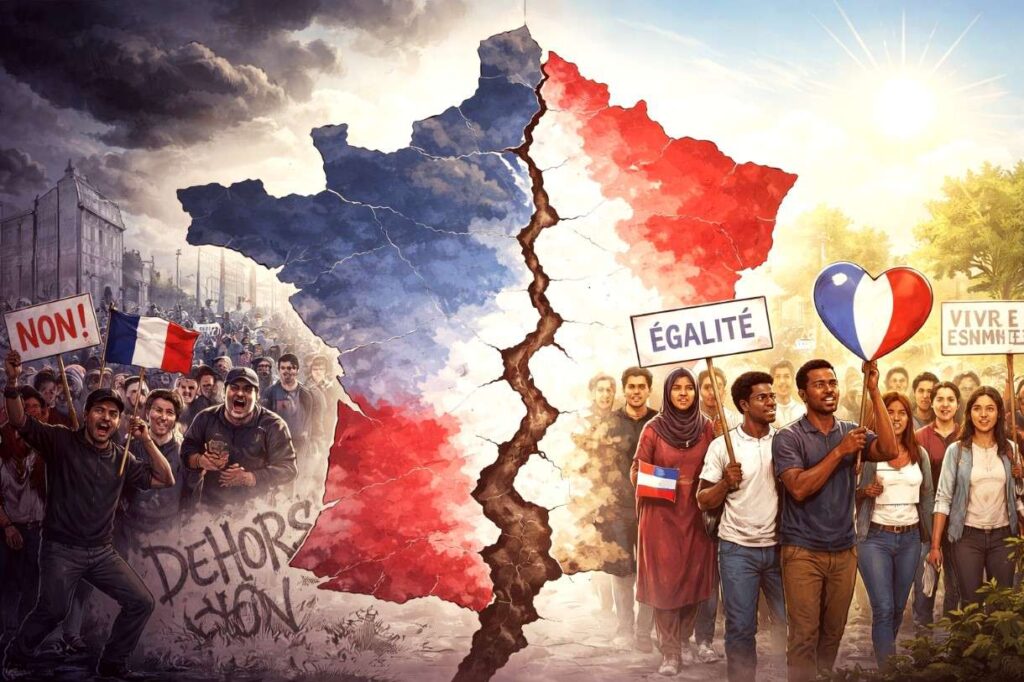
The diagnosis seems clear at first glance: In France, racist incidents are increasing, the public debate is heated, and minorities report more discrimination. But a closer look reveals a more complex picture. French society is moving in opposite directions at the same time – towards more tolerance in its values, but also towards a visible intensification of social tensions.
More Incidents, More Visibility
The statistical findings are hard to downplay. Police surveys show a clear increase in recorded racist crimes and offenses. However, these numbers represent only a fraction of reality. Victim surveys suggest that the majority of incidents are never reported – due to mistrust of the authorities, resignation, or fear of consequences.
This discrepancy points to a structural problem: The state mainly measures what becomes visible, while a large part of everyday discrimination remains hidden. Especially in the labor market, where origin and name can still influence career opportunities, these subtle forms become particularly apparent.
At the same time, certain forms of racism are subject to cyclical fluctuations. Anti-Semitic and anti-Muslim incidents respond sensitively to international crises, domestic political debates, or media events. This leads to spikes that are less an expression of long-term trends and more indicators of political agitation.
The Quiet Progress of Values
In contrast, there is a development that receives less attention but is no less significant: the long-term increase in social tolerance. Since the 1990s, a continuous rise in acceptance of ethnic and religious diversity can be observed.
This change is particularly pronounced among younger generations. They have grown up in a more pluralistic society, generally have higher educational qualifications, and maintain more natural contacts across cultural boundaries. For them, diversity is less a political issue and more a social reality.
This development is also reflected in normative expectations. A broad majority of the population today supports active measures against discrimination and no longer regards racism as a marginal problem but as a central societal challenge.
Polarization through Politics and Media
How can the simultaneous increase in racist incidents be explained against this background? A decisive factor lies in the political and media climate. In recent years, the language in public debate has noticeably shifted. Topics such as migration, national identity, or security are being discussed in a sharper and more confrontational manner.
There is also an observable shift in the boundaries of what can be said. Positions that were previously considered fringe are now entering the mainstream. This concerns not only explicitly right-wing extremist milieus but also parts of the bourgeois spectrum, where migration-critical or identity-political argumentation patterns have gained importance.
This dynamic is amplified by social media. They function as resonance spaces where provocative and polarizing content spreads particularly quickly. Algorithms favor emotional escalation, while nuanced arguments receive less visibility. The result is a public discourse that appears more conflict-ridden than societal reality alone could explain.
The changing perception of racism
Another aspect that is often underestimated comes into play: the change in perception. What is considered racist today was not necessarily labeled as such in the past. Awareness campaigns, scientific studies, and societal debates have contributed to recognizing and naming discrimination more clearly.
This “cognitive shift” has two effects. On the one hand, it leads to a higher willingness to report and thus to increasing case numbers. On the other hand, it changes the social climate by raising expectations of equal treatment. Discrimination is less tolerated, but at the same time also more frequently addressed.
The paradox is obvious: A society that becomes more sensitive to racism appears statistically and subjectively more racist – precisely because it no longer tolerates it.
A Country in a State of Tension
France is thus in a transitional phase. The republican idea of universal equality is under pressure from social inequalities, cultural differences, and geopolitical tensions. At the same time, the demand to truly fulfill this promise of equality is growing.
This double movement creates friction. Advances in social openness are accompanied by backlash that expresses itself politically and socially. The increase in racist incidents is therefore not only an expression of regression, but also a symptom of a more intense negotiation process.
In this sense, the thesis of an “increasingly racist” France falls short. It fails to recognize the simultaneity of progress and conflict. French society is neither on a clear downward nor on a clear upward path. Rather, it moves within a field of tension where normative demands, political interests, and social realities struggle with one another.
It is precisely this ambivalence that makes the finding so elusive – and so politically charged. Those who speak of a simple development underestimate the depth of the structural changes currently shaping France.
Author: Andreas M. Brucker