
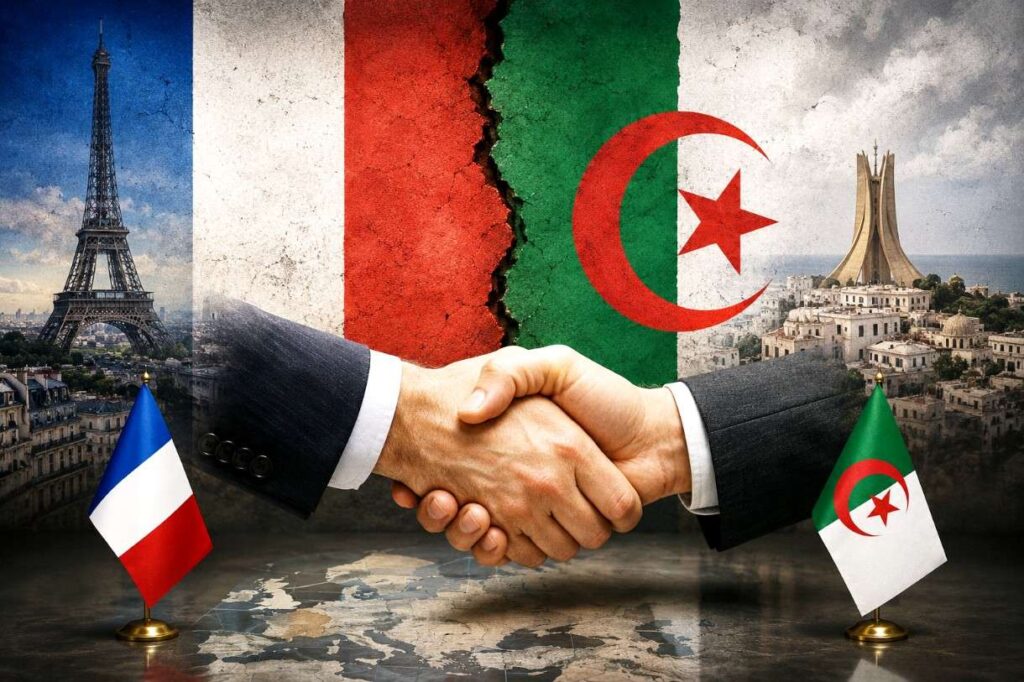
For months, it seemed that once again the familiar diplomatic drama was unfolding between France and Algeria, a drama that has shaped the relations between the two states for decades: public humiliations, mutual accusations, symbolic punitive measures, and a political language that goes far beyond concrete factual issues. Ambassadors were recalled, ministers spoke demonstratively coldly, and domestic political debates further intensified the tone. The crisis at times appeared to be another low point in a relationship that, despite close historical, economic, and social ties, never truly finds lasting peace.
But meanwhile, many signs suggest that Paris and Algiers are quietly trying to contain the escalation. Not because the differences have disappeared. Rather, there is a growing realization on both sides that a prolonged confrontation would cause significant political and strategic costs.
The Western Sahara Conflict as Trigger
The immediate trigger for the recent crisis came from Emmanuel Macron in summer 2024 with a foreign policy course correction of considerable significance. For the first time, France explicitly supported the Moroccan autonomy plan for Western Sahara under Moroccan sovereignty. For Rabat, this was a diplomatic success of high symbolic importance. For Algeria, however, the decision represented a strategic provocation.
The Western Sahara issue is one of the central geopolitical conflict lines in North Africa. Algeria has supported the Polisario Front for decades, which demands an independent Sahrawi state. Morocco, on the other hand, regards the territory as an integral part of its own state territory. France had so far tried to maintain a certain balance between both positions. With Macron’s step, Algiers was effectively pushed to the margins.
President Abdelmadjid Tebboune responded accordingly sharply. The Algerian ambassador was withdrawn from Paris, diplomatic contacts were frozen, and bilateral relations cooled to a level that appeared exceptional even in the historically conflict-laden relationship between the two countries.
A Crisis with Many Levels
However, the tensions were not limited to geopolitical issues. The crisis quickly developed into a mixture of migration policy conflicts, domestic symbolic debates, and mutual distrust.
Particularly burdensome was the arrest of the Franco-Algerian writer Boualem Sansal in Algeria. In France, the case was perceived as an attack on freedom of expression and critical intellectuals. Added to this were disputes over Algerian influencers in France, discussions about deportations of Algerian nationals obliged to leave, as well as the case of the regime critic Amir DZ, whose alleged abduction on French soil triggered new diplomatic accusations.
At the same time, the domestic political debate in France about the bilateral migration agreement of 1968 intensified. This agreement grants Algerians in France partially privileged residence arrangements. Right-wing and conservative forces have been demanding its termination for years and use every crisis with Algiers to mobilize against French migration policy.
This illustrates the particularity of French-Algerian relations: hardly any other bilateral relationship in Europe is so strongly shaped by history, memory politics, and identity issues. Conflicts between Paris and Algiers are never purely diplomatic. They have a direct impact on domestic political debates in both countries.
The colonial past remains politically present
The structural fragility of the relations has deep roots in the colonial history. French rule over Algeria lasted from 1830 to 1962 and was marked by extreme violence. The Algerian War claimed hundreds of thousands of lives and left traumas on both sides of the Mediterranean.
To this day, no shared historical narrative exists about this period. In Algeria, the anti-colonial liberation struggle forms a central part of state legitimacy. The memory of colonial oppression is regularly used by the political leadership as a mobilizing instrument — especially in economically or socially tense phases.
Algeria remains a politically charged topic domestically in France as well. Issues of migration, integration, national identity, and the postcolonial legacy are closely linked to Algeria’s history. Every diplomatic crisis therefore activates societal conflicts within France itself.
This emotional dimension explains why even limited disputes can escalate quickly. Rational-strategic interests are often overshadowed by symbolic conflicts.
Why both sides opt for de-escalation
Despite the aggressive rhetoric, neither Paris nor Algiers had a genuine interest in a lasting rupture. The mutual dependencies remain significant.
France continues to be one of Algeria’s most important trading partners. Millions of people live with family, cultural, or economic ties between the two countries. Added to this are security policy interests: instability in the Sahel, Islamist networks in North Africa, and Mediterranean migration issues make some cooperation nearly indispensable.
Even during the most severe diplomatic tensions, numerous communication channels remained open. Behind the scenes, contacts between security services and presidential advisors continued.
Since spring 2025, many signs have pointed to a cautious rapprochement. The Élysée Palace has recentralized Algeria policy. Foreign Minister Jean-Noël Barrot intensified diplomatic contacts, while direct talks between the presidential administrations were intended to gradually build trust.
Abdelmadjid Tebboune also reduced the personal confrontation with Macron. After a long interruption, both presidents resumed telephone contact. Symbolic steps followed: the gradual return of the French ambassador to Algiers, a resumption of certain security cooperation, and ministerial visits with commemorative political significance.
The Importance of Commemorative Politics
Particularly symbolic was the French participation in the memorial events on May 8, 1945 in Sétif, Guelma, and Kherrata. While France was then celebrating the end of World War II, anti-colonial protests were brutally suppressed in Algeria. The massacres are still considered one of the most formative traumas in Algerian national history.
Paris is now visibly attempting to create new grounds for dialogue through a more open confrontation with the colonial past. Macron has pursued a cautious strategy of historical recognition for years, without, however, being willing to issue comprehensive official apologies. In this way, France is politically navigating a narrow path domestically.
For Algeria, on the other hand, the colonial memory remains a central instrument of national self-definition. Precisely for this reason, every symbolic gesture by France carries enormous political weight.
Nevertheless, the structural problems remain unresolved. The Western Sahara issue continues to be a fundamental geopolitical conflict point. The French migration debate is likely to intensify further with the rise of right-wing parties. And within the Algerian power apparatus, there is still deep mistrust towards France’s long-term intentions.
The current détente therefore feels less like a genuine reconciliation and more like a pragmatic truce. Both sides seem to have realized that permanent escalation is increasingly counterproductive — economically, diplomatically, and in terms of security policy. Yet the deeper causes of the conflict remain.
Thus, France and Algeria remain trapped in a paradoxical relationship: too closely connected to permanently separate from each other, but historically too burdened to build a truly stable relationship. Every rapprochment already carries the seed of the next crisis within it.
Author: P. Tiko