
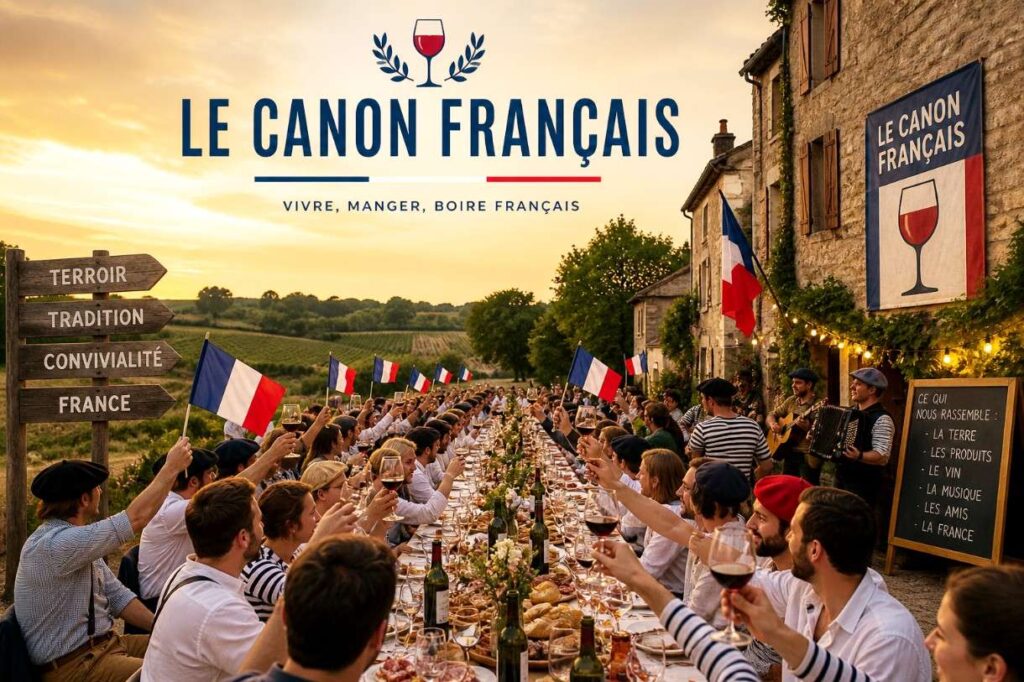
What began as a folkloristic major event has within a few days turned into a political issue of national significance. The banquet of “Le Canon français” on April 18, 2026, in Norman Caen is at the center of a debate about right-wing extremism, cultural symbolism, and the blurring of societal boundaries between tradition and ideology.
A Celebration with Shadows
The concept of the “Canon français” is as simple as it is effective: long tables, regional products, wine, singing, and a staging of French way of life. In a time of social fragmentation, this mixture strikes a chord – not least with an audience longing for supposed authenticity and rootedness.
But the images that circulated after the banquet in Caen paint a different picture. Video recordings, spread among others by StreetPress, show participants making gestures that can be interpreted as the Hitler salute. Additionally, there are reports of racist and Islamophobic statements. Le Parisien also speaks of “Nazi chants” following the event.
The legal assessment of these incidents is now up to the authorities. But regardless of criminal consequences, the incident is already having a significant political impact.
The Politicization of Terroir
The controversy surrounding the banquet is not to be viewed in isolation. Observers had already pointed out the ideological entanglements behind the “Canon français” beforehand. Investigations by Le Monde place the project within a broader “cultural battle over the terroir”.
At the center is the entrepreneur Pierre-Édouard Stérin, who has invested in the company through the Odyssée Impact fund. Stérin is considered an influential representative of a conservative Catholic milieu and is associated with networks that ideologically extend into the radical right.
The strategy does not appear to be new, but it is effective: cultural codes – food, sociability, regional identity – are used to convey political narratives. Political scientist Pierre-André Taguieff speaks in this context of a “metapolitics of everyday life,” where cultural practices are employed for the long-term shifting of societal discourses.
Between an Isolated Case and a Symptom
The central question is therefore: Are the incidents in Caen isolated derailments – or a symptom of structural problems?
Organizers regularly emphasize the apolitical character of the banquets. But critics argue that it is precisely the apparent harmlessness of such events that is problematic. They create spaces where like-minded ideological supporters can meet and normalize radical positions.
Historically, the instrumentalization of culture is not a new phenomenon. Already in 20th century Europe, authoritarian movements deliberately used folk culture and traditions to exclusively and often aggressively reinterpret national identity. The French historian Nicolas Lebourg points out that “cultural codes often serve as a door opener for political radicalization.”
The events in Caen fit into this logic. They mark less a break than rather an escalation of already existing tendencies.
Media under pressure
Particularly alarming is the development following the coverage. According to Télérama, a journalist from the public broadcaster Ici Normandie, who reported on the banquet, became the target of massive online attacks. Insults, threats, and coordinated intimidation attempts have been documented.
The incident is exemplary of a broader trend. According to the annual report by Reporters Without Borders (2025), the number of attacks on journalists in Europe is increasing, especially in the digital space. France is no exception.
The information director of the Ici network spoke of a “worrying normalization of intimidation.” The boundary between legitimate criticism and targeted delegitimization of journalistic work is increasingly blurring.
Political reactions and societal classification
The political reaction has so far been cautious. Local authorities announced investigations, while national politicians assessed the incident differently – depending on their political stance.
This restraint is strategically explainable. The issue touches on sensitive questions of freedom of expression, cultural identity, and political polarization. Too harsh a condemnation could be interpreted by parts of the population as an attack on “traditional values.”
At the same time, the case shows how strongly cultural spaces are politicized. Events like the banquet in Caen no longer function only as social occasions but as symbolic arenas in which societal conflicts become visible.
A Porous Boundary
The central insight from Caen is the increasing permeability between culture and politics. What is staged as a carefree celebration of regional identity can, under certain conditions, become a resonance space for ideological positions that go far beyond the culinary.
It is crucial to distinguish between the legitimate expression of cultural tradition and its political instrumentalization. The “Terroir” – a central concept of French identity – is not per se at issue. Rather, its appropriation by actors who use it for demarcation and mobilization is.
The events in Caen show that this boundary does not exist only theoretically but can be practically crossed. They raise fundamental questions: Who defines cultural identity? And for what purpose?
The answers to these will not be found solely in courtrooms, but in public discourse – and in a society’s ability to distinguish between tradition and ideology.
Author: P. Tiko