
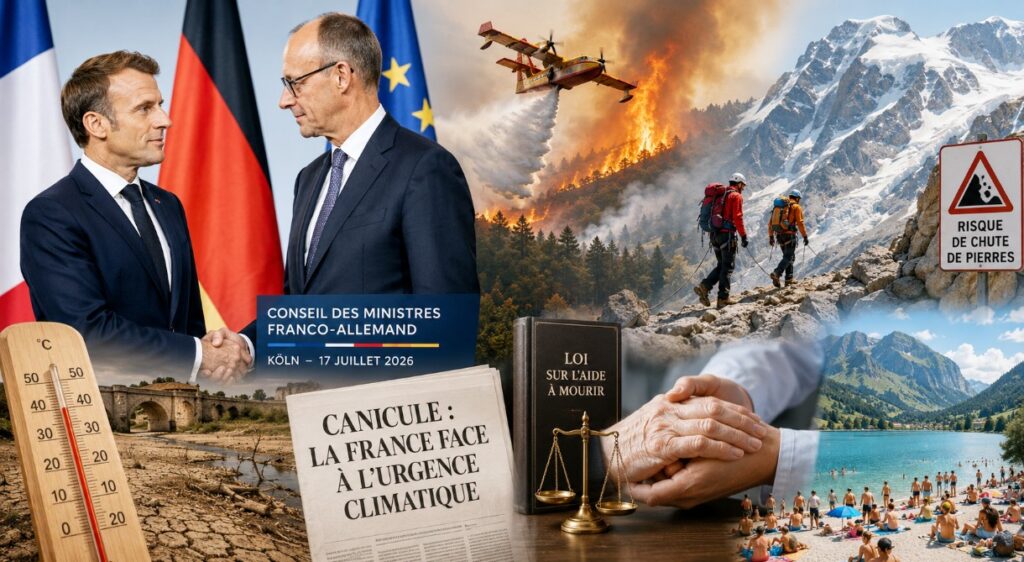
France’s news day is marked by foreign-policy turning points, climate-related challenges and social debates. Coverage focuses on the Franco-German government summit, the consequences of the exceptional heatwave, the discussion on disaster protection following the recent wildfires, the security situation in the Mont Blanc massif, and the ongoing dispute over the new assisted dying law. Together, these issues paint a picture of a country grappling simultaneously with geopolitical challenges and the consequences of profound social and climatic change.
Franco-German summit aims to revive Europe’s engine
The most important political event of the day is the meeting between German Chancellor Friedrich Merz and President Emmanuel Macron at the Franco-German Ministerial Council in Cologne. After years of differing priorities and at times strained relations, both governments want to give their cooperation new momentum.
The focus is on joint initiatives in defense and security policy, the expansion of European armaments projects, the promotion of artificial intelligence, cooperation in space, and issues of European competitiveness. Particular attention is being paid to the planned deepening of security cooperation, including the strategic discussion on Europe’s nuclear deterrence. French commentators view the meeting as an important test of the European Union’s ability to act in an increasingly unstable international environment.
Wildfires and heatwave remain the dominant issue
Despite some easing after the severe wildfires of recent days, the exceptional heatwave remains the dominant domestic issue. Many parts of the country continue to suffer from extreme drought, while local thunderstorms bring short-term relief but also cause new damage.
Coverage is increasingly focusing on whether France is adequately prepared for more frequent extreme weather events. The condition of the firefighting aircraft fleet, the strain on fire services, growing water shortages, and the long-term effects on agriculture, forests and tourism are under discussion. Climate change is no longer portrayed as an abstract question for the future, but as an immediate challenge for the state and society.
Mont Blanc: Safety debate after fatal rockfall
Following the fatal rockfall in the Couloir du Goûter, in which two Czech mountaineers died, numerous media outlets continue to address safety in the Mont Blanc massif.
Geologists and mountain guides attribute the increasing instability of rock faces primarily to accelerated glacier melt and the thawing of permafrost. There are growing calls to temporarily close particularly dangerous routes during extreme heat or to reorganize the mountaineering season. Many observers see the debate as symbolic of how profoundly high mountain areas have already changed as a result of climate change.
Assisted dying remains a contentious social issue
Even after the adoption of the law on assisted dying, the issue remains the subject of intense public debate. Editorials, interviews and commentaries reflect the continuing polarization within society.
Supporters see the law as a significant step toward strengthening the self-determination of seriously ill people. Critics, on the other hand, warn of shifting ethical boundaries and possible shortcomings in its practical implementation. The current debate now focuses on the planned medical review procedures and the responsibility of the doctors and ethics committees involved.
Tourism between summer boom and climate change
At the same time, numerous regional newspapers are reporting an exceptionally strong influx of visitors to France’s mountain regions. In view of the continuing heat, more and more holidaymakers are choosing vacations in the Alps, the Pyrenees or the Massif Central, where temperatures remain significantly more pleasant than along the Mediterranean coast.
Tourism associations see this as a long-term trend that is permanently changing travel behavior. At the same time, however, concern is growing about the future of Alpine tourism. Shrinking glaciers, unstable mountain slopes and more frequent natural hazards pose considerable challenges for regions whose economies depend heavily on summer tourism.
July 17, 2026 illustrates how closely foreign-policy developments, social reforms and the consequences of climate change are now interconnected. While Paris and Berlin seek to give European cooperation new momentum, France’s domestic concerns are focused above all on climate adaptation, public safety and social cohesion. Today’s coverage shows a country facing structural change while seeking answers to challenges that extend far beyond its borders.