
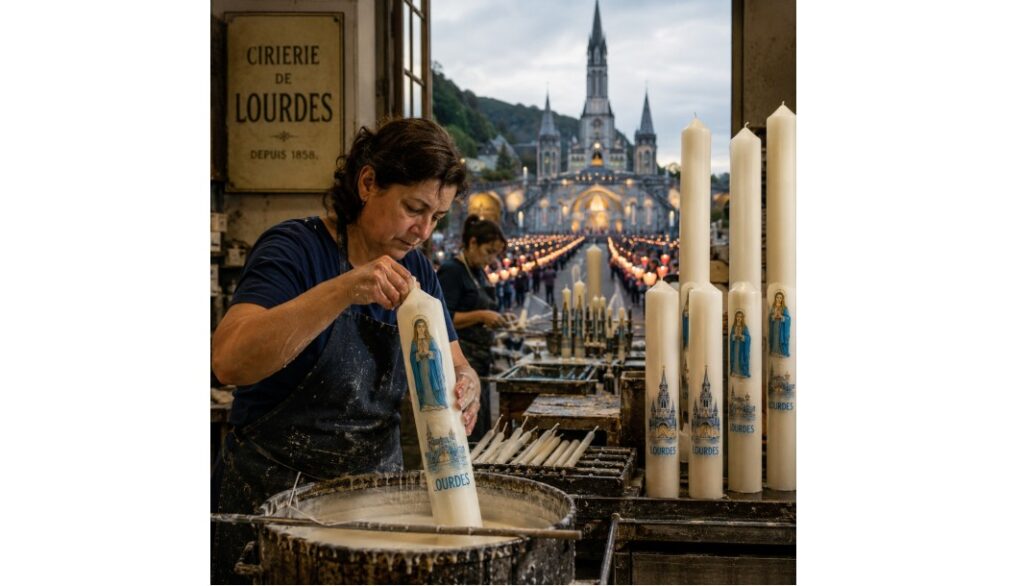
In the early morning, Lourdes carries an indescribable scent. Slightly warm paraffin, a hint of soot, and the heavy air rising from workshops where the same hand movements have continued for decades. Outside, the first groups of pilgrims are already making their way along Boulevard de la Grotte, but behind unassuming facades, work begins that is as much a part of the city’s soul as the sound of bells and whispered prayers.
There, women standing beside long tables pass wicks through melted wax again and again. The repeated movements are as precise as a practiced dance.
Some have worked here for thirty years.
Others for forty.
Their hands already think independently.
Lourdes lives on hope. At first, that may sound exaggerated and sermon-like, but in this town at the foot of the Pyrenees, the concept takes on a remarkably concrete form: a candle. Every year, millions of people come here to light small flames at the Grotto of Massabielle, carry meter-long procession candles through the night, or place flickering lights for the deceased. Candles are not merely religious objects. They function as an extension of human longing.
And between prayer and commerce, a remarkably resilient craft emerges.
When you visit the workshop, there is none of the folkloric spectacle for tourists or the picturesque romanticism of a museum. There is work. Real work. The space is functional, sometimes even rough. Metal frames. Wax remnants scattered across the floor. Heat. Large vats filled with molten material. In between, women in aprons, bent over and hardly ever looking up. Every movement has to be precise.
Because pilgrimage candles do not allow for carelessness.
Especially the huge candles carried in Marian processions require experience that reaches to the fingertips. The wax must be neither too hot nor too cold. The wick must always be kept taut. Even the slightest irregularity will cause the candle to lean and burn unsteadily later on. What often appears to outsiders as a simple product is, in Lourdes, more like a quiet ritual in its production.
“You do not learn that from books,” says a worker in a local television report, wiping wax splashes from the back of her hand. The words sound simple, but they say a great deal about France.
This is because the country has spent years discussing lost industries, vanished professions, and an increasingly digital world of work. Between artificial intelligence, start-up culture, and automated supply chains, places like Lourdes exist almost like time capsules. Here, gestures still matter. Repetition, muscle memory, matter.
Or, as the French often say: avoir le métier dans les doigts.
To have one’s trade in one’s fingertips.
What a wonderful expression.
It does not indicate a technical qualification, but rather a physical intelligence. A kind of knowledge etched into movement over decades. The women’s hands remember temperature, resistance, and the tension of materials the way a musician remembers chords. People who have been drawing wax for years can supposedly tell from the sound alone whether its viscosity is right. It sounds almost insane, but that is how it is.
At the same time, Lourdes itself often seems like a city between two realities. On one side is the spiritual realm: pilgrims with rosaries, sick people in wheelchairs, evening songs crossing the square. On the other is the highly organized economy of faith: hotels, souvenir shops, restaurants, and religious-goods dealers. Faith creates demand, and demand creates jobs.
The candle factory is part of this city’s inconspicuous engine.
When lighting a fire at dusk, most people do not think of that place.
Yet many livelihoods depend on it.
Older residents of Lourdes once said that almost every family knew someone involved in the pilgrimage. One drove pilgrimage buses. Another sewed religious flags. Yet another made candles. The town functioned like a small universe of its own centered on spirituality. Now much is changing. Cheap imports from abroad are putting pressure on prices, and young people are moving to larger cities. Traditions often quietly disappear, frequently without great drama.
That is why the sight of these workshops is so moving.
Because something that has already been lost elsewhere continues to live on there.
Of course, candle production also has modern elements. Safety standards, delivery logistics, machines for certain processes. This does not glorify working twelve hours in hot air. But the core remains remarkably unchanged. Many movements are still carried out by hand. Especially for large procession candles, they prefer to rely on experienced workers rather than fully automated processes.
There, routine replaces almost every theory.
Manufacturing follows a rhythm that has something meditative about it. Dip the wick. Pull it out. Let it cool. Apply a new layer of wax. Dip again. Turn again. For hours. The process almost recalls the liturgical repetition of a religious service. Perhaps that is why a unique connection arises between production and spirituality. The work itself even seems to be influenced by the rhythm of the pilgrimage city.
Outside, people march through the streets singing.
Inside, candles grow centimeter by centimeter.
And sometimes these worlds blur together.
The nighttime procession is especially impressive. Thousands of small lights move slowly through the darkness. From a distance, it looks almost like a burning river. Anyone who has taken part even once is unlikely to forget the sight. The large candles at the front are almost dramatic. The flames flicker in the wind, wax drips slowly, and voices echo across the square.
But before this spectacle comes into being, somewhere on the outskirts of town, women stand at workbenches inspecting those candles centimeter by centimeter.
It is invisible work.
Perhaps that is precisely why it is so fascinating.
In France, there is a deep cultural respect for craftsmanship. This difficult-to-translate word lies somewhere between skill, experience, and style. You see it in bakers, wine producers, tailors, and cheesemakers. Lourdes adds a spiritual dimension to this tradition. Here, craftsmanship does not create gourmet luxuries, but objects with emotional meaning.
People who buy a candle in Lourdes rarely do so on a whim.
In most cases, it comes with a story.
A prayer for an ill mother.
A remembrance of a deceased father.
Hope for healing.
Or simply the wish for a small moment of comfort.
Perhaps that explains why the work in the workshop is taken so seriously. What is made there is not an ordinary consumer product. Every candle later disappears into a personal story. The workers know this. Some have witnessed the same pilgrimage seasons, the same busy summers, and the same processions for decades. They experience Lourdes as an annual cycle of light.
Yet hardly anyone talks about them.
Pilgrims photograph the basilica.
Hardly anyone photographs the workshop.
But it is precisely these places that say something about Europe today. About regions trying to preserve their identity between tourism and tradition. About professions whose value cannot be measured by productivity alone. About women’s work that has often been historically overlooked. About the fact that many industries have been sustained by that work.
In Lourdes, candle production is mainly carried out by women. It has been so for generations. Many started young, sometimes straight after leaving school. The work demands endurance, concentration, and tremendous precision. Hands age quickly. Heat and wax leave their marks. At the same time, a quiet solidarity develops among colleagues. They know each other’s movements, help without words, and assist one another in carrying heavy molds.
There is a small world of its own there.
Almost like a family.
When traveling through France today, one encounters a sense of cultural acceleration everywhere. Town centers are becoming increasingly alike. Small shops are disappearing. Traditions can turn into tourist decoration. By contrast, Lourdes seems to resist in a strange way. There are neon signs and plastic souvenirs here too, of course. But beneath the surface, something surprisingly old continues to live on.
The women who make candles are part of it too.
Their work is not flashy. Nor is it glamorous. There is no hip urban rediscovery in the style of a manufactory. No one is likely to make a Netflix series about a paraffin workshop. And perhaps that is where their dignity lies. They work not for trends, but for continuity.
Day after day.
One flame at a time.
One could almost say: while the outside world spins ever more frantically, Lourdes preserves a slower time. A time of repetition, a time of ritual, a time of patience. Perhaps that is why so many people seek comfort there. Not only because of religion, but because of the experience of constancy itself, which has become so rare.
A candle burns slowly.
It does not blink.
Nor does it send push notifications.
It demands attention.
And perhaps therein lies a quiet lesson about our present.
In an age of permanent speed, the workshops of Lourdes appear almost subversive. What matters there is not self-presentation, but experience. Products are not created in seconds, but shift by shift, layer by layer. There, hands still matter.
Who would have thought that a single candle could say so much about France.
About faith.
About work.
About memory.
And about the people whose names almost no one knows. Without them, Lourdes’s famous procession of lights would never have the same effect.
When flames dance along the basilica in the evening and pilgrims raise their candles toward the night sky, no one sees the workshops anymore. No one thinks of melted wax or heavy metal molds. All that is visible is the light.
Perhaps that is enough.
Article: M. Legrand