
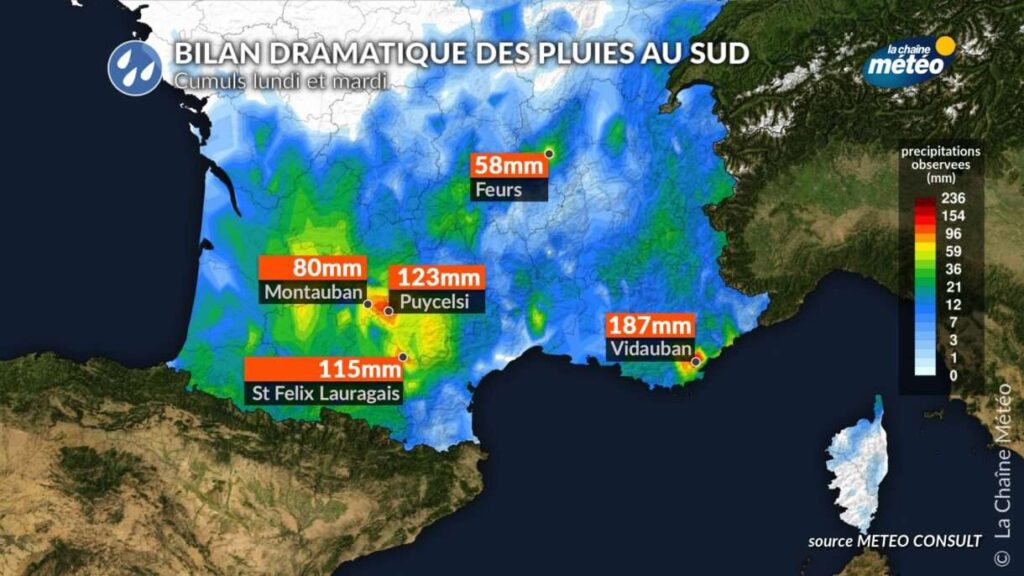
When the sky opened its floodgates in the southern French département of Var on 20 May 2025, no one expected such a severe storm. Within hours, an ordinary rainy day turned into a nightmare – with deadly consequences.
Three people died in the floods, homes were devastated, and roads and bridges were washed away. Now mayors, ministers and citizens are jointly demanding: The state must act – and quickly.
When the rain sweeps everything away
The towns of Lavandou and Vidauban were particularly hard hit. In Cavalière, a district of Lavandou, an incredible 256 litres/m2 of rain fell in a single hour. Within six hours, Vidauban experienced an amount of water that normally falls over three months – 185.9 litres/m2.
An elderly couple was caught off guard by the water and could not save themselves. An 81-year-old woman died in her car, which was virtually swallowed by the floodwaters.
These rainfall figures may seem abstract – but anyone who has ever had to wade knee-deep through water in their kitchen knows: This is not just about statistics. It is about human lives. About livelihoods.
Politicians respond – quickly and with clear words
Just a few hours after the first emergency calls, senior officials went to assess the situation on site. François-Noël Buffet from the Interior Ministry wanted to see the damage for himself. President Emmanuel Macron promised solidarity – a gesture intended to be more than mere comfort. Above all, it is meant to give hope.
The affected municipalities are now officially calling for recognition of the “state of natural disaster”. This official classification is the decisive lever in France for rapid financial assistance. Those who lose everything to natural forces should at least receive fair compensation.
What exactly does “state of disaster” mean?
The procedure sounds matter-of-fact, yet it determines the future of many families. Affected municipalities must submit a request to the prefect. An interministerial commission then reviews the data: How severe was the event, how unusual was it, and what damage has occurred?
If the green light is given, a corresponding decree is published in the “Journal Officiel”. Then the countdown begins for the victims: They must report their damage to their insurer within ten days. Sounds bureaucratic? It is—but there is no alternative.
Millions in damage—and just before the holiday season
The economic damage is enormous. In Le Lavandou, Mayor Gil Bernardi speaks of “scenes like in a war”. Roads were torn up, bridges washed away, and electricity and water lines damaged. Not to mention that the tourism industry is facing a disaster.
Hotels are experiencing cancellations, beaches are muddy, and hiking trails are closed. For many small businesses in the region, the high season is their lifeline—and it has now been brutally affected.
Climate change is knocking—and insistently so
Such extreme weather events are no longer isolated incidents. Anyone who thinks that southern France is safe from the forces of nature is proven wrong year after year. Heavy rainfall events, storms and periods of drought are now becoming more frequent.
Is it enough to keep clearing away the debris? Or must we finally begin to radically change the way we think and act?
Urban planners, climate researchers and local politicians are calling for exactly that: new building concepts, early warning systems, renaturalized areas. Because the best protection against flooding is not the sandbag, but a smart, forward-looking concept.
The recognition of the state of disaster in the Var is not only a necessary measure for rapid assistance. It is also a symbol—of the fact that politics, society and the economy must finally face the new realities.
Because the next storm is sure to come. The question is: will we merely react again—or will we finally begin to think ahead?
By Andreas M. Brucker