
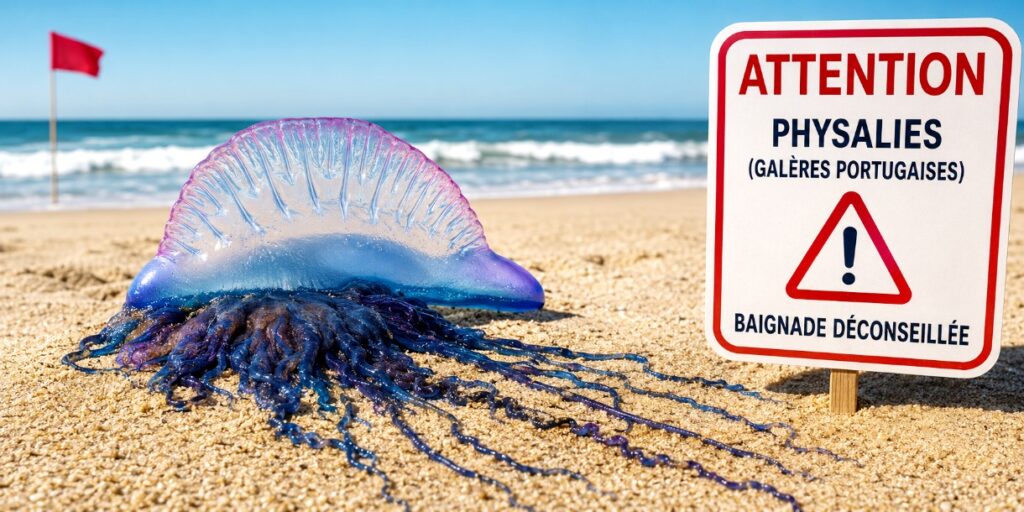
Portuguese man o’ wars are currently drawing increased attention at several beaches in southwestern France. The marine creatures, also known as false jellyfish, have once again been spotted along the Atlantic coast and in Landes. Winds and ocean currents are responsible for carrying them to the shore. Lifeguards and authorities are therefore monitoring the situation particularly closely and warning beachgoers about the risks.
At first glance, the Portuguese man o’ war resembles a harmless jellyfish. In reality, however, it is something entirely different. It is not a single living organism, but a colony of several highly specialized organisms that live together permanently and can survive only as a group. Its distinctive feature is a blue-violet, slightly translucent float that protrudes from the water like a small sail.
The real danger, however, usually remains hidden. Beneath the water’s surface hang long tentacles that can measure several meters and, in isolated cases, even several dozen meters in length. They are covered with thousands of tiny stinging cells containing an extremely potent venom.
Contact with these tentacles usually causes significantly more pain than the sting of an ordinary jellyfish. Those affected often report intense burning, accompanied by noticeable, whip-like red streaks on the skin. Muscle cramps, nausea, or vomiting are also not uncommon. In severe cases, breathing difficulties, circulatory problems, or even loss of consciousness may follow. Children, older people, and individuals with pre-existing health conditions are considered particularly at risk.
Another danger is that a washed-up Portuguese man o’ war does not immediately lose its ability to harm. Even if it already appears dead or severely dried out, its stinging cells often remain active for days or even weeks. Anyone who picks up or accidentally touches such an animal on the beach therefore also risks painful injuries.
If contact does occur, prompt and correct action is essential. If the sting happens while swimming, the affected person should first be brought safely out of the water. Then, the affected area of skin should be rinsed exclusively with seawater. Fresh water is expressly unsuitable, as it can activate additional stinging cells and intensify the release of venom.
Attached tentacles must never be removed with bare hands. Tweezers, a plastic card, or another firm object are better suited. It is also important not to rub the skin. A cold pack or ice wrapped in a cloth can then help relieve the pain.
If shortness of breath, severe pain, circulatory problems, or other serious symptoms occur, emergency services should be called immediately. The same applies to extensive injuries or when children or particularly vulnerable individuals are affected.
Avoiding typical mistakes is equally crucial. Neither fresh water nor vigorous rubbing of the skin will help – quite the opposite. Even Portuguese man o’ wars that appear dried out must never be touched or picked up. Their venom cells often remain active for a surprisingly long time.
The marine creature can be identified by its float, only a few centimeters in size, shimmering blue, violet, or pink and drifting on the water’s surface like an inflated sail. Its long tentacles, by contrast, usually remain invisible beneath the water.
Anyone who spots a Portuguese man o’ war on the beach should keep their distance and inform the lifeguards or the responsible municipality. Beach closures or swimming bans are intended to protect all visitors and should be strictly observed until the danger has passed.
Author: C.H.