
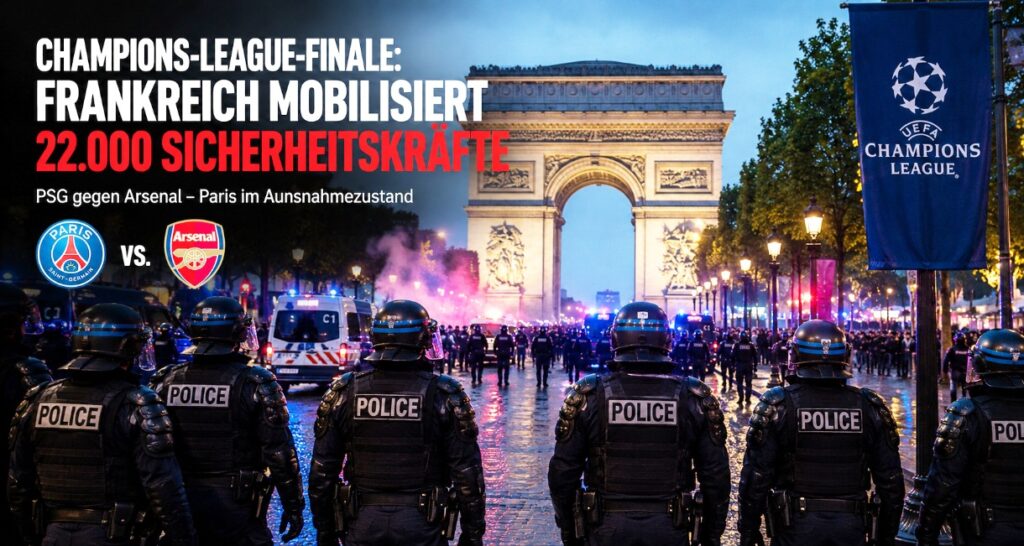
France is preparing one of the largest security operations of the year. Ahead of the Champions League final between Paris Saint-Germain and Arsenal, 22,000 police officers and gendarmes will be deployed nationwide. Around 8,000 security personnel will be on duty in the Paris metropolitan area alone. Authorities are preparing for possible mass celebrations if PSG wins the most important European club title.
This exceptional mobilization underscores the significance of the match far beyond the sporting context. Paris Saint-Germain is once again in a European final, and a victory could bring hundreds of thousands of fans onto the streets of the capital and other French cities. At the same time, memories of riots after previous successes of the club are still fresh.
Following the Champions League triumph last year, celebrations were overshadowed by numerous incidents. In Paris and other cities, there were lootings, vehicles set on fire, and clashes between celebrants and security forces. More than 500 people were arrested at that time. The events serve as a warning for the government and have significantly influenced the planning for this year’s final.
Interior Minister Laurent Nuñez emphasizes that this time the authorities are relying on a particularly comprehensive and robust security concept. Key areas include the Champs-Élysées, traditionally a central gathering place for football fans. Increased security measures also apply around the Parc des Princes, where the final will be broadcast on big screens.
The authorities’ strategy is based on a combination of prevention and rapid response. The goal is to prevent possible disturbances at an early stage while remaining flexible to react to unforeseen developments. Security officials especially fear that individual violent offenders could mix with the celebrating crowds or exploit the attention around the match for targeted riots.
Additional measures aim to reduce the risk of incidents. For example, certain metro and RER stations may be temporarily closed. Traffic restrictions will apply in parts of central Paris, and some shops in particularly sensitive areas will close earlier. Furthermore, the sale of fuel in cans and carrying certain items that could be used as throwing objects or improvised weapons have been banned.
The security measures are not limited to the capital. The 22,000 personnel will be distributed throughout the country to monitor even spontaneous fan gatherings in other cities. Authorities expect that the impact of a potential PSG victory could be felt well beyond Paris.
This development shows how much major football events have changed. European finals are no longer just sporting highlights but also significant challenges for public safety. For the French government, it is therefore not only about ensuring a smooth celebration but also about demonstrating that it can maintain public order. While PSG hopes for the title win, security authorities focus on preventing new riots.
Author: Andreas M. Brucker