
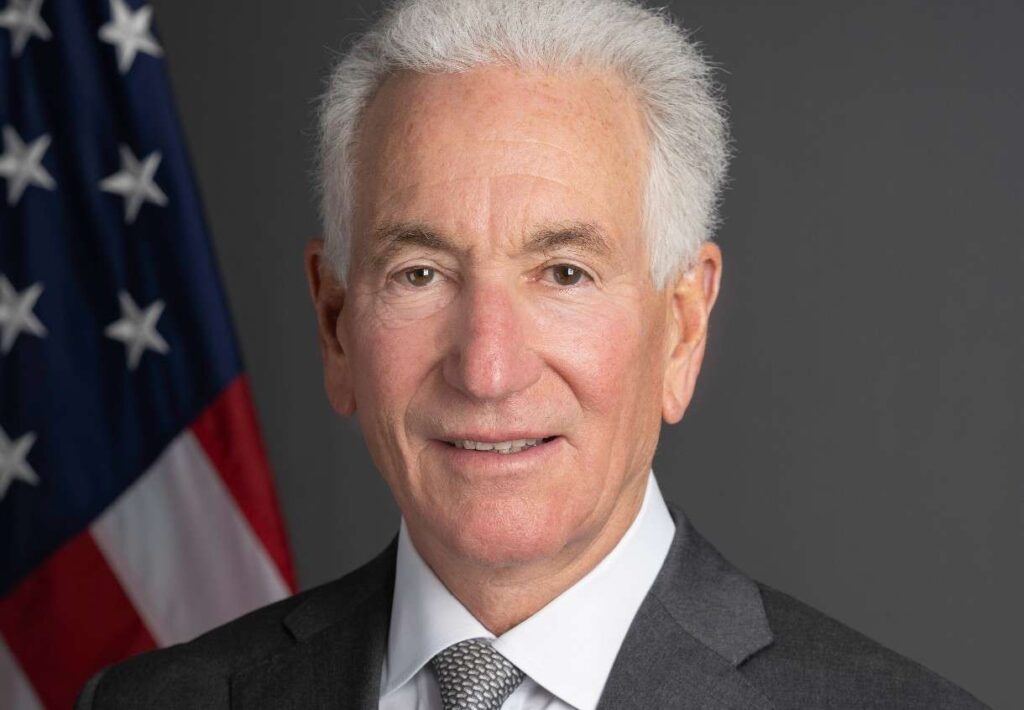
The appointment of Charles Kushner as the American ambassador to Paris could have passed as a footnote in a personnel decision in Washington. Instead, it developed within a few months into a diplomatic strain between two traditionally close allies. The real estate entrepreneur from New Jersey, closely connected to Donald Trump’s circle and burdened with a criminal record, has since been at the center of a debate about style, mandate, and limits of modern diplomacy.
From Real Estate Magnate to Political Spotlight
Charles Kushner, born in 1954 in Elizabeth, New Jersey, built a significant real estate company with Kushner Companies, which is particularly active in the New York metropolitan area. The family, of Jewish origin with roots in Belarus, has been strongly engaged philanthropically for decades, especially in education and community life within the American Jewish community.
His career long followed the classic pattern of a discreet real estate developer. This changed fundamentally in 2005. In a highly publicized criminal case, Kushner pleaded guilty to 18 counts – including illegal campaign contributions, tax evasion, and witness tampering. Particularly explosive was the accusation that he had deliberately sought to compromise a family member who was cooperating with the justice system. The court imposed a two-year prison sentence, of which he served about 14 months in a federal prison.
He was politically rehabilitated in 2020 through a pardon by then-President Donald Trump. This step occurred during a period of intense political polarization in the United States and was viewed by critics as another example of the mixing of personal loyalties and state decision-making authority.
Appointment with symbolic significance
In 2025, during his second term, Trump appointed Kushner as the United States Ambassador to France and Monaco. The US Senate confirmed him by a narrow majority – a vote that reflected the partisan divide. Kushner did not bring formal diplomatic experience. His key political qualification was familial: he is the father of Jared Kushner, Trump’s son-in-law and advisor in the White House.
The personnel decision follows an American tradition where ambassadorial posts are often awarded to political supporters or major donors. However, France is not an insignificant sideline position but a key destination of transatlantic diplomacy – a NATO partner, an EU heavyweight, and a permanent member of the UN Security Council. Accordingly, expectations for diplomatic sensitivity and institutional experience are high.
The first scandal: Open letter to Emmanuel Macron
The tensions first became openly visible when Kushner circulated a public letter in the summer of 2025, in which he accused the French government of inadequate action against antisemitism. Antisemitic incidents have been a serious political and social problem in France for years, regularly being the subject of state reports and measures. However, the public tone of a sitting ambassador toward the host country, according to many observers, crossed the boundaries of diplomatic conventions.
In Paris, the step was seen as interference in internal political affairs. The French Foreign Ministry – traditionally referred to as the Quai d’Orsay – summoned the ambassador. However, Kushner did not appear in person but was represented by his chargé d’affaires. In diplomatic circles, such an absence is considered a deliberate signal of distance or disregard.
For President Emmanuel Macron, the incident came at a sensitive time: France was politically experiencing a phase of heightened tensions, among other things in the context of social polarization and debates about extremism.
Second Crisis: Accusations of Interference
The situation escalated again after the violent death of a far-right activist in Lyon. On social networks, the US State Department and the American Embassy in Paris spread statements suggesting an increase in “violent left-wing radicalism” in France. The French government reacted sensitively. It regarded this as an inappropriate commentary on ongoing domestic political debates.
The French Foreign Minister Jean-Noël Barrot summoned Kushner again. Once again, the ambassador did not appear in person and referred to private commitments. Paris then took an unusual step: Kushner’s direct access to members of the French government was temporarily restricted. Such a step is extremely rare between close allies and signals considerable displeasure.
Only afterward did Kushner seek a phone conversation with the Foreign Minister and assured that they did not want to interfere in France’s internal affairs. However, the episode left lasting irritation.
Diplomacy in the Style of the Trump Era?
The scandals raise fundamental questions. First: What role does professional training play in the diplomatic service? Classic career diplomats usually undergo decades of training and practice before taking a post like Paris. They are trained in protocol, discreet negotiation, and political sensitivity.
Secondly: To what extent does Kushner’s behavior reflect a deliberately chosen political strategy? Observers see parallels to the communication culture of the Trump administration: direct address, public confrontation, use of social media as a political tool. This form of “public diplomacy” relies on visibility, not discreet channels.
Thirdly, the institutional question of the politicization of diplomatic offices arises. The appointment of close confidants or political supporters is legal and historically rooted in the United States. But in a geopolitically tense environment – with Russian aggression against Ukraine, strategic rivalry with China, and debates about European strategic autonomy – transatlantic coordination gains importance. Every additional irritation can complicate strategic coordination.
The transatlantic dimension
France and the United States share a long history of mutual support – from American independence to the founding of NATO. At the same time, the relationship has traditionally been characterized by phases of latent tension: from the Iraq War 2003 to trade conflicts and debates about European defense capabilities.
In this context, the behavior of an ambassador does not act in isolation. It sends signals about respect, priorities, and political culture. France reacts sensitively to perceived interference in its domestic affairs – a reflex historically rooted in the emphasis on national sovereignty.
Kushner’s conduct in office therefore has not only personal but structural implications. It touches on the question of how resilient the transatlantic partnership remains in times of political polarization – both in the USA and in Europe.
Charles Kushner thus embodies a new form of political appointment: economically successful, politically loyal, but diplomatically inexperienced. His interventions may come from conviction, especially on issues of antisemitism or political violence. Yet the way they are articulated decides their impact. Between Washington and Paris, trust is a strategic asset. Whether Kushner will consolidate this trust or further strain it depends less on his convictions than on his ability to respect the unwritten rules of diplomacy.