
When it comes to trash on French beaches, many people think of plastic bottles, packaging materials, and cigarette butts. These can be found visibly lying on the sand, floating on the water surface, or accumulating between rocks and sand dunes. However, there is another type of litter that is less noticeable—despite being present in millions—and that is chewing gum.
A young biologist, Marine Guilbaud, is addressing this inconspicuous environmental problem. She aims not only to clean up the coast with an unusual idea but also to raise awareness about a widely misunderstood fact. Her project starts from a point that many people do not even consider problematic.
This is because modern chewing gum is no longer made from natural materials. The part that is chewed mainly uses synthetic polymers derived from petrochemicals. In other words, many gums contain plastic. When discarded gum falls on streets, sand, or in natural environments, it does not disappear easily. It maintains its shape for years, decomposes slowly, and can eventually become microplastic.
It is a small piece of litter, yet it has a significant impact.
This issue has long been known to cities and municipalities. Gum is one of the most common kinds of litter carelessly discarded in public places. Because it is small, it is hard to notice, but the quantity is enormous, and its removal requires special cleaning methods, consuming time, personnel, and costs.
The situation worsens at the coast. Rainwater flushes gum into the sewage system, from where it reaches rivers and then the sea. The ocean already contains a vast amount of plastic waste placing great pressure on marine ecosystems, and gum becomes a part of this pollution.
Marine Guilbeau deeply understands these connections through her research. After majoring in environmental management and coastal ecology, she has long worked on the impacts of marine pollution. From this experience came the project “CreaGum,” an initiative that treats gum not just as waste but as a resource.
This idea looks surprisingly simple.
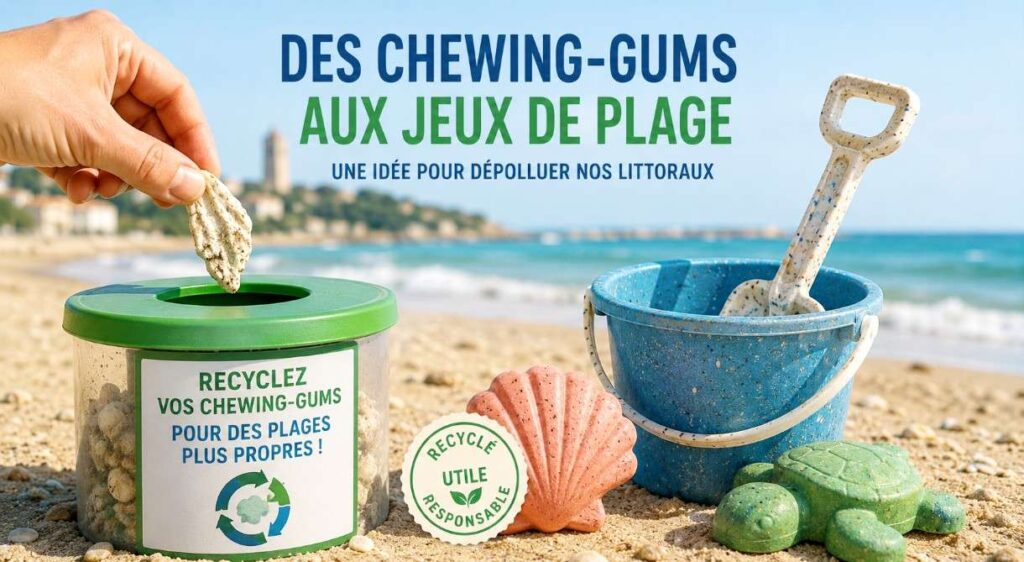
Used gum is collected at collection points, sorted, and processed. Then it enters the recycling process and is transformed into new products. Particularly notable are beach toys for children. What used to pollute the sand is turned into practical items like buckets and shovels.
At first glance, it may seem a little strange.
But that is exactly the strength of this idea. Children playing on the beach with toys made from recycled chewing gum can engage very concretely with the issue of environmental pollution. Abstract terms like circular economy and microplastics suddenly become tangible realities that can be held in hand.
This initiative also aligns with trends that are gaining importance in many fields. Companies and municipalities are increasingly pursuing ways to transform waste, which was traditionally seen as a problem, into new resources. They are giving materials that were once discarded a second chance.
CreaGum clearly combines this idea with a sense of locality. Not only is the coastal area around La Rochelle the site of the activities, but it has also become a symbol of protecting the delicate marine environment. By linking beach cleanups, environmental education, and recycling, a cycle involving citizens, tourists, and municipalities is created.
Of course, recycling chewing gum alone will not solve the global plastic problem. The scale remains small compared to the huge amount of debris flowing into the oceans.
However, small ideas can sometimes have a special impact.
It shows that environmental protection does not necessarily have to be large-scale projects worth billions of yen. Sometimes, it is enough to simply look at everyday things from a new perspective. Chewing gum thrown on the ground may seem meaningless, but in reality, it tells a big story about consumption, responsibility, and the use of resources.
Marine Guilbaud’s project visualizes exactly that. It transforms inconspicuous waste into something useful and reminds us that many environmental issues start right at our feet. If you look closely, solutions are often hidden where you think there is just trash.
From C. Hattie