
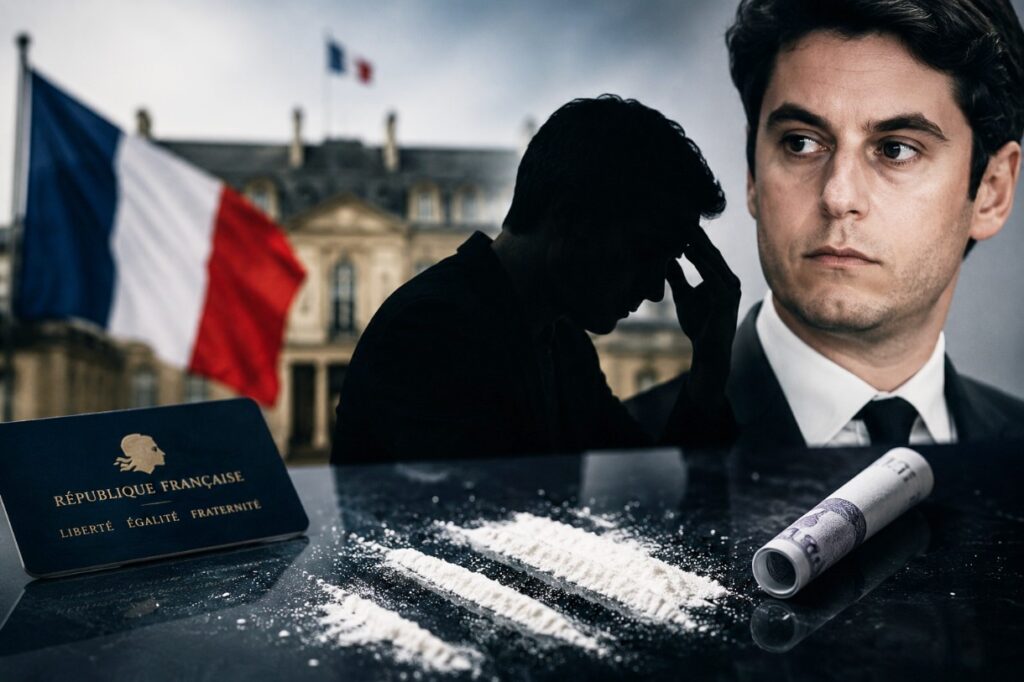
When Louis Jublin, the longtime communications adviser to former French Prime Minister Gabriel Attal, made his past cocaine addiction public, it was about far more than the personal fate of a political strategist. His confession draws attention to a reality that is rarely discussed openly within France’s political and business elites: the connection between enormous performance pressure, an excessive work culture and drug use.
Jublin’s decision to go public himself was apparently no coincidence. According to his own account, a video has been circulating among several newsrooms for months that allegedly shows him consuming a white powder. Before the footage could be published and used against him, he chose to go on the offensive – and described his former addiction in detail for the first time.
A stark admission
In unusually candid terms, Louis Jublin described the extent of his excesses at the time. He used the vulgar French expression: «Je me dézinguais à m’en faire péter la couscoussière.» Roughly translated, it means: “I wrecked myself completely until my head exploded.”
The stark wording illustrates just how deeply the now 40-year-old says he had fallen into addiction. His cocaine use was particularly intense in the autumn of 2022 – at a time when Gabriel Attal held the post of Minister for Public Finances.
Jublin stresses, however, that this phase has been behind him for years. He says he has completely stopped using drugs and no longer wants to be reduced to the image of a “gay, cocaine-addicted and crazy” man. According to his account, personal characteristics, past addiction problems and rumors about his mental state are being deliberately conflated in order to discredit him publicly.
Six years at the heart of political communication
For years, Louis Jublin was part of Gabriel Attal’s inner circle. Between 2018 and 2024, he accompanied the political rise of the current chair of the Renaissance parliamentary group through several key positions within the French government.
As Attal first became Secretary of State for Youth, then government spokesperson, education minister and finally prime minister, Jublin was responsible for key parts of his communications. Such advisers usually work far from public view, yet they wield considerable influence over political presentation. They draft speeches, develop communication strategies, coordinate crisis responses and shape the public image of their political principals.
After leaving Attal’s circle, Jublin founded the consultancy Minerva. He also worked for a time for Helene Arnault, the wife of businessman Bernard Arnault. In Paris’s political and business circles, Jublin has for years been regarded as an exceptionally talented communicator with a personality that is as extravagant as it is unconventional.
No indication of Gabriel Attal’s involvement
Public interest in Jublin’s statements is also explained by the political context. Gabriel Attal remains one of the most promising figures in the liberal governing camp and is considered a possible candidate in the 2027 presidential election.
So far, however, there is no indication whatsoever that Attal knew about his employee’s cocaine addiction at the time or was himself connected to it in any way. Jublin does not make such an allegation either.
A former adviser’s personal addiction therefore cannot be attributed to his former employer, either politically or morally. The affair initially concerns Jublin alone.
Cocaine as the performance drug of the elites
Nevertheless, the case takes on broader social significance because it makes visible a phenomenon that security authorities and addiction researchers have been observing for years. Cocaine has long since moved beyond the traditional drug milieu and is increasingly found in professions marked by heavy workloads, constant pressure to s쳮d and intense competition.
Particularly in political apparatuses, corporate headquarters, law firms and media organizations, cocaine is sometimes viewed as a supposed means of enhancing performance. The drug temporarily conveys concentration, self-confidence and resilience. At the same time, regular use significantly increases the risk of psychological and physical dependence.
Jublin’s statements fit this picture. His descriptions point to a working world in which lack of sleep, constant availability and unrelenting pressure to s쳮d are part of everyday life, one that can blur individual boundaries.
France debates supply above all – and demand less so
One statement by Jublin is particularly noteworthy: anyone in Paris seeking to put “cocaine on trial” would inevitably also have to talk about the entire influential Parisian milieu. The remark may seem provocative, but it points to a debate that is often conducted only incompletely in France.
Politically, the discussion usually focuses on drug trafficking, organized crime and violence in disadvantaged suburbs. Far less attention, by contrast, is paid to the social demand for cocaine in wealthy and influential circles. Without affluent consumers, the lucrative cocaine market would hardly have grown to its current scale.
Jublin’s confession thus brings an uncomfortable question to the forefront: How widespread is the use of performance-enhancing drugs really among France’s political, business and media elites? There are still hardly any reliable answers, since the subject is rarely discussed openly for obvious reasons.
The public admission by the former Attal adviser is therefore far more than a tabloid story from political Paris. It reveals the darker side of a world in which public image-making, constant performance pressure and personal self-optimization are closely intertwined. At the same time, the case is a reminder that addiction knows no social boundaries. It can affect people in almost every social stratum – including those who prepare political decisions every day or help shape public opinion.
Author: P. Tiko