
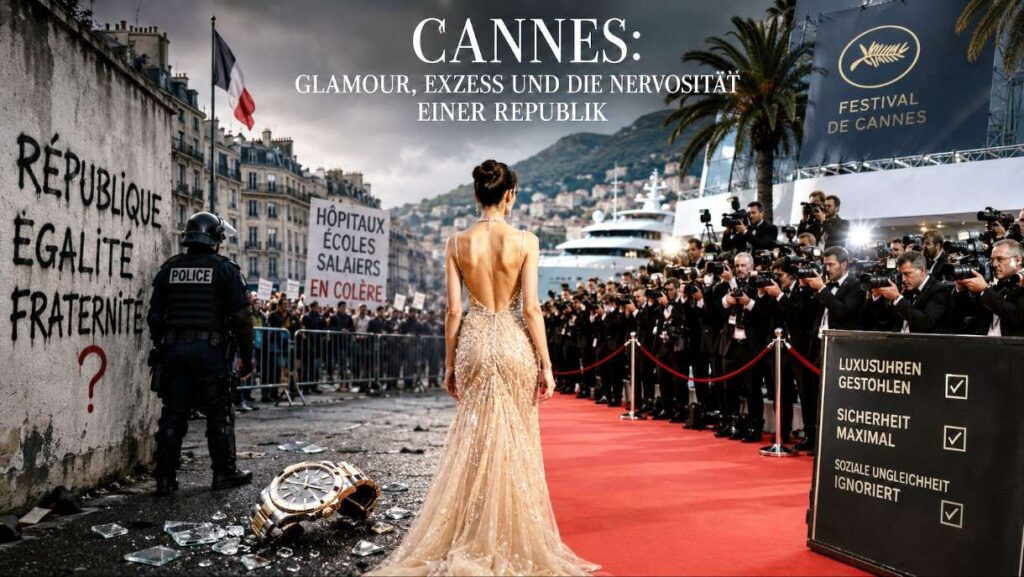
There is hardly a place that describes France in 2026 more precisely than the Croisette in Cannes. While ministers in Paris debate austerity programs, explain fuel prices, and justify new budget gaps, influencers stroll along the Côte d’Azur with diamond-studded handbags on red carpets, flanked by heavily armed police officers. Cannes has long been more than a film festival. It has become a political symbol — perhaps the most honest image of contemporary France.
At first glance, everything seems as usual: champagne receptions, designer dresses, superyachts, luxury hotels. The international elite celebrates itself in a setting of flashlights and decadence. But behind the glamour lies a nervousness that has now become almost tangible. France presents itself to the world like an old aristocrat putting on his finest tuxedo one last time, although the castle has long shown cracks.
The security measures around the festival now resemble a mix between a high-security zone and a military parade. Streets are cordoned off, bags checked, cameras watch every corner. Not without reason: theft of luxury watches has become almost folklore in the Cannes ritual. Rarely does a festival go by without reports of stolen Richard Mille, Rolex, or Patek Philippe models. The crime is not just a marginal phenomenon. It has become part of the mise-en-scène. Luxury attracts its own shadows.
France nowadays appears as a country that simultaneously wants to flaunt and hide itself.
While presidents and ministers invoke social cohesion in their Sunday speeches, Cannes shows a different reality: that of a society whose upper layers move within segregated zones, while uncertainty increases outside. You could almost call it a republican feudalism. Inside: caviar, couture, and cryptocurrencies. Outside: police sirens, social tensions, and a state that increasingly seems ill-equipped to handle the task.
This display is made particularly grotesque by the omnipresent social media culture. Cannes today is less a film festival and more a global content factory. Actors, models, and influencers continuously produce images of artificial perfection that have about as much to do with the daily lives of most French people as Versailles does with a suburb of Marseille.
Even the films often become secondary. It is no longer about cinema, but visibility. Who wears which dress? Who kisses whom on which yacht? Who posts the viral moment of the evening? Cannes is today’s France in accelerated time: a country obsessively looking at itself while barely able to solve its structural problems.
Of course, France has always been a country of mise-en-scène. Louis XIV understood the power of spectacle better than any modern communications advisor. The Grande Nation has always also lived off the myth of its cultural superiority. But in the past, there was at least a political or economic foundation behind the mise-en-scène. Today, it often seems that only the background remains.
Because parallel to the glamour, social exhaustion is growing. The national debt is rising, public services are coming under pressure, schools and hospitals are struggling with chronic underfunding. In many suburbs, there is a feeling of permanent disconnection from the republican promise. And yet Cannes sends out the same message every year: France wants to keep shining, no matter the cost.
That is also where the real tragedy lies.
Because Cannes does not only show wealth. It shows the panic fear of losing meaning. France clings to its role as a cultural world power with the same intensity with which it is losing influence economically and geopolitically. The festival thus becomes a kind of national mirror room: beautifully lit, but full of distortions.
The irony is hard to overstate. While the state talks about budget cuts and calls on citizens to make sacrifices, hotel suites in Cannes are booked for five-figure amounts per night. While trade unions protest against social harshness, tech millionaires party on mega yachts off the coast. And while the Minister of the Interior warns of rising crime, stars openly pose with jewelry that costs more than the annual income of many French people.
That is why Cannes is not just a festival. It is a symbol of the contemporary Western era — but in France, this symbol comes into sharp focus. Perhaps because the country has historically always claimed to embody equality and social dignity. Precisely for this reason, the contrasts are sharper there than elsewhere.
In Cannes, you see a France that no longer fully trusts itself. A country that wants to be admired and has to defend itself at the same time. Behind every red carpet stand security barriers. Behind every luxury facade lurks the fear of a fall. Behind every Instagram post hides the desperation to remain relevant.
And maybe that precisely explains the peculiar atmosphere of these days on the Côte d’Azur: that mix of beauty and tension, of wealth and insecurity, of glamour and latent crisis.
Cannes still shines. But now it shines like a precious vase that already shows fine cracks.
A commentary by Andreas M. Brucker