
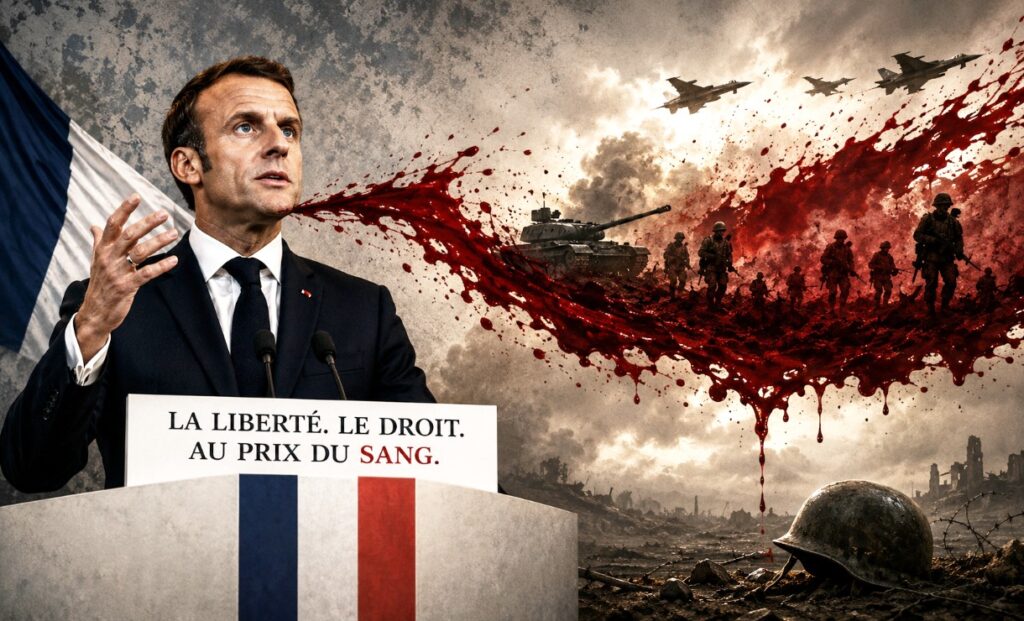
The price of blood – how quickly the language of war becomes socially acceptable again
He was considered the opposite of Europe’s old power politicians. Emmanuel Macron – young, eloquent, educated, European. The president who wanted to build bridges, not trenches. The man who wanted to lead France into the 21st century. And now he too speaks of the “price of blood.”
How quickly words change. And with them, politics.
Only a few years ago, terms such as diplomacy, mutual understanding, and European cooperation sounded like the foundation of the future. Today, people are once again talking about rearmament, a war economy, deterrence – and now, quite naturally, about blood. As if it were a sober budget item. As if the term merely had to be repeated often enough for it to lose its horror.
The price of blood.
A sentence that comes surprisingly easily from the lips in air-conditioned meeting rooms. There, people in tailored suits sit and discuss strategies, while others later wear uniforms and are allowed to pay the bill. After all, blood is always that of others.
Of course, it will immediately be explained that all of this has been misunderstood. After all, it is only about deterrence. About defensive readiness. About values. About freedom. About Europe. It sounds noble. It sounds responsible. It sounds almost heroic.
There is only one thing it does not sound like: peaceful.
Ironically, every justification for more weapons is that they are meant to safeguard peace. Every new armament program supposedly serves de-escalation alone. Every billion-euro budget is a peace project. And when the “price of blood” is ultimately discussed, then of course also in the name of peace.
One cannot help but wonder: how many more speeches about peace are actually needed before no one notices that the vocabulary has long since come from the history books of past wars?
Europe once wanted to be a continent that had learned from its history. Today, it seems to have mainly learned how to put old concepts into modern packaging. Rearmament becomes “resilience.” Armament becomes “strategic autonomy.” Readiness for war becomes “defense of values.” Marketing can truly work wonders.
And Emmanuel Macron? The very president who so often presented himself as an intellectual now resorts to language that evokes bygone eras more than 21st-century Europe. Perhaps that is the real shock. Not that a president wants to defend his country—that is part of his office. But that even those who once stood for dialogue now choose words that make the state of emergency seem normal.
Peace rarely dies with a drumroll. Often, it disappears sentence by sentence.
When politicians begin to speak of blood, citizens should not applaud. They should listen very carefully. Because blood is not a rhetorical device. It has names, faces, and families.
And whoever invokes its price should never forget that, in most cases, he does not pay it himself.
Andreas M. Brucker