
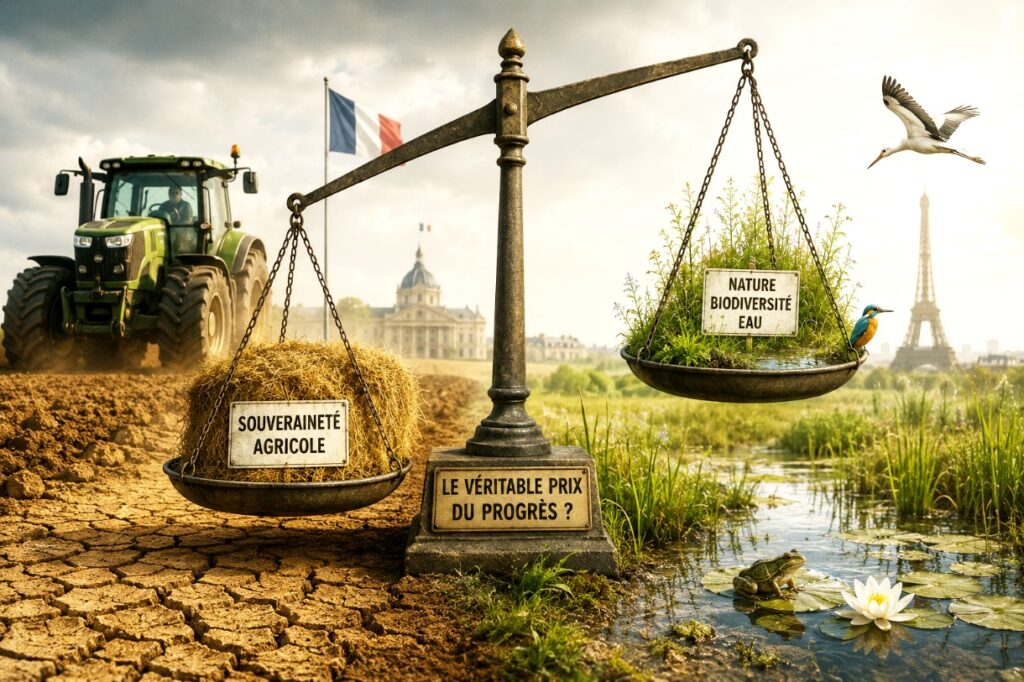
France has a new favorite word: “food sovereignty.” It evokes independence, self-determination, and national strength. Who could oppose it? Who would want to import food from overseas when it can be grown right outside their door?
The government’s response is simple: when farmers protest, the rules are relaxed. When farmers might protest again, the rules are relaxed even further. And if this leads to the disappearance of wetlands, the drying up of rivers, or the loss of the last refuge for certain animal species – well, nature doesn’t block highways or dump waste in front of ministries.
The real tragedy of this new agricultural law doesn’t lie in its individual clauses. It lies in its message. France suddenly acts as if it has to choose: either agriculture or the environment. Either food or biodiversity. Either the farmer or the beaver.
What an absurd confrontation.
Because nature is not the enemy of agriculture. It is its condition. No water, no harvest. No pollinating insects, no fruit trees. No healthy soils, no food sovereignty. He who cuts the branch on which he sits should not be surprised to fall one day.
What is particularly remarkable is the political speed of this turnaround. For years, citizens were told that climate change was the greatest challenge of our time. That protecting biodiversity was indispensable. That water would become the most precious resource of the century.
Then come a few months of agricultural protests – and suddenly politics discovers that environmental demands were apparently nothing more than non-binding decorations.
Nature has a structural problem: it does not have a lobby with tractor parades. Frogs do not protest in Paris. Wetlands do not block prefectures. Bees do not organize general strikes. They simply disappear. Silently. Permanently.
Unfortunately, this is its entire political weakness.
Thus, a law intended to support agriculture becomes a document of political surrender. Not to the farmers – whose concerns are often legitimate. But to the idea that conflicts can be resolved in the short term by worsening problems in the long term.
Today, France celebrates agriculture. That is understandable. But one day the bill will come. And then it may turn out that food sovereignty over a dried-up field is a concept as convincing as maritime navigation without water.
Nature does not make demands. It does not write petitions. It does not vote.
Today, France celebrates agriculture. That is understandable. But one day the bill will come. And then it may turn out that food sovereignty over a dried-up field is a concept as convincing as maritime navigation without water.
Nature does not make demands. It does not write petitions. It does not vote.
She only reacts. And her judgments are final.