
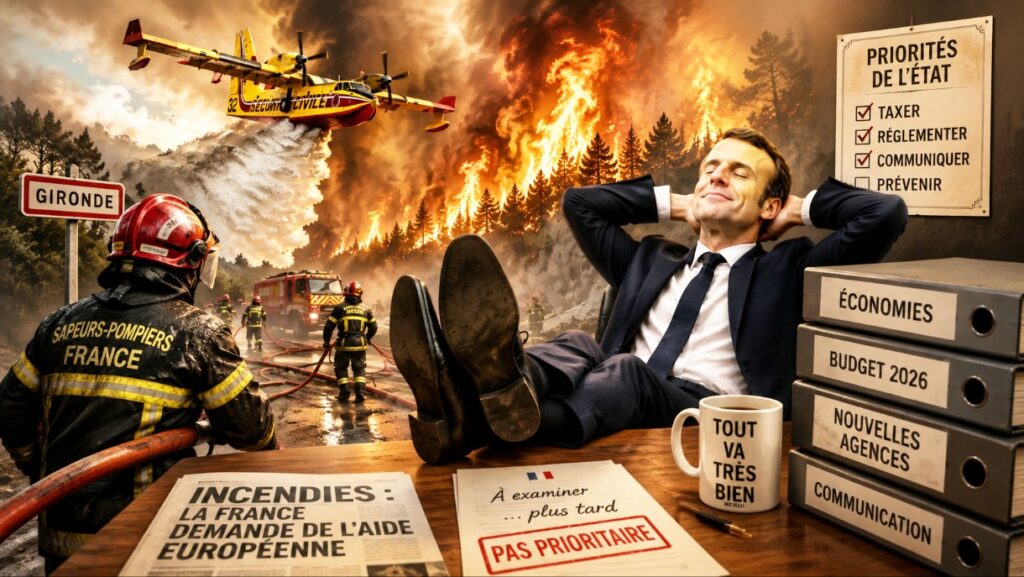
Who would have thought that firefighter would become the profession of the future? Children used to want to become pilots, astronauts or professional footballers. Today, a realistic career adviser should say: “Better learn how to fight forest fires. There will be plenty of work.”
France is burning. Again. The sky turns orange, forests disappear, villages are evacuated, firefighters fight day and night against flames that have long since grown beyond any political horizon. And while men and women in heavy protective gear risk their health, the now familiar ritual begins in Paris: concerned faces, serious press conferences and the solemn promise to “consider all necessary measures.”
Of course. Like every year.
You could almost believe that forest fires are an entirely new natural phenomenon. Some kind of climate surprise. Like snow in December. Who could have guessed that a country with increasingly hot summers might one day need more firefighting aircraft? Completely unforeseeable.
And yet today, Canadairs that have almost become museum pieces are flying over France. Thirty years old? No problem. In France, not only presidents, bridges and nuclear power plants age gracefully—firefighting aircraft, too, are expected to last a few more decades, please. After all, as long as they do not all need maintenance at the same time and the forest, out of courtesy, burns in only one place, it somehow works.
The real response doctrine apparently goes something like this anyway: let us simply hope that climate change respects the operational plan.
What is particularly captivating is the political arithmetic. There is money for almost every prestigious project. New agencies? No problem. Additional advisers? Of course. Communication campaigns? Indispensable. But backup aircraft for disaster protection? Well, yes—they just sit idle most of the time. What incredible waste! Obviously, it is far more sensible to invest only once the forest already looks like a lunar landscape.
In the short term, this saves money. In the long term, it costs forests, homes, and sometimes human lives.
But don’t worry: if things get difficult, there is always Europe. France calls—and Spain helps. Spain calls—and Italy helps. Italy calls—and Greece helps. Until half of Southern Europe is burning at the same time and everyone realizes that, unfortunately, a firefighting aircraft cannot be sent to five countries simultaneously via video conference.
Perhaps then they will simply create a working group.
The real heroes, after all, are not in ministries, but in the smoke. Volunteer firefighters, professional rescue workers, pilots, emergency services—people who work where others have spent years saving on their responsibility. They do not only extinguish fires. They extinguish political illusions.
Because the uncomfortable truth is this: climate change did not decide to enter this new reality with an outdated fleet, meagre reserves and chronically underfunded structures. That was a political decision. Or more precisely: many political decisions made over many years.
Perhaps that is why, after every major fire, we should stop asking the same question: “Where is the Canadair?”
A better question would be: Why do we ask it again every year?
Apparently, France has an astonishing ability. It can turn every foreseeable crisis into an unexpected one.
And while the sky above the forests turns black, in Paris there apparently remains an unshakable hope: perhaps it will rain after all.
Politics the French way.