
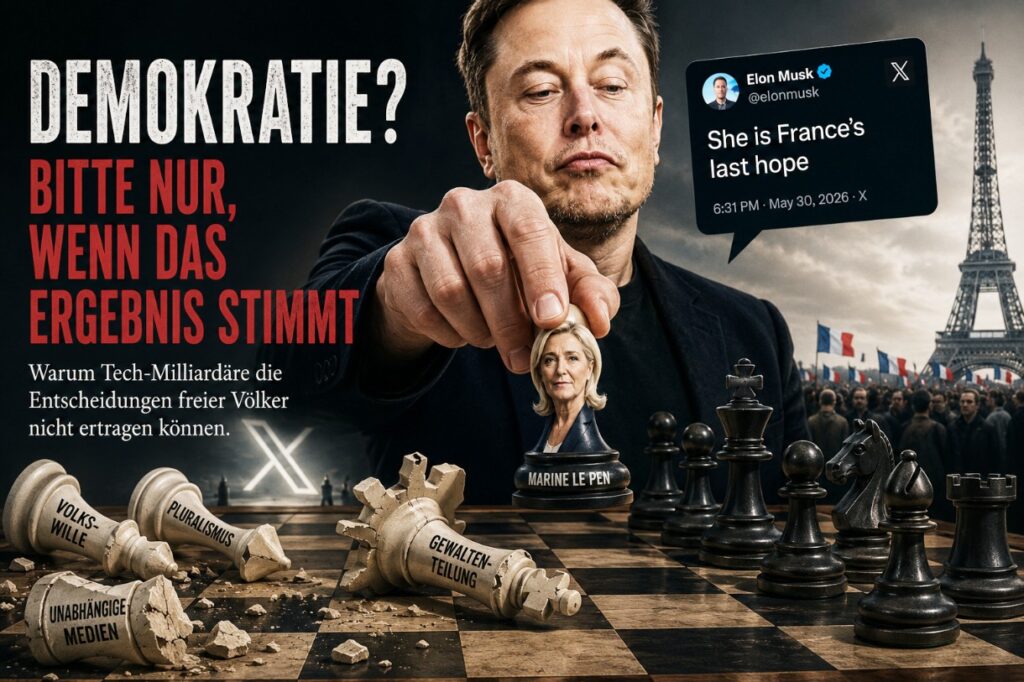
Unfortunately, democracy works differently.
It is arduous. It is slow. It produces compromises rather than maximum returns. Above all, however, it has one decisive design flaw – at least from the perspective of some of the super-rich: every citizen has exactly one vote. The cashier from Marseille counts exactly as much on election day as the richest man in the world. What an outrageous imposition.
Perhaps that is precisely where the real affront lies.
After all, democracy has no premium membership. There is no gold status for billionaires, no VIP entrance to the ballot box and no way to secure additional votes through one’s share price. Money brings influence – but not democratic legitimacy.
What is particularly ironic is that it is precisely these circles that speak incessantly about freedom of expression. Of course, Elon Musk is entitled to express his political opinion. No one disputes that. But freedom of expression also protects the right to call this interference what it is: an attempt by one of the world’s most powerful entrepreneurs to shape political debates in sovereign states according to his own ideas.
Imagine the reverse scenario. The owner of a major European media group tells American voters, just months before a presidential election, which candidate is their “last hope.” The outrage in the United States would be predictable and probably enormous. In Europe, by contrast, people seem to have almost grown accustomed to such transgressions.
Perhaps that is the larger problem.
For Elon Musk is no longer an isolated case. Increasingly, global technology entrepreneurs are behaving like unofficial governors of a new digital world order. They possess platforms whose reach exceeds that of many states, control public debates and comment on elections as if they were stock-market forecasts or product reviews.
The real paradox, however, is that precisely those entrepreneurs who constantly preach innovation and disruption seem to have little patience for democracy. Democracy is stubborn. It cannot be programmed, bought or optimized with a software update. It accepts no autocrats with verification badges.
In the end, one simple conclusion remains: France does not need a last hope from California or Texas. France needs free elections, independent institutions and citizens who decide for themselves whom to vote for.
Anything else may work on X.
In a democracy, it should not.
Andreas M. Brucker
Elon Musk has spoken once again. This time, he declared Marine Le Pen to be France’s “last hope.” A single sentence – yet it reveals a remarkable worldview. It is the worldview of a man who apparently believes that the future of European democracies can be managed as effortlessly as the algorithm of his own platform.
One inevitably wonders: what has become of the old American principle of not interfering in the internal affairs of other democracies? Apparently, this restraint no longer applies once one has enough billions and owns a communications platform whose reach surpasses that of many traditional media outlets.
Yet this is not really about Marine Le Pen. One may support or oppose her – that is a matter for French voters. That is precisely the core of a democracy: citizens decide. Not Washington. Not Brussels. And certainly not an entrepreneur from Texas.
Yet this very idea seems to be becoming increasingly alien to some tech billionaires.
Those who have spent decades seeing companies bought up, competitors pushed aside and political attention generated with a single mouse click may come to believe that democratic processes are merely another business model. All that is missing is an update, a new CEO and a few more efficient users.
Andreas M. Brucker
Andreas M. Brucker
Unfortunately, democracy works differently.
It is arduous. It is slow. It produces compromises rather than maximum returns. Above all, however, it has one decisive design flaw – at least from the perspective of some of the super-rich: every citizen has exactly one vote. The cashier from Marseille counts exactly as much on election day as the richest man in the world. What an outrageous imposition.
Perhaps that is precisely where the real affront lies.
After all, democracy has no premium membership. There is no gold status for billionaires, no VIP entrance to the ballot box and no way to secure additional votes through one’s share price. Money brings influence – but not democratic legitimacy.
What is particularly ironic is that it is precisely these circles that speak incessantly about freedom of expression. Of course, Elon Musk is entitled to express his political opinion. No one disputes that. But freedom of expression also protects the right to call this interference what it is: an attempt by one of the world’s most powerful entrepreneurs to shape political debates in sovereign states according to his own ideas.
Imagine the reverse scenario. The owner of a major European media group tells American voters, just months before a presidential election, which candidate is their “last hope.” The outrage in the United States would be predictable and probably enormous. In Europe, by contrast, people seem to have almost grown accustomed to such transgressions.
Perhaps that is the larger problem.
For Elon Musk is no longer an isolated case. Increasingly, global technology entrepreneurs are behaving like unofficial governors of a new digital world order. They possess platforms whose reach exceeds that of many states, control public debates and comment on elections as if they were stock-market forecasts or product reviews.
The real paradox, however, is that precisely those entrepreneurs who constantly preach innovation and disruption seem to have little patience for democracy. Democracy is stubborn. It cannot be programmed, bought or optimized with a software update. It accepts no autocrats with verification badges.
In the end, one simple conclusion remains: France does not need a last hope from California or Texas. France needs free elections, independent institutions and citizens who decide for themselves whom to vote for.
Anything else may work on X.
In a democracy, it should not.
Andreas M. Brucker