
In an era filled with crises, wars and a constant atmosphere of tension, such news is becoming increasingly rare. For many years, inflation, social tensions, geopolitical conflicts and economic uncertainty have dominated public discourse. Many people have grown accustomed to waking up in the morning to bad news and going to bed at night with new worries.
That is precisely why the changes quietly taking place in France are particularly striking and almost go unnoticed—perhaps this is why they are so significant: people are starting to help one another again. Not out of obligation, not through state organizations, but because they realize that no one can get through these turbulent times alone.
It is a quiet return of humanity.
These small gestures that suddenly become important
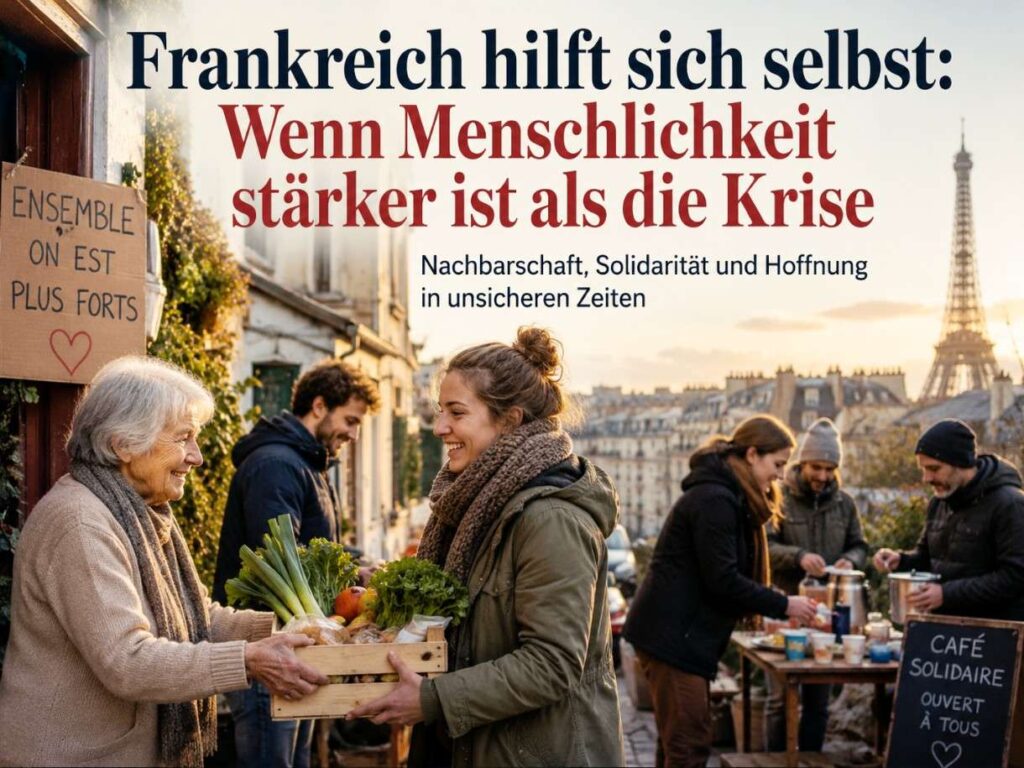
People like these are rarely mentioned in major political debates: residents who go shopping together with their neighbors, those who prepare free meals for students, care for elderly people in the village, or look after children so that single people can work.
But it is precisely in these places that France is now showing encouraging signs.
Carpooling is emerging in apartment buildings. Strangers give away furniture, clothing, or household appliances. Young families organize group purchases to save money. Students help elderly people fill out online forms, and the elderly return the favor with warm lunches. In many communities, people are suddenly remembering their neighbors’ names again.
It is precisely these inconspicuous scenes that are moving.
Because they contradict the social image that supposedly consists only of individualism, irritability, and selfishness.
The crisis changed people
France has been through difficult years. The pandemic left deep scars. It was immediately followed by inflation, rising energy prices, political tensions, and panic driven by fear of social decline. Many people lost faith that wealth necessarily brings security.
But crises do not bring only negative consequences. Sometimes they also remind people of what truly matters.
Suddenly, time becomes more important than consumption. Closeness more important than status. Help more important than competition.
The past years have shown many French people how fragile modern life is. How easily what seems like a stable existence can be shaken. Perhaps this gave rise to something long believed lost: genuine compassion.
Those who have experienced instability are more likely to sense the unease of others.
A society that rejects cold harshness
What is particularly moving is that this kind of solidarity often comes from those who have almost nothing. Many communities are supported not by the wealthy, but by those who know how difficult life can be.
Pensioners on meagre pensions who still give out food. Workers who drive their neighbours to work for free. Students who share their last portion of pasta. Bakers who give away leftover bread in the evening.
These acts may not be spectacular, but they tell a fundamental story about France.
Despite political tensions, despite anger, anxiety and social exhaustion, some French people clearly refuse to become cynical.
This may be the most important message of our time.
The return of “us”
For many years, the feeling prevailed that everyone had to fend for themselves. Professions, competition, pressure to achieve, and the constantly rising cost of living created an everyday reality that left hardly any room for community.
Today, something new is slowly beginning to emerge—or rather, something very old.
People are rediscovering the value of community. This is not a political theory, but a real-life reality. People help one another because they understand that in times of crisis, social warmth is more important than economic success.
This development cannot be measured by growth data; it does not appear in any statistics of the European Central Bank. Yet it may be more important than many economic reform plans.
Because a society does not collapse primarily due to inflation or crisis, but when people stop caring for one another.
And what France is showing right now is precisely the opposite.
Perhaps this is how hope begins
Of course, mutual aid cannot solve a nation’s major problems. It cannot replace sensible social policies, fair wages, and affordable housing. Many people are still struggling with the anxiety of survival.
But amid this uncertainty, something happened that had long seemed impossible: people renewed their trust in one another.
Perhaps that is the real positive message.
Not that everything suddenly became better, but many French people, despite numerous difficulties, still retain the ability to unite and cooperate.
In a world full of aggression, social indifference, and constant anger, that is almost a revolution.
Perhaps hope does not begin with grand political speeches, but with a hot meal prepared for a neighbor, with help carrying bags, with attentive listening, with people saying to one another: “You are not alone.”
And perhaps this will ultimately be stronger than any crisis.