
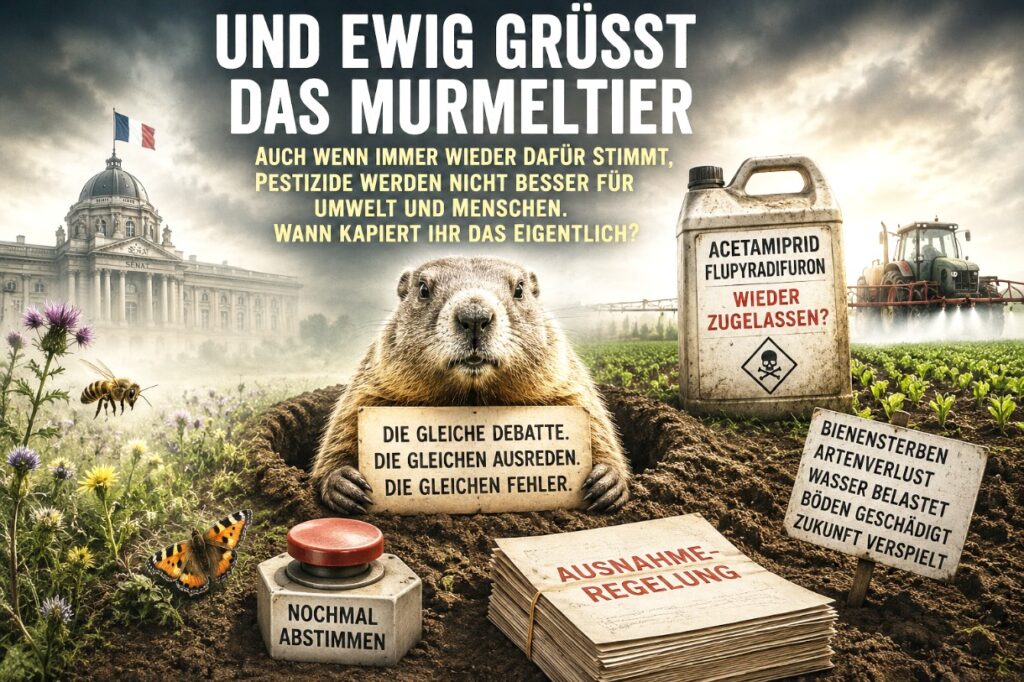
Just when you think the debate is finally settled, the same show starts all over again. Once more there is a vote on whether pesticides that were banned for good reasons might suddenly be a brilliant idea after all. As if chemistry, biology or the laws of nature had changed overnight.
Spoiler: They haven’t.
Acetamiprid remains a pesticide. Flupyradifuron remains a pesticide. And pesticides do not become safer just because a parliamentary majority raises its hand. They do not lose their effect on insects nor their potential risks to the environment and biodiversity simply because they are written into a new law or dressed up with euphonious terms like ‘exemption’.
How many more times do we want to play this game?
For years the insect die-off has been debated. Scientists warn of the loss of biodiversity. Bees are disappearing, wild insects are declining dramatically, whole ecosystems are thrown out of balance. At the same time we bemoan the decline in species diversity, invest millions in conservation programmes and plant flower strips. And then, reliably, the next proposal comes along to reintroduce exactly those substances that can contribute to this problem.
That’s roughly like trying to put out a fire—and periodically pouring gasoline on it.
Of course many farmers are under enormous economic pressure. They do not bear the responsibility for that alone. Politics, retail and consumers demand the highest environmental standards, while at the same time expecting food at prices that often barely cover production costs. This dilemma is real and deserves solutions.
But the answer cannot seriously be: Then we’ll just bring back the old pesticides.
What’s next? Asbestos because modern insulation is more expensive? Or leaded petrol because the engine runs so smoothly with it?
Time and again it’s argued that other European countries also use these agents after all. Since when has ‘they’re doing it too’ been a viable political concept? By that logic you would have to call every environmental or health regulation into question as long as lower standards exist somewhere in the world.
Progress doesn’t mean repeating old mistakes. Progress means developing better solutions—resistant varieties, biological plant protection methods, modern research and an agriculture that is economically viable without further burdening the natural foundations of life.
Sometimes, however, the impression arises that some decision-makers only think as far as the next harvest—while the consequences for soils, waters and biodiversity are left to coming generations.
Therefore a simple question:
When will you finally understand that pesticides don’t become any less harmful just because someone keeps voting for them?
A commentary by Andreas M. Brucker