
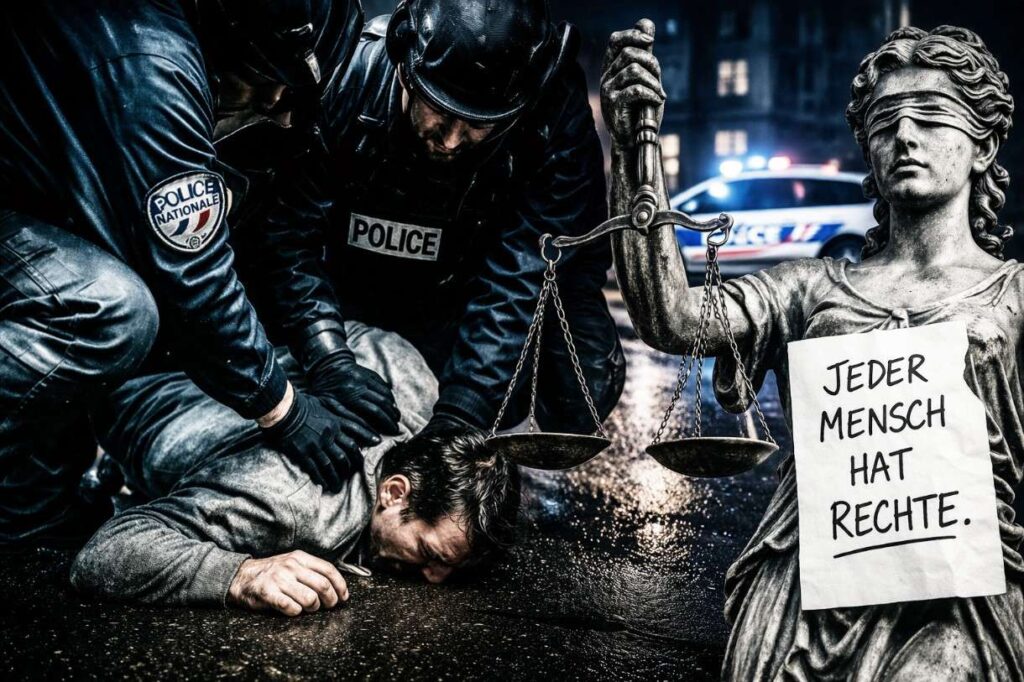
It is one of those bitter lessons that run through history like a red thread, unfortunately not one of velvet, but of wire: Human rights always apply – only sometimes not for everyone. And sometimes not immediately. And sometimes only when a court determines after months that they perhaps should have been observed after all.
Welcome to the year 2026.
Welcome to a Europe that likes to celebrate itself as the cradle of enlightenment – and whose police units occasionally act as if they have simply skipped the last two hundred years. The Noisiel case is not an isolated incident. It is an echo. A loud, unpleasant one.
Just imagine it quite plainly: A person is arrested. A state intervenes – with all its power, all its authority, all its monopoly on violence logic. And exactly at that moment, the rules apply most strictly. Not more leniently. Not “situationally”. But stricter. Because the state is not just any actor. But the one who sets the rules of the game.
Or should set them.
But apparently there are operations where the Basic Law – pardon, the French Constitution – takes a short break. A kind of legal closing time, initiated with handcuffs. There is hitting, pressing, restraining, until a suspect becomes a body. An object. A thing.
And later?
Then the familiar drama begins.
Reports are being written. Perspectives changed. Versions compared. Suddenly everything is complicated. Everything gray. Everything somehow understandable. The blow may have been necessary. The grip perhaps too tight. The situation perhaps tense. Maybe, maybe, maybe.
One almost wants to applaud – so much understanding for state overwhelm.
Only: For the one who was on the ground, there was no maybe.
It is a strange imbalance. On one side the citizen, who must behave lawfully, at all times, uncompromisingly. On the other side the state, which occasionally grants itself leeway. Rooms for interpretation. Expansion joints of force.
That is called reality.
Or, less kindly put: a problem.
Because rights are not favors. They are not a reward for good behavior. And they are certainly not negotiable in the heat of an operation. Anyone who sees it differently has not understood what a constitutional state is – or does not want to understand it.
Perhaps the real drama of this case lies precisely therein. Not in the individual night, not in the individual blows. But in the self-evidence with which something like this can happen again and again.
As if it were part of the system.
As if it belonged to it.
Yet the message is so simple that it almost sounds banal: Every person has rights. Period. Even at night. Even during an arrest. Even when he is inconvenient.
One would think this has long been learned.
But apparently it takes a few more processes until this insight prevails.
How unpleasant.