
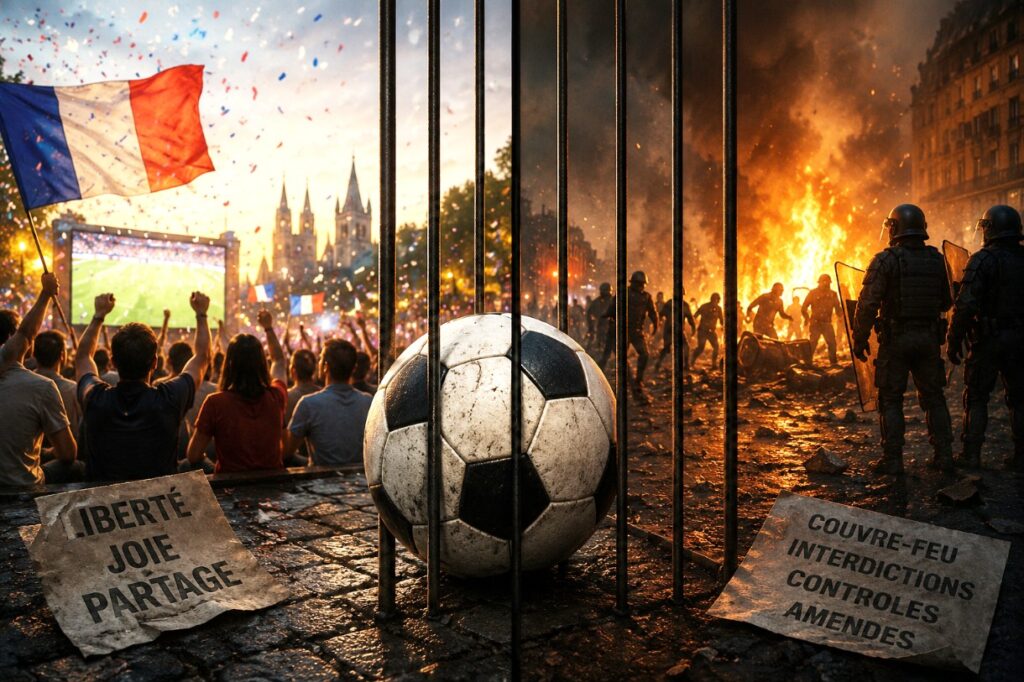
There was a time when a football World Cup was a celebration. Families gathered in front of the television, neighbors celebrated together in public squares, children wore the jerseys of their idols and dreamed of one day standing on the big stage. For a few weeks, political divides, social tensions, and everyday problems seemed to fade into the background. Football created community.
Today, it seems people prepare for major events like a natural disaster.
When a city imposes curfews for youths just days before a World Cup, restricts public gatherings, bans fan zones, regulates alcohol, prohibits barbecues, and mobilizes additional security forces, this is not the program for a folk festival. It is the script for a state of emergency.
How far have we actually come?
The irony could hardly be greater. A tournament meant to excite billions of people now forces authorities to take protective measures as if a hostile army stands at the city gates. Instead of anticipation, security concepts dominate. Instead of flags, barricades are put up. Instead of shared euphoria, there is debate about curfews for children.
Of course, we are told that the vast majority are peaceful. That is probably true. But this observation is of little help when an ever smaller minority suffices to bring whole inner cities to a standstill, devastate shops, set cars on fire, and attack police officers. In the end, everyone else pays the price.
What is especially bitter is that it is precisely the youth who bear the cost. Thousands of decent young people are broadly suspected because a few hundred troublemakers seize every opportunity to escalate. Those who want to peacefully watch a game with friends at night are treated like potential troublemakers. A society that locks up its youth in order to protect its youth from its own youth delivers a remarkable testimony to its condition.
And yet it is difficult to blame those responsible. What are mayors supposed to do when every larger celebration carries the risk of riots? Look the other way? Hope? Wait and see? Political decision-makers no longer respond to sport itself but to the violence that accompanies it.
Perhaps therein lies the real tragedy. The curfews themselves are not the problem. They are only the symptom.
The problem is a society that has managed to turn even a football game into a security incident.
In the past, before a World Cup, people asked: “How far will our team go?” Today the question is: “How many emergency forces will be needed?”
That alone says more about the state of our times than any police statistic.