
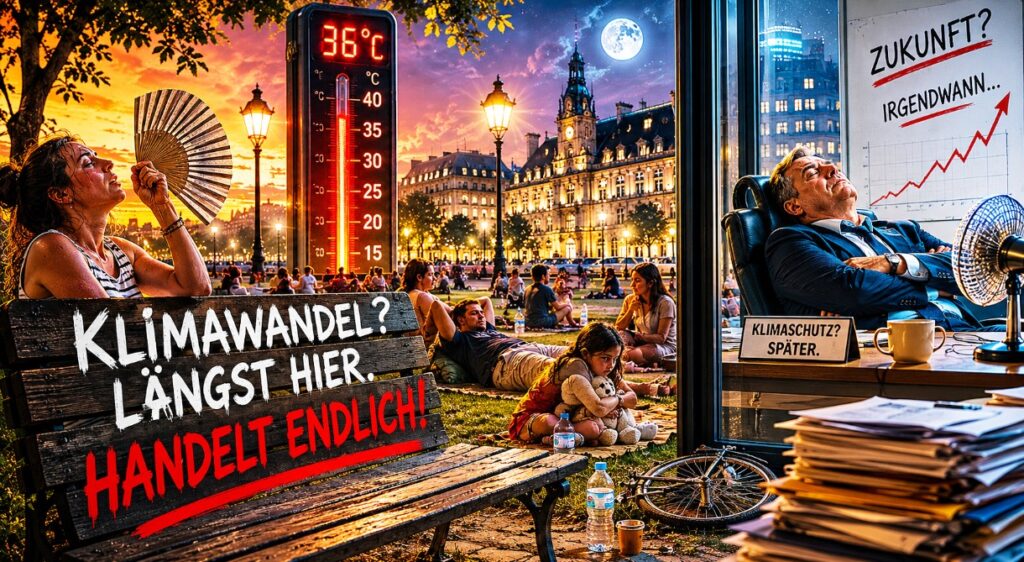
Oh, so suddenly after all.
Suddenly politicians discover that heat is dangerous. That cities no longer cool down at night. That older people lose consciousness, children suffer, and apartments turn into concrete ovens. Welcome to 2026 — nice that you sometimes drop by too.
While people in Rennes sit on park benches at night because their bedrooms have become unbearably hot, somewhere else committees are still discussing “long-term climate strategies.” Long-term. That word now sounds like obvious irony.
Climate change is no longer at the doorstep. It has long since settled in our living rooms, consuming the electricity of fans and robbing us of sleep.
And yet many responsible people behave as if this is just a rather prolonged period of bad weather. A few drinking fountains here, a little irrigation there — and voilà, a local cosmetic measure. Of course, such measures help temporarily. No doubt. But they already look like a bandage on an open wound.
The truth is that for decades people spoke, postponed, downplayed. It was constantly said that you must not overload the economy, you must not alarm citizens, you must not pressure industry. It is only surprising that now whole cities are overloaded — by temperatures that once were a rare exceptional event.
And what now? Now parks are opening at night.
That is humanly sensible. But at the same time it is a depressing symbol. After all, if at the end of May in Brittany people must seek refuge in parks at night, then something went very wrong long ago.
Political hypocrisy looks especially absurd. The same voices that for years dismissed climate protection as hysteria or “too expensive” now present extraordinary measures for heat as great innovations. Bravo. Truly. Perhaps the next discovery will be that trees provide shade.
Sarcasm is hard to express, because the situation has been extremely serious for a long time.
Future summers will be harsher. Cities will continue to heat up, water will be scarcer, extreme weather events more frequent. All of this has been described for years in scientific reports. No one can say they were surprised. The strangest thing is the persistence with which politicians still try to downplay the obvious.
People have long felt that something is changing. Not in some models. But at night in their own beds. Looking at the dried green growth. Feeling short of breath even though the sun set long ago.
How many more tropical nights are needed for real action to finally emerge from empty rhetorical words?
Do they seriously expect that even the last air-conditioned meeting halls will one day become too hot?